

Designing Beauty out of Pollution
In the heart of Mumbai’s congested streets, architect Tejas Sidnal asked a radical question: Can we design beauty out of pollution? Could it be possible to turn carbon-rich waste like tyres into a sustainable building material instead of an environmental hazard?
I was nine years old when I first made the connection between the bike tyres I rode around on and where they came from. In a rubber plantation near Kota Kinabalu, East Malaysia, I was mesmerised by the way the latex sap slowly wept from the shallow, angled cuts in the bark of the rubber tree into a bucket below.
Rubber for tyres comes from two main sources: natural and synthetic. Natural rubber is harvested from the latex of the Hevea brasiliensis tree, primarily cultivated in Southeast Asia, where over 90% of global natural rubber is produced.
Synthetic rubber, on the other hand, is made from petrochemicals which are derived from crude oil and natural gas through polymerisation processes. Modern tyres typically contain a blend of about 40–45% synthetic and 25–30% natural rubber. A hybrid composition provides strength and flexibility but makes recycling more complex.
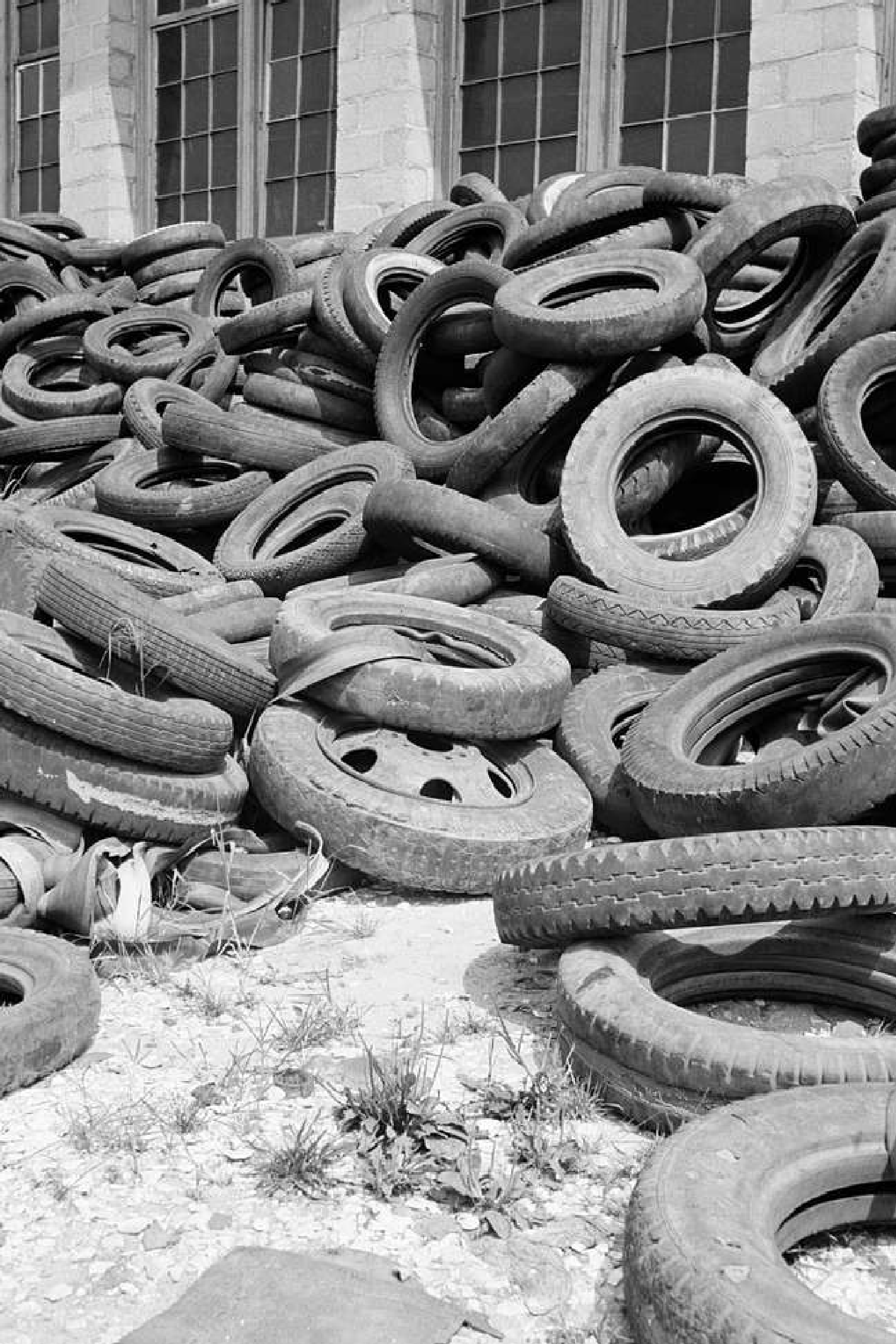
The lifecycle of a tyre typically follows a linear path: raw materials, manufacturing, use, disposal. Once worn out, tyres are shredded, landfilled, or burnt. From my inner-city apartment in spring, we watched the dark plumes of smoke linger on the horizon for a week as a dump with millions of tyres, 35 kilometres away, burnt uncontrolled. News coverage sparked discussions as if the life cycle of a tyre were a new phenomenon, raising outrage over the carbon and volatile organic compounds released from the fire. Every bike, scooter, car, bus and aeroplane we use as transport ultimately contributes to these rubber graveyards.
There are multiple tyre recovery projects aiming to turn end-of-life tyres (ELTs) into valuable materials while reducing environmental hazards. In Europe, the BlackCycle project converts ELTs into secondary raw materials for new tyres, and Life for Tyres produces biofuels and syngas from ELTs. Though globally fewer than 13% of European ELTs are recycled into high-value materials.
Some of the most powerful solutions, however, are emerging from design studios and labs that are creatively transforming a stubborn environmental problem into a climate win.
In the heart of Mumbai’s congested streets, architect Tejas Sidnal asked a radical question: Can we design beauty out of pollution? Could it be possible to turn carbon-rich waste like tyres into a sustainable building material instead of an environmental hazard? His startup, Carbon Craft Design, found an answer through a mix of architecture, biomimicry, and materials science. The company collaborates with carbon-recycling firms that use pyrolysis—a process that heats waste tyres without oxygen—to produce carbon char. This char, instead of being discarded, is refined and crafted into elegant, durable floor and wall tiles that lock away pollution rather than emit it Each square metre of tiles is estimated to offset the equivalent of 30,000 litres of polluted air. Rather than viewing waste as an end-of-life stage, Sidnal treats it as the starting point of a new design journey with a mission: “to make air pollution tangible, to turn it into something people can see, touch, and build with.”
Design and clean technology can convert waste into value, shifting the perception of pollution and embedding circularity into urban life. Integrating reclaimed carbon into functional and aesthetic applications demonstrates that sustainability can coexist with creativity and innovation. Creative climate-win stories remind us that sustainability is not just about minimising harm but about reimagining potential, where what was once waste or pollution becomes a canvas for creativity.
Words and research by Anna Borrie for Rethinking Climate
Rethinking Climate:
In a world often defined by crisis headlines and carbon counts, stories of climate action can feel like they live on the periphery, minuscule in the shadow of an overwhelming challenge. Climate stories go beyond scientists, policymakers, and activists. They also take shape in unexpected places: studios, workshops, design labs, community spaces, small corners of cities and in rural landscapes.
These essays grew out of noticing this. They trace how creativity and care intersect with the climate crisis, how artists, architects, and makers are turning what once symbolised environmental failure into forms of renewal. Each story begins with a familiar problem – a tyre fire on the city’s edge, smog above the skyline, discarded textiles, and industrial offcuts – and follows the people transforming these materials and ideas into new forms of value.
To rethink climate is to shift perspective, to see potential where others see residue, and to design systems that regenerate rather than extract. This isn’t only about technology; it’s about creativity, empathy, and design. It’s about finding beauty in what was once waste and building futures that don’t just sustain life but also enrich it.
Anna Borrie:
Anna Borrie is Associate Editor at Planted Journal, where she explores the intersections between ecology, art, and storytelling. Her work is rooted in a creating meaningful connections between people and their environments. She runs a community garden in Madrid, where she cultivates both plants and relationships with fellow gardeners. Her interests lie in creating collaborative environmental art and promoting zero-waste practices, seeking ways to harmonise creativity with environmental responsibility.