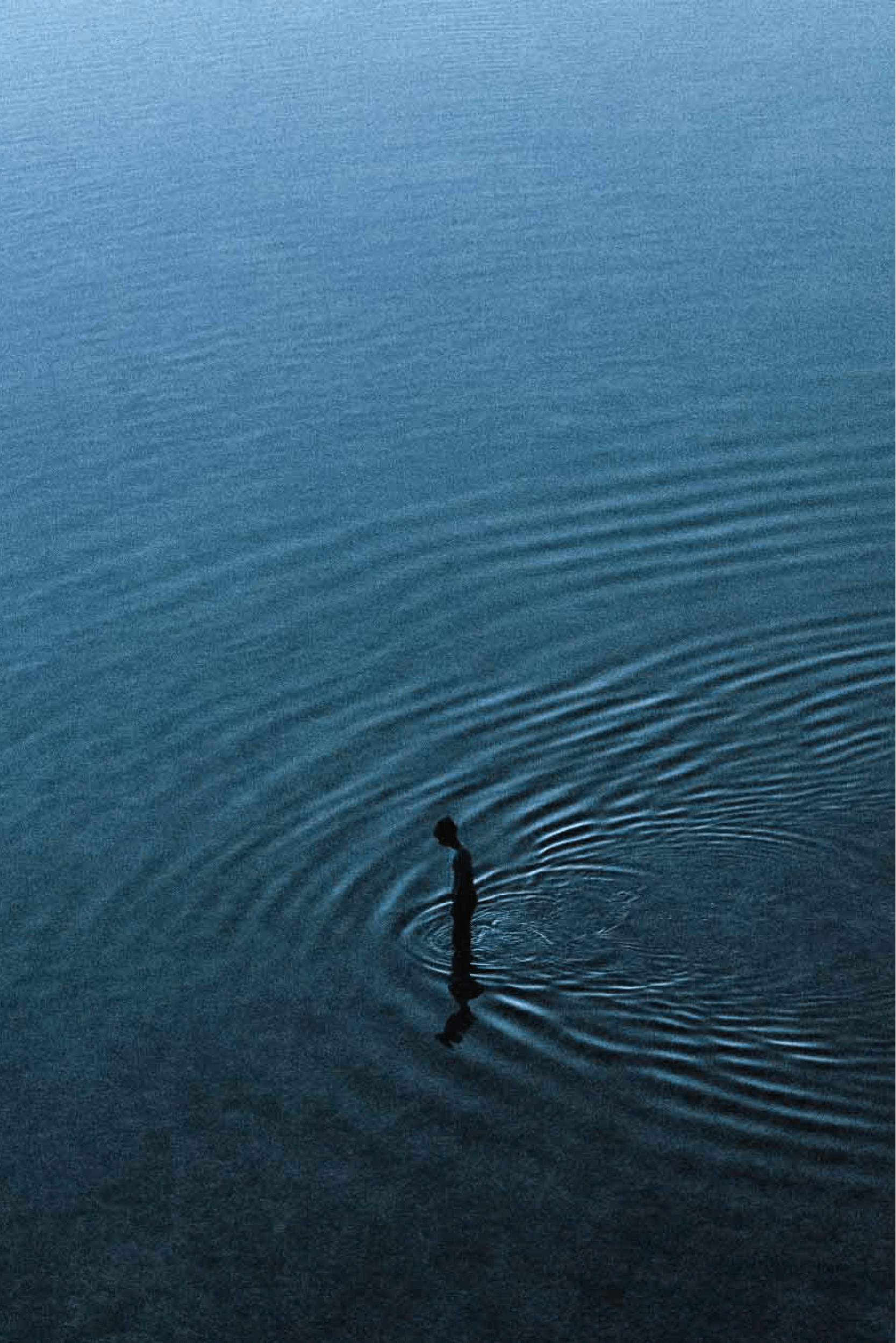

I am a water person.
This is my origin story.
Rivers, straits, seas—they’ve shaped me in ways cities never could.
Born by the Paraná, raised by the Río de la Plata.
Then the Bosphorus, where continents meet and drift apart again.
Water taught me to listen before I could speak.
To slow down.
To move with patience.
As Mary Oliver wrote, “It falls cold into my body, waking the bones.”
I still feel the ache—the reminder that reverence is not stillness but rhythm.
Water is never just water.
It is memory.
Medicine.
The body of the sacred feminine flows through every shore I’ve touched.
The Amazon reminded me of this.
AMAZON
The River That Refuses Maps (Initiation)
Brazil holds in its heart an immense brown river, the colour of fertility—of clay, of bark, of memory. It seemed like a continuation of the earth itself, as if the water and the land were still negotiating their boundaries, refusing the colonial cartography which insists on clear lines between things.
I went to the Amazon carrying questions about water and people, but the river dissolved the grammar of separation. There was no with—only as.
✶
Each morning, the mist lifted slowly, as if the forest were taking its first breath. Canoes moved soundlessly across the surface, their wakes fading before my eyes. There was a rhythm older than reason, and it did not care for my vocabulary. In that heat, language dissolved. Silence became grammar.
✶
In that quiet, I began to hear what words had obscured. The women of the river community taught me about yatsuka, the house of the Moon, where water and light meet. To enter the river is to purify oneself—not only in body but in spirit, to return briefly to the time before separation.
✶
In this cosmology—passed down through generations of river-dwellers—before birth, we are water, and one day we return to it. Between these two tides, we are a temporary land.
I thought of my own body as part of that cycle—the same molecules moving from rain to river to skin. The forest smelled of wet earth, ozone, and something almost sweet—rot deciding to live again. Over time, I learned the siriuba flower, whose wood becomes the drums of Amazonian festivals.
One day, I stopped taking notes. The notebook remained damp, its pages curled into small waves of paper. I turned off the computer. Knowledge no longer wanted to be written down; it wanted to be absorbed. The river offered no lessons, only a recognition: every current carries a memory, and every act of care begins with attention.
The Amazon is seven thousand kilometres of cosmopercepção—an embodied way of knowing that links humans with non-human kin across millennia. In this cosmovision, before birth, we might have been water, wind, animal, or fruit. After death, we may become a snake, a bird, or a spirit in the current. This is knowledge. Identity is fluid. Sharp boundaries between species are colonial inventions.
Reverence means remembering we are part of the web, not outside it.
The river is alive. When humans pour oil or blood into the water without asking permission, her children—the fish—die. “When there is an oil spill, the spirits leave. Then we are left without fish.” The spirits’ leaving is not superstition—it is ecological knowledge in spiritual language. When the river is poisoned, life departs. This is cause and effect. This is the truth.
What the Hechiceras Taught Me
The hechiceras are taught by the plants through dreams. You “diet” a plant, and in the altered state, it teaches you: what it heals, what it needs, how to be in relation. It happens in the encounter, in the reciprocity between body and plant intelligence.
This is the sacred feminine the Amazon revealed to me: not a goddess to worship, but an ontology. Earth as body, territory, and spirit in one continuous pulse. When they spoke, the sorceresses drew a spiral in the mud—a map, or maybe a warning
In these teachings, the forest embodies what patriarchy has gendered ‘feminine’—the capacity to create, welcome, and care. But these are not women’s work. They are life’s work, eroded by the masculinist logic of extraction. Reverence for the feminine is not about worshipping women; it is about restoring reciprocity—the understanding that everything we consume comes from a body, and that taking without asking is violence.
✶
No reverence survives untouched. The Amazon burns—not by accident, but by design. Loggers, miners, ranchers. Around one-fifth of the forest is gone. Nearly a third of the land is without defined rights, open to looting. The colonial project continues, dressed as progress.
Private property was designed to be costly and racialised. The denial of Indigenous presence became the precondition for theft. Terra nullius—“empty land”—was the legal fiction used by European empires to justify occupation. Lands inhabited and stewarded for millennia were reclassified as vacant, available, unowned. Entire cosmologies erased through bureaucratic language.
Resistance persists. The poet’s voice insists: “While my heart burns, the Indigenous woman in me does not die. Nor the promise I made to walk with my people, step by step, toward the sun.”
The hechiceras are not relics of a pre-modern past. They are women of the present, fighting to keep alive a cosmology of relation. Their knowledge is a survival strategy.
The ancestral is not nostalgic; it is reparative.
It teaches bem viver—living well, in balance—against the capitalist viver bem that devours rivers to build resorts and calls it development.
When I left the Amazon, I carried this knowing in my body. Water is never just water. Slowness is the tempo of reverence. The sacred feminine is not an idea to be understood but a pulse to be felt—the heartbeat of the Earth, still sounding beneath the noise of progress, still calling us to remember that we, too, are water.
And so the river carried me to the ocean, to another register of the sacred feminine—not the green hush of the forest, but the salt-spray ecstasy of the Orixás.
SALVADOR
The Ocean That Answers (Devotion)
I arrived in Salvador in February, during the season of festivals. The air was thick with drums and the smell of dendê on every corner. This is the land where the Orixás walk openly, where the rosary and the ilèkè touch the same skin without contradiction.
Salvador is blessed daily by all the saints and all the Orixás—a doubling that is not confusion but abundance. This is called ‘enredo’‘—entanglement. Not fusion, but a living web where proximity becomes transformation.
To have enredo with an Orixá is to carry a part of divinity in your body, across visible and invisible worlds.
The Atlantic itself is an enredo—African spirits and European saints, the blood of all who crossed unwillingly, woven into something that refuses to be named by either side alone. Syncretism was not theology. It was strategy. The Orixás survived by wearing masks, by speaking through other mouths, by refusing to die when their names were forbidden. This is not fusion. This is refusal dressed as compliance.
I became enredada with Yemanjá one morning at the sea, the day her name was celebrated. I had come carrying white roses, unsure of the protocol—a foreigner trying to honour a goddess I was just beginning to know. The beach was crowded with women in white, their skirts billowing like sails.
Dozens bent together, the gesture repeating like a wave. We walked slowly toward the surf, holding flowers and mirrors. Our movements followed the tide—each step a small consent to the sea. Her presence is both mother and storm. We bend toward her, and the sea answers.
The tide collects all the offerings. Yemanjá teaches that love, like the sea, is never pure: it is movement, collision, and return.
✶
A woman standing beside me said quietly, “A maré é viva. O mar responde.” The tide is alive. The sea answers.
In her voice, devotion sounded like certainty. Not faith needing proof, but commitment before understanding. Reverence is not submission but rhythm. Moving with what exceeds us, without trying to possess it.
My enredo with Yemanjá taught me identity is not fixed. It is tidal. It is the capacity to carry multiple truths in one body—to be simultaneously foreign and belonging, to let the salt rewrite what I thought I knew about myself.
In Salvador, I learned devotion is not about reciprocity. It is about showing up. The women return to this beach every year, carrying their flowers and their grief and their hope. Yemanjá may or may not answer. But they come anyway.
Devotion asks for no guarantees, only presence.
The ocean does not explain itself. Neither do the Orixás. They ask only that we keep coming back.
And so the ocean released me. I carried Salvador’s rhythm in my body as I travelled to Venice, where water moves differently—slower, patient, edged with fog and forgetting.
VENICE
The Lagoon That Remembers (Elegy)
I came to Venice in autumn, when the mists rise from the lagoon like memory made visible. The water here does not rush. It laps, seeps, rises with the moon and floods the streets, patient as grief. Venice is sinking; everyone knows this.
✶
Venice taught me to walk slowly. Not because the bridges are steep, but because speed here is violence against beauty that will not last. The acqua alta comes without warning, transforming campi into mirrors, forcing us to move deliberately, to notice what we are standing in.
I learned the tides from sirens that wail before the lagoon reclaims the stone. Venetians do not fight this; they put on boots, raise café tables, and negotiate with water as they have for centuries.
This is reverence as accommodation. As the daily practice of loving what threatens you.
And yet. The light here—fog softens every edge until the city seems to float, unmoored from time. At dusk, the lagoon turns pewter, the colour of forgetting. I thought of
Fulvio Roiter—how he let the fog speak louder than the city: not illumination, but breath.
I stopped moving through the city and started moving with it. I watched the water move through the city like breath—in and out, rising and falling, wearing away stone so slowly it’s visible across centuries. Venice shimmered differently now—the South had changed my eyes.
Reverence is this: to remain present to what you cannot save. To walk slowly through beauty that will vanish, knowing this does not diminish love—it deepens it.
The lagoon will take Venice. The ocean will take us all. But not today. Today there is mist, bells, and the slap of water against stone. I am still here. I never said goodbye. I suspect I never will.
REVERENCE
I carry three waters in my body now.
The Amazon initiated me—teaching slowness, reciprocity, and the dissolution of boundaries between human and forest, water and land, and self and other. The hechiceras showed that knowledge comes through dreams, that plants are teachers, and that reverence begins with asking permission.
Salvador’s coastal waters ignited devotion—the surrender to forces larger than the self. Yemanjá taught that love is tidal, that enredo is not fusion but the courage to carry multiple truths in one body. Devotion is not certainty. It is showing up, year after year, with flowers in hand.
Venice offered elegy—the capacity to love what is already leaving, to walk slowly through beauty edged with loss. The lagoon taught that reverence is sometimes accommodation, the daily practice of bearing witness without looking away.
Reverence is not one gesture but a deepening spiral of slowness, rhythm, presence. The knowing that water—like memory, like love, like life itself—cannot be possessed, only honoured.
We, too, are water.
Words by Sandra Bustamante
Sandra Bustamante is an Argentina-born political scientist, evaluator, and writer based in Italy. For over three decades she has worked across Latin America, Africa, and Europe on gender, social inclusion, and development cooperation. Her recent work bridges research and creation through a feminist-decolonial lens, integrating photography, walking, and participatory methods. She is developing a long-term project, Portable Atlas of Reparative Scenes, which explores urban and climatic geographies through water, light, and embodied attention.