

Realistic Hope: Changing the Climate Narrative | Another Way Film Festival
As long as we remain socially connected – as long as we preserve a sense of the common good and a shared future – societies have historically been able to respond to moments of extreme stress through collective intelligence.
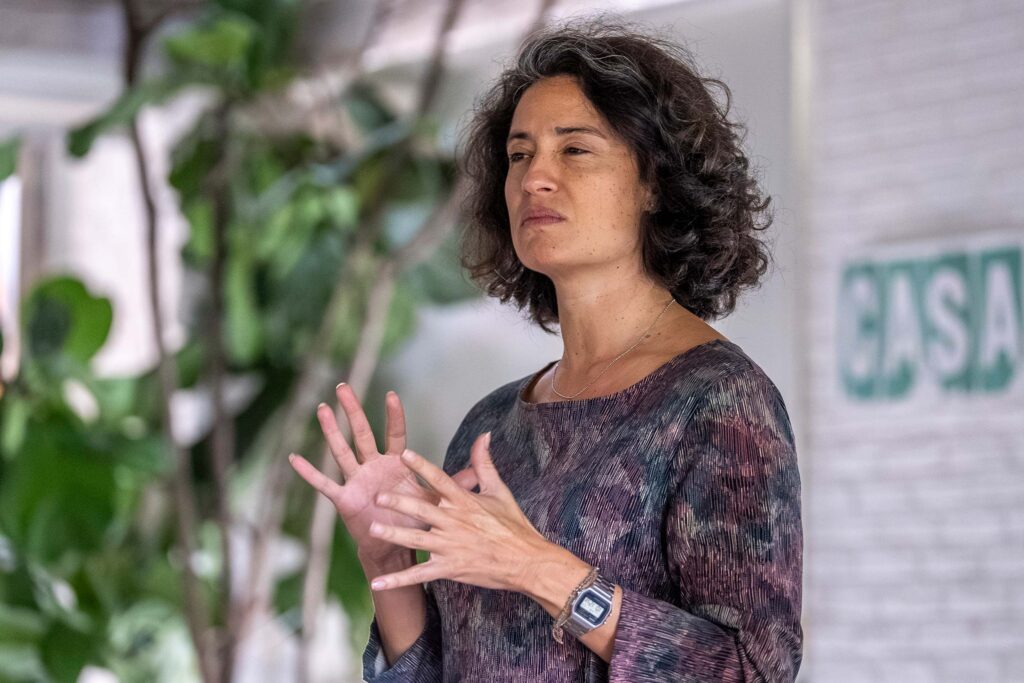
Marta García Larriu
Founder and Director Another Way Film Festival
It is a cold winter lunchtime in 2018 when the topic of “the stories we tell ourselves” bubbles up between Founder and Director of Another Way Film Festival Marta García Larriu and me. We realise that the narrative and stories we tell ourselves about climate change affect how we see, act, and envision the world in a time of ecological crisis. And so it begins with a session on a sunny terrace a few months later, where we are guided by Maite Aranda from La Escuela de Cuentacuentos through the stories we have and hold about wilderness, nature, and hope: a seed of change. A consciousness of the stories that live inside us and ultimately define us.
Changing the narrative around the climate crisis has been on Marta’s mind since founding the festival more than a decade ago. Narratives in cinema can confront today’s social and climate crises while cultivating what she calls “realistic hope”. She sees a necessary shift in storytelling that moves beyond dystopia and individual hero narratives and that instead places community, collective intelligence, and protopian futures in the foreground. Narratives in film and series are not only a medium of representation but also a catalyst, shifting audiences from awareness to reflection and ultimately toward meaningful collective action.
Anna Borrie What made you realise that the climate crisis is not only an environmental issue but also a crisis of narrative, of the stories we tell ourselves about the future?
Marta García Larriu One of the turning points for me was reading Tout peut s’effondrer (How Everything Can Collapse) by Pablo Servigne and Raphaël Stevens. In the book, they analyse the different pathways through which our societies could collapse – ecological, economic, political – but they argue that the most devastating collapse would not necessarily be biodiversity loss or rising temperatures, but the collapse of the social fabric itself. Their core thesis is that as long as we remain socially connected – as long as we preserve a sense of the common good and a shared future – societies have historically been able to respond to moments of extreme stress through collective intelligence. But the loss of a common horizon, of a future we can imagine together, would represent an irreparable fracture for humanity.
Around the same time, I encountered Olivia Bina’s research “The Future Imagined”, which analyses 64 literary and cinematic works that have profoundly shaped social imaginaries. That study examines how fiction influences not only how we imagine the future, but also how societies position themselves politically and culturally in the present.
The convergence of these readings – combined with my own concerns as a filmmaker, someone who works with narratives for a living – led me to connect what now seem almost obvious truths. I began to notice how dominant audiovisual narratives, perhaps in search of catharsis or refuge, overwhelmingly projected apocalyptic futures. Series and films like The Last of Us (Craig Mazin), Black Mirror (Charlie Brooker), Children of Men (Alfonso Cuarón), Mad Max: Fury Road (George Miller), The Road (John Hillcoat) or Snowpiercer (Bong Joon-ho) shape a collective imagination where collapse feels inevitable.
At the same time, in everyday conversations with people close to me, I sensed that collapse had almost been accepted as a given. Conversations often ended with a resigned “well… we’re doomed anyway.” I could feel a widespread unease, a quiet exhaustion. That was when it became clear to me that the climate crisis is also – and perhaps above all – a crisis of imagination and narrative.
Anna Borrie How has your understanding of the role of storytelling evolved? What has surprised you most in the way audiences respond to climate narratives?
Marta García Larriu Today, very few people hold an optimistic vision of either their personal future or our collective one. On a personal level, many are overworked and underpaid, struggling to access decent housing – whether renting or buying – and finding it increasingly difficult to meet basic needs. These pressures directly affect major life decisions: starting a family, caring for relatives, or simply being forced to prioritise paid work over care and community.
On a collective level, the growing frequency of extreme climate events – which literally derail short- and mid-term plans – combined with national and international political instability, feeds a sense of fragility and loss of control. More broadly, as Alain de Botton explains in his interview on The Diary of a CEO, the hyper-individualism promoted by unrestrained capitalism ultimately erodes the very social bonds that sustain us as living beings.
This is precisely why I believe it is essential to work with climate narratives framed as protopias – a concept that refers to plausible, incremental futures that are better than the present without pretending to be perfect. Protopias reject both dystopia and utopia, and instead invite us to imagine desirable common futures that foster empathy, solidarity and action.
Audience reactions, in that sense, are not particularly surprising. When narratives are confrontational or moralising, the initial response is often rejection. When they are hopeful, humorous or emotionally intelligent – as in Don’t Look Up – they tend to be far more widely embraced. The real challenge lies in helping audiences move from understanding, to reflection, and ultimately to action, without triggering guilt or paralysis.
The climate crisis is also – and perhaps above all – a crisis of imagination and narrative.
Marta García Larriu
Founder and Director Another Way Film Festival
Anna Borrie Many mainstream climate stories are either dystopian or overly techno-optimistic. What kinds of stories do you think genuinely inspire agency rather than paralysis?
Marta García Larriu Research confirms that neither dystopia nor techno-solutionism is particularly effective – and pure utopias tend to leave audiences equally indifferent because they feel unrealistic. What does work is realism infused with grounded optimism.
One key insight we’ve identified is the need to reclaim community as a central character, rather than relying on classic hero or heroine narratives that place the burden of success or failure on a single individual. As Alain de Botton also points out, these narratives reinforce unrealistic expectations and deepen feelings of inadequacy. Human essence lies in the collective, in creativity and cooperation.
Stories that inspire agency are those that feel good without being naïve, that acknowledge complexity without surrendering to cynicism. They remind us that change is relational, imperfect and shared.
Anna Borrie What do you think cinema evokes about the climate crisis that data and policy discussions can’t?
Marta García Larriu I would like to dive into the research I mentioned earlier. In 2016, researchers Olivia Bina, Sandra Mateus, Lavinia Pereira and Annalisa Caffa published a study exploring the relationship between fiction, future imaginaries and European policymaking. Their work proposes an innovative approach to analysing Europe’s Grand Societal Challenges by examining how speculative and creative fiction – novels and films – offer alternative visions of 21st-century futures.
They analyse 64 works produced over the last 150 years, from 1984 to Blade Runner, Children of Men and Dune, showing how fiction addresses sustainability issues such as oppression, inequality and the ethical dilemmas of science and innovation.
Fiction, they argue, functions as a form of creative foresight: it can act simultaneously as a warning – pushing risks to their extremes – and as an imaginative engine that provides “images, options and spaces of possibility that go beyond instrumental reason, nourishing our capacity for speculation, imagination and social innovation.” By offering detailed visions of possible futures, these narratives shape collective imaginaries and can support political decision-making or challenge dominant ideas of progress.
Their conclusion is powerful: imaginative literature and cinema are the most important ways through which cultures redefine themselves and explore alternatives to the social and political status quo.
One key insight we’ve identified is the need to reclaim community as a central character, rather than relying on classic hero or heroine narratives that place the burden of success or failure on a single individual.
Marta García Larriu
Founder and Director Another Way Film Festival
Anna Borrie Climate change is often described as a ‘wicked problem’. How do you cultivate realistic hope rather than naïve optimism?
Marta García Larriu For me, it comes down to honesty, humility and creativity.
We must be honest about the scale of the problems and name them clearly, without allowing governments or corporations to muddy the diagnosis. As Naomi Klein explains in This Changes Everything, fossil fuel companies invest hundreds of millions every year in disinformation campaigns designed to sow doubt and delay action.
Humility is equally important: acknowledging planetary limits, recognising mistakes, and accepting that large-scale transitions are inherently imperfect. Keeping global warming below 1.5°C – as recommended by the IPCC – will not be a linear process. We are in a period of trial and error, and we must accept that things will not work perfectly the first time. A current example is the debate around renewable energy deployment, which has not always been socially just or environmentally rigorous, particularly for rural communities. Naming these tensions openly allows for more credible solutions and builds trust in transition movements.
Creativity is what enables us to navigate these contradictions – and to communicate them. That is why I believe cinema is such a powerful tool. Finally, realistic hope also means embracing uncertainty. As Rebecca Solnit argues in Hope in the Dark, certainty – especially certainty of collapse – leaves no room for hope. Hope lives in the unknown. It also requires collective memory: remembering past victories driven by people power. History is full of successful transformations, and recalling them reminds us that together, we are capable of steering our future toward far more desirable places.
Hope lives in the unknown. It also requires collective memory: remembering past victories driven by people power.
Marta García Larriu
Founder and Director Another Way Film Festival