


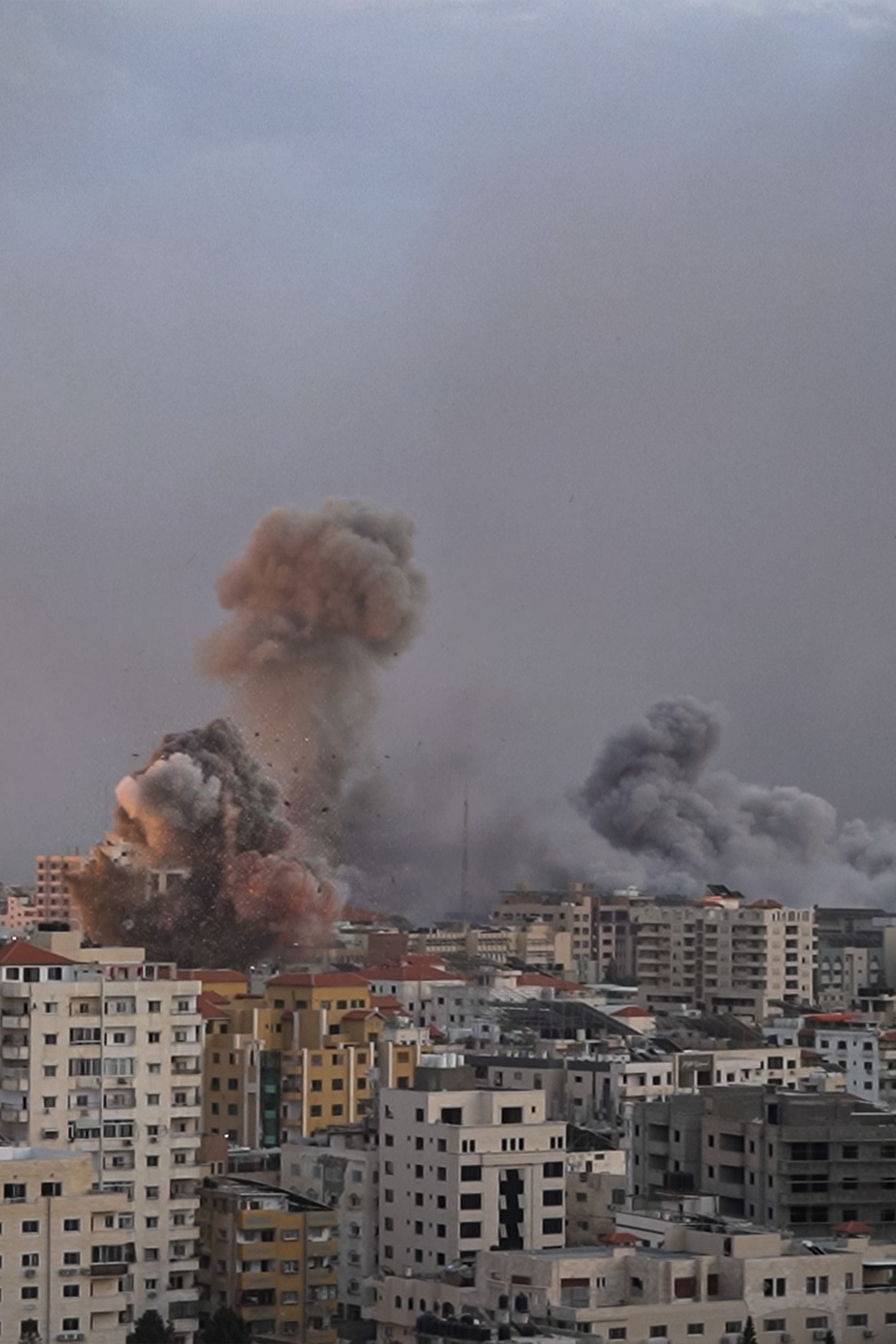
War and conflict intensify the climate crisis through increased military infrastructures, fossil fuel dependencies, and environmental destruction. Anna Borrie looks into the environmental impacts of armed conflict, how they are often overlooked and why they matter in the context of the climate crisis.Unfiltered updates on global conflicts flood the screens in our pockets. We are privy to the latest death toll, bombardment, missile launch – the complete disregard for human life, the social fabric of communities and the ecosystems that they inhabit. Yet the impact of conflict is still predominantly framed through a humanitarian lens, leaving the environmental costs of deforestation, pollution, contamination, and the loss of plant, animal, and marine life largely sidelined. An omission that is striking, given that the degradation of ecosystems directly affects human health and long-term survival.
As former UN Secretary-General Ban Ki-moon observed, “The environment has long been a silent casualty of war and armed conflict. From the contamination of land and the destruction of forests to the plunder of natural resources and the collapse of management systems, the environmental consequences of war are often widespread and devastating.”
Overexploitation of biodiversity and competition over limited natural resources such as water, precious metals and oil both drive conflict and are exacerbated by it, creating a vicious cycle in which war accelerates climate change and climate change fuels future instability. The environmental cost of conflict and military activity was absent from climate change conversations at COP30. Although the military is one of the most energy-intensive sectors globally, estimated to account for 5.5% of global emissions.
The conflict currently dominating the media’s attention is fundamentally tied to fossil fuels and military weaponry – the war between Iran, Israel, and the United States. Globally we are feeling the immediate economic effects through rising fuel prices, though there should be more concern for the long-term effects of conflicts based around fossil fuel infrastructure, as they often lead to ecological emergencies. The UN Draft Principles on Protection of the Environment in Relation to Armed Conflict, provides the environment with the same protection as a civilian object. A protection that is filtered through military necessity, where extreme environmental damage is prohibited in theory but, in practice, allowed when it is part of a military objective. A loophole that reduces environmental protection to a mere nice-to-have, as opposed to a necessity.
Every missile strike is another downpayment on a hotter, more unstable planet, and none of it makes anyone safer.
Patrick Bigger
Research Director
Climate and Community Institute
The first 120 days of the war in Gaza generated more than half a million tonnes of carbon dioxide. Analysis of the first two weeks of the US-Israel-Iran conflict has the greenhouse gas emissions at 5 million tonnes, which is draining the global carbon budget. Patrick Bigger – research director at the Climate and Community Institute and co-author of this analysis – comments, “Every missile strike is another downpayment on a hotter, more unstable planet, and none of it makes anyone safer.”
Human history is littered with conflict-induced environmental degradation that continues long after a ceasefire. Depleted uranium contamination in Iraq, decimation of fisheries in Gaza, deforestation in Lebanon and Sudan – the environmental costs of war are both immediate and cumulative.
The residual effects of the US military spraying 80 million litres of herbicides, including Agent Orange, has lingered for decades in soils, water and food chains across 2.9 million hectares of land in Vietnam. Environmental recompense in postwar has primarily focused on safety hazards, such as clearing unexploded ordnance, rather than ecological restoration. Can mapping environmental damage then serve countries when seeking restoration?
The magnitude of the damage that conflict causes is vividly seen in the emissions data from the first 14 days of the assault on Iran:
- 20,000 civilian buildings have been damaged, equivalent emissions of 2.4m tonnes of CO2 (tCO₂e).
- Aircraft and support vehicles of the US have consumed between 150 and 270 million litres of fuel, equivalent emissions of 529,000 tCO₂e.
- Destroyed military hardware, including aircraft, naval vessel and missile launcher, equivalent emissions of 172,000 tCO₂e.
- Used ammunition contributed to equivalent emission of 55,000 tCO₂e.
While the European Union was the first international body to criminalise ‘ecocide’ – the large-scale devastation and destruction of the environment – damage during conflict and war is not covered. There is more of a focus within the EU on environmental remediation in post-war clean up, prioritising green construction.
Every armed conflict leaves a lasting imprint on ecosystems, biodiversity, and the global climate. These impacts extend beyond the immediate areas of violence, affecting generations to come. The pursuit of peace, therefore, is not only a humanitarian imperative but also an environmental one. Scientific evidence demonstrates that environmental harm caused by conflict is rarely confined to the battlefield. Through processes such as transboundary pollution and global atmospheric circulation, pollutants and ecological damage disperse across borders, producing regional, national, and even planetary effects.
Breaking the cycle in which human and planetary health are collateral damage in armed conflict requires a fundamental shift, beyond balancing environmental harm against military necessity and gains. Instead, we must move towards a framework that recognises environmental health as a key condition for human survival. Transboundary environmental impacts are a shared global risk, and we need to decide what risks are considered acceptable.
Words by Anna Borrie
Anna Borrie is Associate Editor at Planted Journal, where she explores the intersections between ecology, art, and storytelling. Her work is rooted in a creating meaningful connections between people and their environments. She runs a community garden in Madrid, where she cultivates both plants and relationships with fellow gardeners. Her interests lie in creating collaborative environmental art and promoting zero-waste practices, seeking ways to harmonise creativity with environmental responsibility.