A water from the source, a deep, subterranean water that trickles in the womb, a meandering river, a flow of life, of words running over or slowly dripping down the pages. This keeping alive and life-giving water exists simultaneously as the writer’s ink, the mother’s milk, the woman’s blood and menstruation.
Trinh T. Minh-ha
The waves rise in an enchanted delirium, splattering on rock: blue becomes white and blue again; water becomes mist and water again. Here everything is in flux: colour and element, identity and individuality, all pour into borderlessness. The land and the ocean converse in tidal tongues.
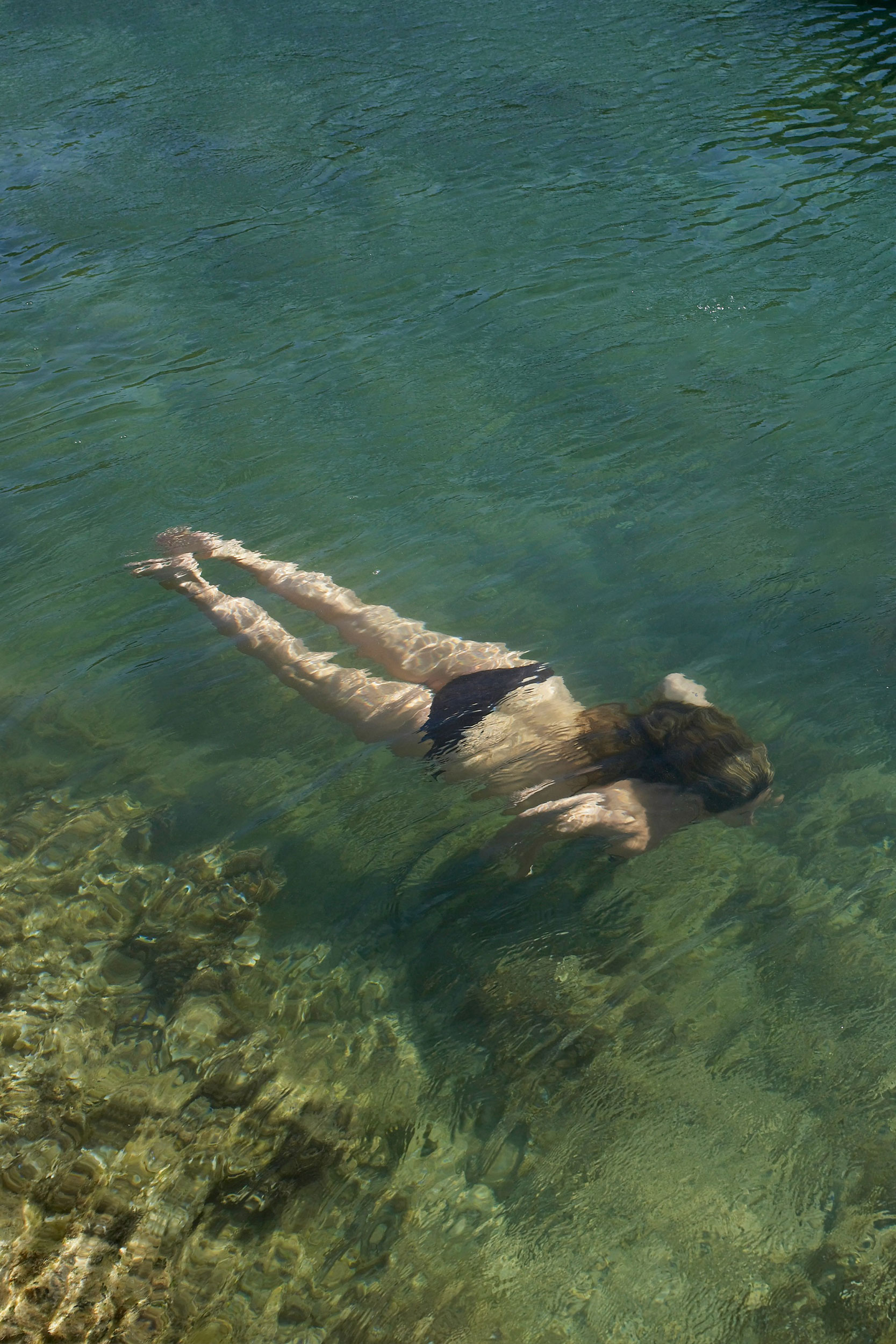
I too have changed colour, burnt and browner; my skin tastes like the ocean. I let myself float, but not too far. A body of water levitating on another body of water, both contained by the Earth. The emotions rise and fall like tides; women, water and womb remain connected.
Before this, I had never been near or lived by the ocean, only the sea. When I was four, my mother felt restless, scared by the crashing sound of waves. Whenever we went to the shore, she held me tightly, as I ran too close to the water. My grandparents were farmers; our rituals and rites, our communion with the Earth, materialised in seeds and grains, a language that differs from the communities that are nourished by the sea.
In languages like French (la mer) and Romanian (la mare), the word for ‘sea’ is grammatically feminine; in English, ‘sea’ is often personified as a woman. In Hindi, ‘Samudar’ (sea) is masculine. In Spanish she could be both, a he and a she, flowing out of the binary. I have never questioned if the sea is feminine or masculine. But Immersed in salt water, I certainly feel I’m back in the womb, held, safe, being washed from all the deaths I have carried.
The body of a woman is an altar of life and death, cycles of fertility and flow; her nature is dualistic and uncontainable. To cite Australian philosopher Elizabeth Grosz, “Can it be that in the West, in our time, the female body has been constructed not only as lack or absence but with more complexity, as a leaking, uncontrollable, seeping liquid; as a formless flow… a formlessness that engulfs all form, a disorder that threatens all order?” For her it is “the deep-seated fear of absorption” that men (patriarchal ideologies) in literature and culture cast out liquidities from their own corporeality.
The fragile human body, entrapped in concrete ideas that place humans above nature, separated from the living systems of Earth, suffers from amnesia. But as water bodies, we can reclaim memories; through sweat and tears, blood and semen, we become part of the hydrosphere. Fluidity can overcome rigidity.
Water is fluid, soft, and yielding. But water will wear away rock, which is rigid and cannot yield. As a rule, whatever is fluid, soft, and yielding will overcome whatever is rigid and hard. This is another paradox: what is soft is strong.
Lao Tzu
I do not know the struggles of men and of humans who live out of the binary and how they experience softness and fluidity, but for me, I find myself putting up walls, safeguarding, and solidifying. I too resist the flow. Growing up in a small town in India, coming from a farming community, I cannot wash the colour of my skin; I have become far too cautious. But I do want to believe in a world where humans will not be burdened by their sexuality, or gender, or class. I want to believe justice isn’t rare, peace is not occasional, the ruptured relationship between man, woman and nature could heal, and creativity can spark life-changing conversations and when these thoughts fade, I can hear the waves crashing, and a part of me is glad that I’m not scared. If my mother walked with me, I would hold her hand this time, and tell her, ‘’let’s flow, in the womb, the sea is a woman.’’