
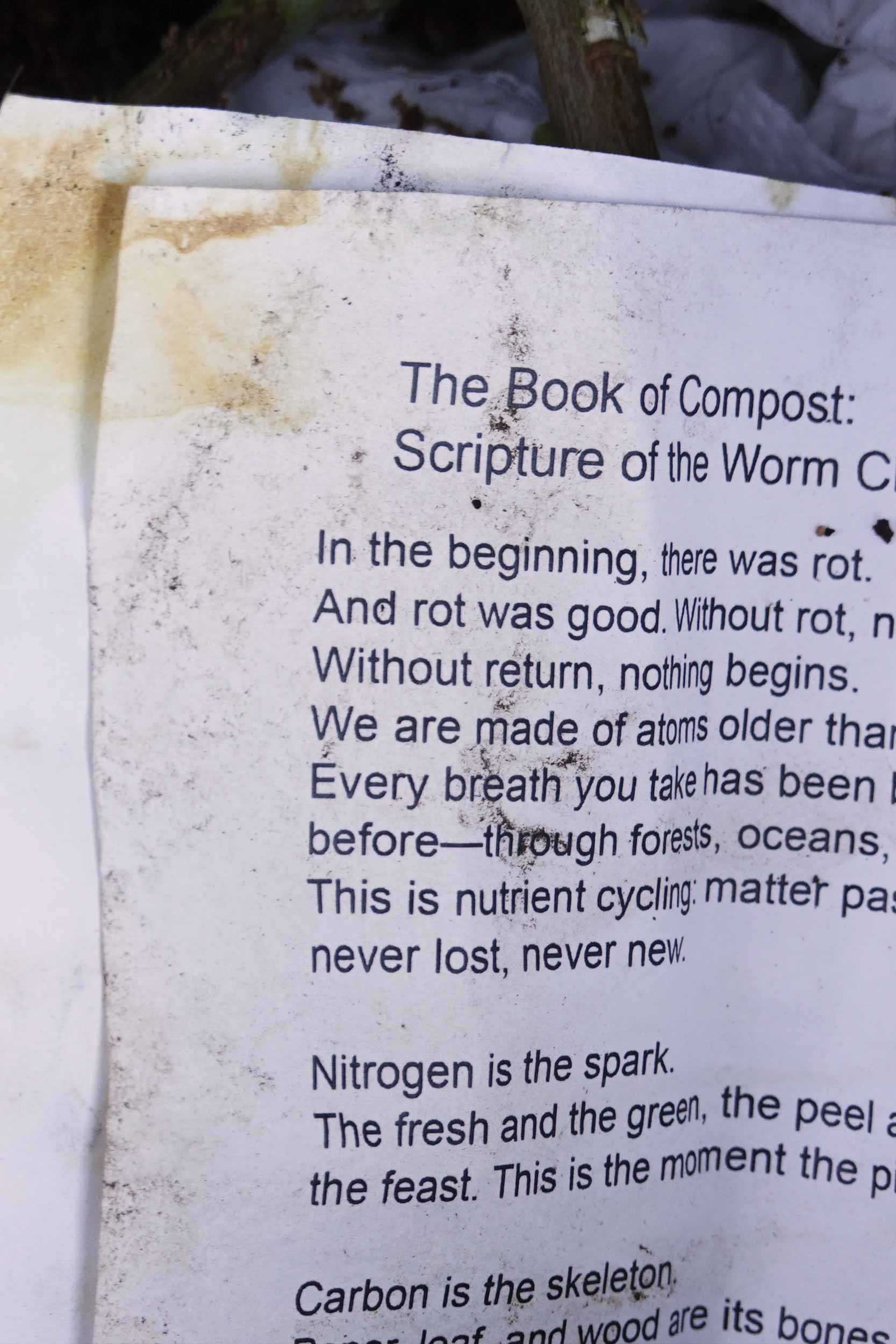
All bones are built from the same elements, largely carbon and minerals borrowed from the earth. When they decompose, those elements don’t disappear. They move back into soil, into microbes, into plants, air, and on through the food web, eventually back to us – nutrient cycling, nothing new, matter passing endlessly among the air, water, soil, rocks, and organisms themselves.
It began quietly. One person showed up to the first Worm Choir I hosted in early summer. If two came next time, I told myself, that would be a one hundred percent increase. Maybe then I’d go all in. Getting strangers – even friends – to show up to anything in real life is hard.
For the second gathering, I posted to a community listserv with a free offering that read:
The Worm Choir: A Sensory Rite of Compost Initiation.
Feeling disconnected? Swap doomscrolling for dirt-sniffing. Let a worm explain the secrets of the universe (or at least decomposition). Looking for a no-cost nervous system reset? Get your hands in living soil, inhale that microbial perfume, and remember you’re part of a much slower, older story.
No perfection, no pressure, just microbes, magic, and a little mess.
Uneven terrain, stairs, slopes, kneeling, praying, crying, gagging (all optional).
See you in the mess,
Maggie
Ten strangers, to me and to each other, arrived and entered in silence. Guided by a low a cappella hum from a small speaker placed between Arroyo willows in my Bay Area garden, we walked quietly past the Wormtel 6, a worm hotel I made from a discarded 50 gal food-grade barrel. From their hotel, worms can come and go when the conditions are right, rather than being trapped in a bin. Think of it as a kinder, less pressured way to vermicompost.
The worms had inadvertently helped me through the traumatic death of a close family member. I found that through caring for the littlest creatures – the worms as well as the microbes, fungi, and bacteria that feed them – I was able to nurture the bigger, more impossible parts of loss. Much like religion, finding God, or other types of healing, once you experience it yourself, you are compelled to share it. I feel this way about hot compost too: once your hand is in warm earth, you want to replicate that feeling of living earth for others. Perhaps this is because healthy compost produces Mycobacterium vaccae, a potential mood-boosting bacterium – research suggests that this bacterium can trigger the brain to produce serotonin. I was a convert, and I wanted to share the wealth.
The guests gave up their phones at the iPhone Exchange Station: a wooden box for phones and a silver platter offering tactile objects from nature, in case your fingers need something to swipe other than a screen. Habits can be hard to break. The platter held smooth river rocks, tiny bones found in owl pellets, and a cactus node. This was an offline event. Nothing to post, nothing to prove. An invitation to be present with a sensory experience in front of you, something “real” you don’t have to question the validity of – an increasingly hard task to navigate in our screen-filled world.
As people entered the circle of chairs, I poured a drink, and it passed from hand to hand in silence. It was lukewarm garden mint tea in small, delicate, black ceramic vessels. To my surprise, no one broke the silence to ask what was in it; maybe they were already converted, or just ready to believe.
The charcuterie butcher block in the center of the circle wasn’t an afternoon snack for my guests. It consisted of artfully arranged apple cores collapsing into themselves, bread half-claimed by mold, citrus giving way to numerous black beetles, and a worm emerging up from a partly composted bone that someone was able to crumble between their fingers. This bone was a remnant from Thanksgiving the year my family member died. In the midst of grief, I was unable to just throw the large bones away after making bone broth with them, somehow wanting to honor another life by watching the bones decay over a few years. All bones are built from the same elements, largely carbon and minerals borrowed from the earth. When they decompose, those elements don’t disappear. They move back into soil, into microbes, into plants, air, and on through the food web, eventually back to us – nutrient cycling, nothing new, matter passing endlessly among the air, water, soil, rocks, and organisms themselves. Being able to witness this, however slowly, makes an invisible system feel alive and endless, and reminds me of how materially connected we are through life and death.
In silence, I offered tools to poke at the items, but encouraged and demonstrated with my hands. The initial shyness of interacting with rot and bugs subsided pretty quickly; we were all willing participants. This is What You Came For. Someone found a clump of hair, nearly unrecognizable, which is a nitrogen-rich element for compost (and why the bathroom is a good place to keep a compost bin!). I hoped that my guests wouldn’t leave too grossed out and that perhaps they’d even emerge with a regained reverence for all the material that has the potential to become new again. Eventually, I asked the group if they remembered being taught to avoid these interactions, another separation from living systems, and nobody could really name when, where, or by whom. I made sure to point out where they could find hot water and soap, of course. Nobody seemed squeamish. In fact, I could tell they were hungry for more, ready to meet my friends, the red wrigglers (Eisenia fetida).
“Forest floor” is what I named the finished compost, given away at a neighborhood crop swap. It describes the smell and texture of the compost I’d made with discarded substrate from a local mushroom farmer: dark, rich, earthy, damp, alive. We listened to what decay had to say. It didn’t listen back. Compost doesn’t care for you; you care for it. It decays regardless; we just have the privilege of time travelling: speeding it up or slowing it down depending on our actions. Decay is always hard at work, something I find weirdly comforting on days I don’t have it in me to turn the piles or visit the worms. If you love gardening, you’ll love compost, and likewise, if you hate gardening, you’ll love compost – it’s just helping plants die. People wrote wishes and words on paper towel rolls and muffin wrappers, added them to a compost tumbler as a carbon source, and gave it a spin, surprised by the heft.
Compost doesn’t care for you; you care for it. It decays regardless; we just have the privilege of time travelling: speeding it up or slowing it down depending on our actions.
I didn’t advertise after that initial listserv post (very nineteen hundreds of me), but the gatherings spread nonetheless, person to person, and through helpful supporters. The guests left with a Church of Compost sticker. Through the season, I witnessed tears, laughter, and steady curiosity. I tried not to talk or “teach” too much, instead holding space for whoever and whatever was present in the moment. Most guests didn’t want a program. They wanted a place to witness things falling apart without fear, to learn how waste becomes renewal, and how things that are rotting will soon be new again.
Some people who attended wanted to learn how to compost at home. Perhaps they were drawn to an unconventional, more casual way of learning from a feminist and anti-capitalist framework (speed, productivity, and “getting it right” aren’t the goals; rather, connection, noticing, and care are). The local microbes you invite through place-based compost vastly outcompete anything you can buy in a bag, while saving the emissions and potential contamination associated with city bin programs. We’re lucky to have those programs in the Bay, and many other places, but they also send valuable waste far away with more emissions, further separating us from our food systems, and in my experience, ourselves. Some wanted to sit with rot, with endings, as a kind of somatic meditation. Others just wanted to hold a worm, sometimes for the first time. I gently picked up a worm cocoon: a small, transparent, lemon-shaped egg, no larger than half a piece of rice, containing multiple worm babies. Every time I pick one of these out and open my palm, a genuine gasp of wow or whoa is the first thing I hear.
Most guests didn’t want a program. They wanted a place to witness things falling apart without fear, to learn how waste becomes renewal, and how things that are rotting will soon be new again.
By late summer, forty people gathered for a hybrid worm-bin workshop and Worm Choir. With that many voices, the call and response took on a different kind of power:
“In the beginning.”
“There was rot.”
“Rot is good.”
“Again!”
“IN THE BEGINNING…”
Forty voices chanting this without irony on a Sunday says something about now. Climate grief is everywhere. Faith in screens is thin. People are hungry for sensory reality: worms, soil, decay, and each other.
I daydream about starting a brick-and-mortar Church of Compost, maybe in one of the many vacant churches that seem to be everywhere. I wonder where faith has gone. It would be an informal but dedicated setting to learn, explore, make and share local compost, grow worm colonies, and practise our connection to nature and all things decay. Anyone with dirt under their fingernails can tell you it’s hard not to glean meaning from what’s hidden beneath our feet – what is abundantly around us but hard to see. The Worm Choir isn’t a religion. It’s a communal practice rooted in the oldest engine of renewal we have – a potential for how we stay grounded while things are breaking down. The Book of Compost ends; we read out loud together:
