Documenting Conflict: Structures of Visibility and Displacement | Khaled Barakeh
This interview is part of Documenting Conflict, a series that explores the ways in which conflict is documented and how who gets to document it shapes how we remember, interpret, and understand it. Documentation extends beyond journalists and historians, spilling into studios, workshops, galleries, and public spaces.

This series of interviews with artists will provide a critique on how truth is constructed and what it means to witness in an era of mass media. Trace how creativity and care intersect with the recording of conflict, turning trauma and societal fracture into forms of reflection and dialogue.

Rethinking how conflict is documented means placing empathy and witness at the centre. It is about uncovering what is often silenced and shaping memory in ways that go beyond mere collection, inviting dialogue, reflection, and understanding.
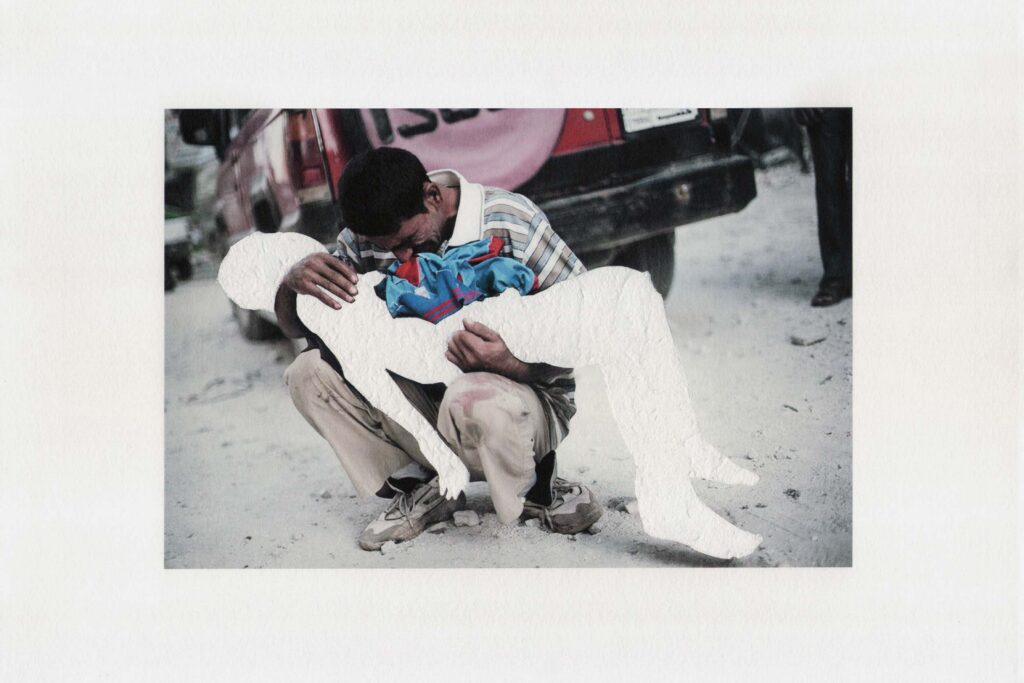
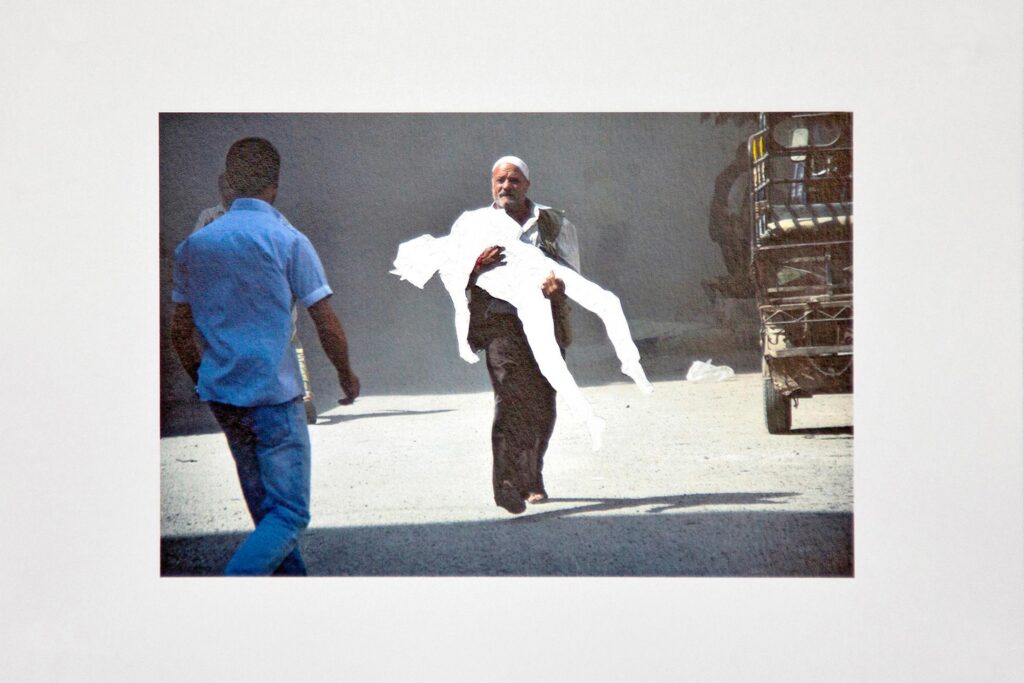
In situations of violence, direct representation is often trapped inside the same regime that produced the violence in the first place: victims’ exposure, material for media circulation, and then overconsumption that leads to numbness. The wounded body is shown again and again, forced to bear meanings that exceed its own suffering.
Khaled Barakeh
Syrian contemporary artist
Syrian-born, Berlin-based multidisciplinary artist and cultural activist Khaled Barakeh works at the intersection of art, politics, and social engagement. He views art as a tool for action, critique, and collective reflection, using it to address power structures, conflict, and displacement. Through participatory installations, interventions, and his nonprofit coculture, he fosters support, care, and agency for displaced and under-represented artists as well as communities affected by conflict, exile, and erasure.
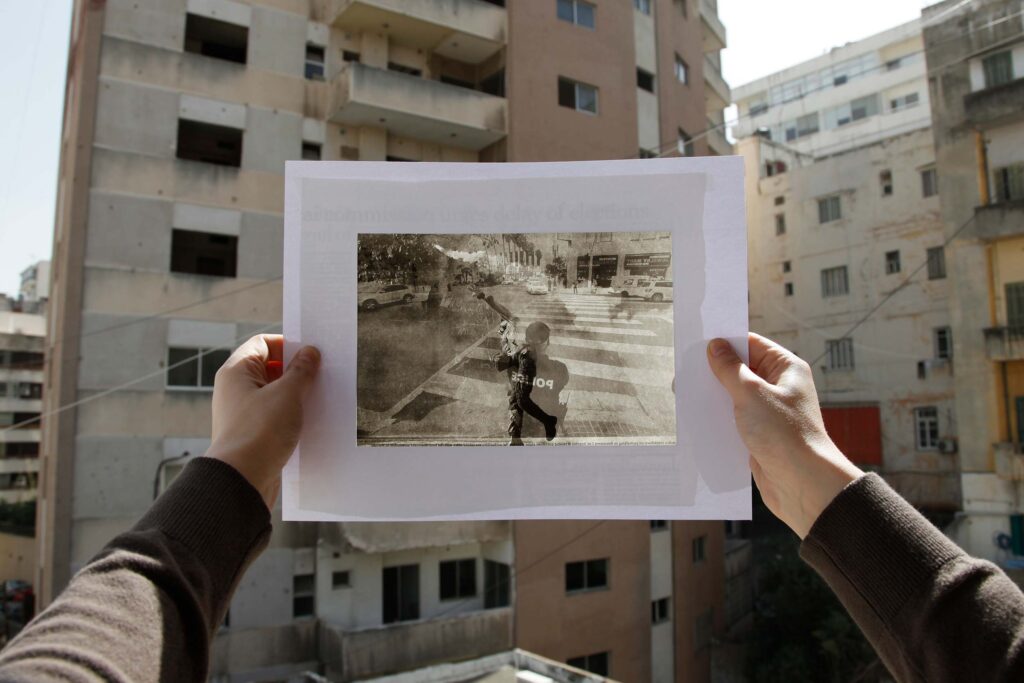
Anna Borrie: Your work bears witness to violence without reproducing graphic images. In The Untitled Images, figures are erased from photographs depicting loss and violence. How can absence reveal presence, protect memory, or tell us more about suffering than what is shown?
Khaled Barakeh: In general, I do not believe that political art becomes more truthful by becoming more explicit. Actually, in contrast. In The Untitled Images, absence is not a void but a different way of presence. In situations of violence, direct representation is often trapped inside the same regime that produced the violence in the first place: victims’ exposure, material for media circulation, and then overconsumption that leads to numbness. The wounded body is shown again and again, forced to bear meanings that exceed its own suffering. I wanted to interrupt that logic.
What remains often says more than direct exposure does, because it forces the viewer to reckon with what has been taken rather than to consume what is offered. Erasure, self-censorship, and fragmentation in this sense become both ethical and political: they protect victims’ dignity while revealing how violence also operates through the systems that decide which bodies may be seen and under what terms. Sometimes the most truthful image is the one that refuses to show you everything.
Anna: Your methodology, The Practice of Necessity, was developed as a way to respond to reality rather than represent it. What led you to develop this approach particularly, and how do you think this shift redefines the role of the artist in times of urgency, conflict, or social need?
Khaled: I arrived at The Practice of Necessity when I realised that art’s representation no longer felt morally sufficient. There was a moment when the old contract between me as an artist and the art world broke down. I decided that reality does not need to be interpreted further, but rather confronted; not framed and presented, but entered and challenged. Coming from a conflict-ridden zone and later into exile, I found that the studio’s traditional distance could quickly become a form of evasion. I could not continue treating art as a sealed aesthetic exercise while institutions were collapsing, people were disappearing, and public life itself was being dismantled. So the question shifted. It was no longer “How do I make a work about this?” but “What form of action, structure, or intervention does this condition demand from me now?” That shift eventually became what I called The Practice of Necessity. It is not a style of production, but an ethic of responsiveness shaped by pressure, rupture, and the refusal of irrelevance.
What is changing, I think, is the artist’s role itself. In times of urgency, artists cannot remain only producers of images or interpretations. They can use their creative force to become builders of conditions, of spaces, relations, institutions, and counter-publics. That does not mean art should dissolve into activism or administration. It means that form must carry consequences. A work, a platform, an archive, an exhibition, even an organisation can all become artistic acts if they reorganise how people remember, gather, speak, or imagine together. For me, the real test is whether art can still generate agency where reality has been structured to produce helplessness. Under those conditions, necessity is not what limits art. It is what returns it to its most serious task.
Coming from a conflict-ridden zone and later into exile, I found that the studio’s traditional distance could quickly become a form of evasion. I could not continue treating art as a sealed aesthetic exercise while institutions were collapsing, people were disappearing, and public life itself was being dismantled.
Khaled Barakeh
Syrian contemporary artist
Anna: The nonprofit you founded, coculture, seeks to reconnect dispersed communities through creativity. How has this work enabled individuals and communities to reclaim and reshape their own narratives?
Khaled: I founded coculture because exile does more than displace people; it fragments the social and symbolic tissue through which a community recognises itself. What interested me was how to resist the quieter violence of dispersal: the loss of continuity, context, and collective authorship. coculture grew as a response to that condition, first through physical space in Berlin, then through workshops, exhibitions, residencies, conferences, and later through long-term platforms such as theindex.art, which maps and reconnects Syrian artists and cultural workers across borders, and the Syrian(s) Biennale, which was conceived as a platform for reassembling a fractured cultural public across geographies and for shifting Syrians from the position of being spoken about to that of speaking, curating, and imagining collectively again. This evolution is a move “from improvisation to structure,” from an urgent response to a durable institutional practice.
What matters to me is that narrative is never only a matter of storytelling. Narratives are shaped by institutions, permissions, and infrastructures: who is visible, under what conditions, and through which frame. Once artists begin to inhabit and build those structures for themselves, they stop being merely represented and become authors of their own public existence. That is the deeper work of coculture: rebuilding the infrastructures and conditions under which a fractured community can think, remember, and imagine itself together again.
Anna: The installation MUTE provided a silent witness outside a war crimes trial. What does it mean to hold space for collective remembrance, and why is that necessary within communities that have been shaped by conflict?
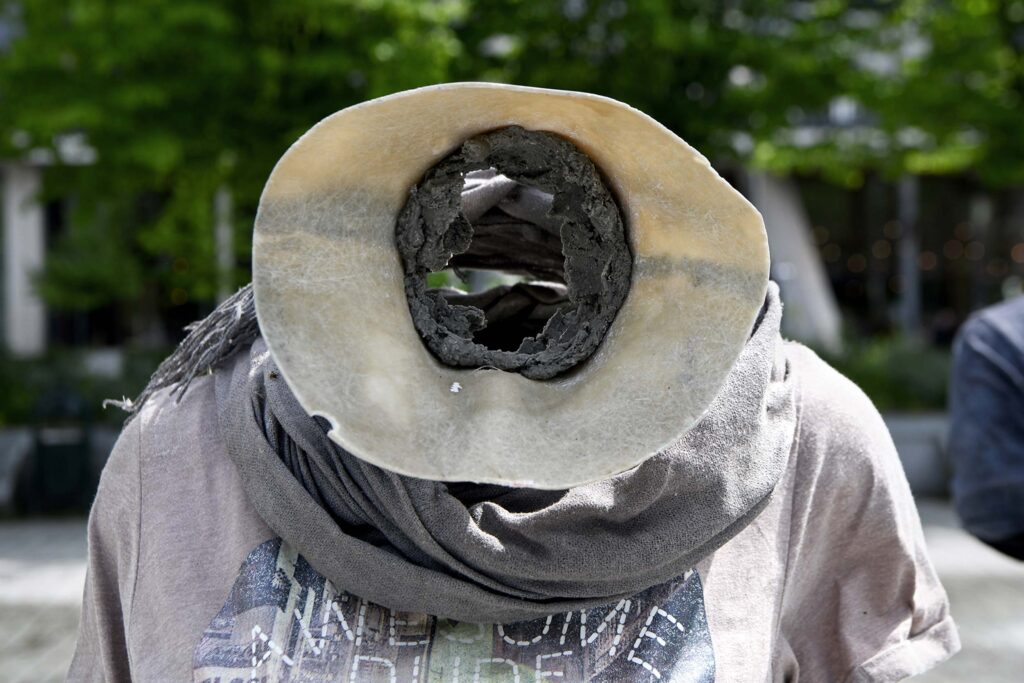
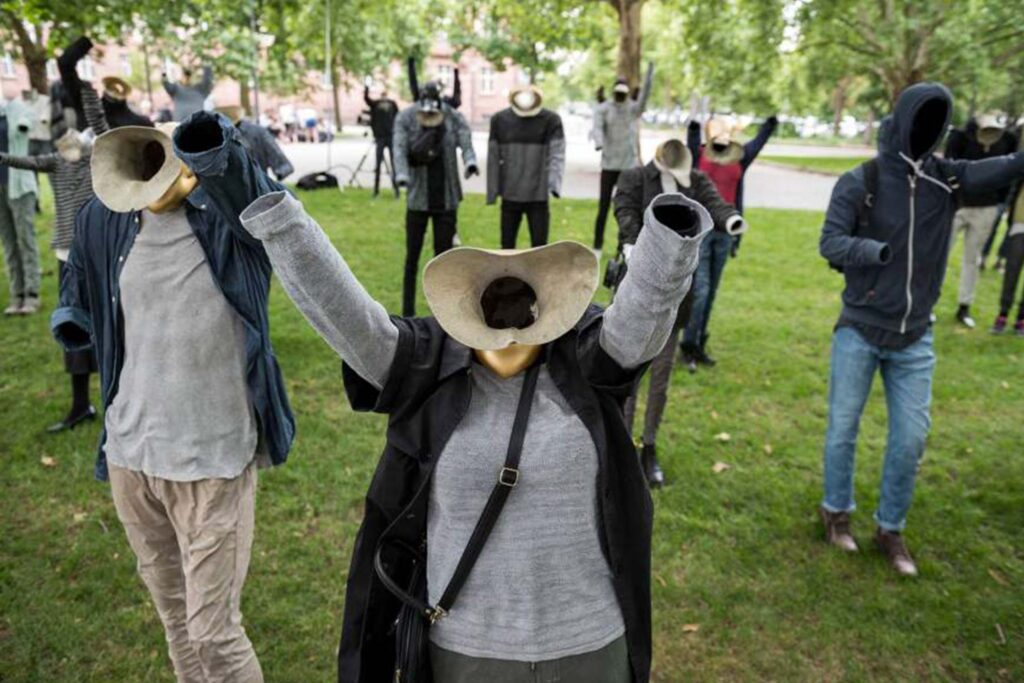
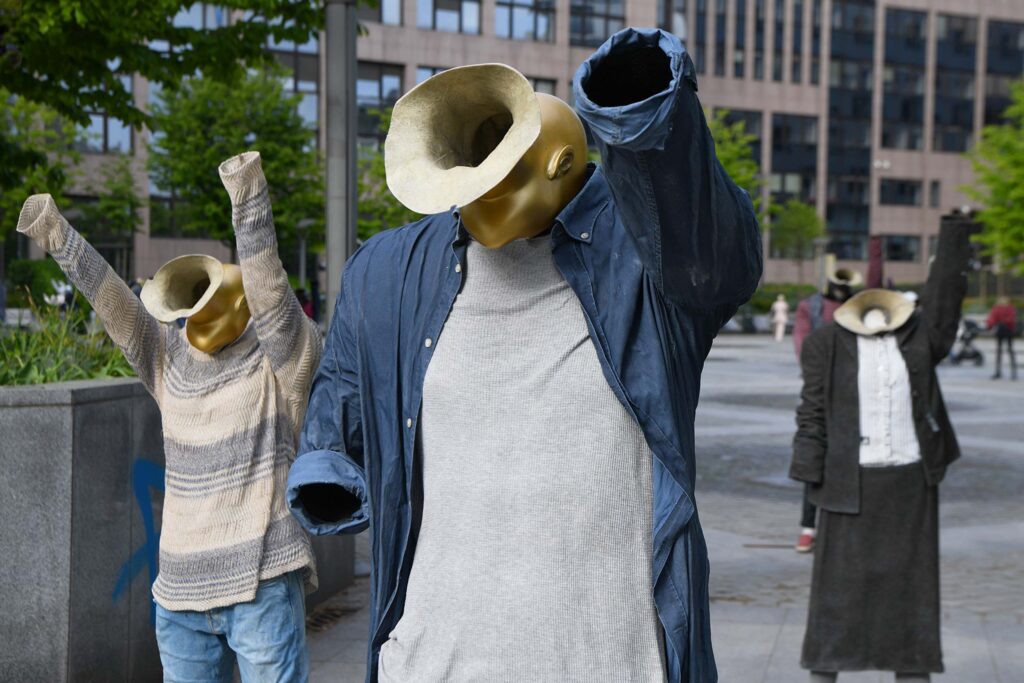
Khaled: MUTE began with a very specific contradiction: a historic court, during a global pandemic, was finally trying to address Syrian state torture, yet many of the people most marked by that violence could not enter the room, nor, if they did, could they understand what had been said because of the lake of missing translation. The 49 silent figures, dressed in clothes donated by Syrians in exile and placed outside the Koblenz courthouse, formed what I think of as an interruption: not testimony in the legal sense, but testimony in the ethical sense.
Because to hold space for remembrance is not to preserve the past as a sacred object. It is to prevent violence from achieving its final goal, which is not only to wound bodies but to reorganise reality so that victims disappear from the common field of perception. Conflict fragments memory. It privatises grief, bureaucratizes suffering, and often leaves communities carrying enormous knowledge with no legitimate place in which to gather it. In that condition, remembrance becomes a political form of reassembly.
That is why I think such spaces are necessary. Without them, justice remains procedural, and memory remains scattered. With them, even silence can become a shared structure of presence.
Narratives are shaped by institutions, permissions, and infrastructures: who is visible, under what conditions, and through which frame. Once artists begin to inhabit and build those structures for themselves, they stop being merely represented and become authors of their own public existence.
Khaled Barakeh
Syrian contemporary artist
A bombed city can become a headline for one week and then a visual habit the next. In that trading shift, the public does not become more knowledgeable; it often becomes more desensitised, and repetition becomes part of the problem: once violence becomes a continuous stream of headlines and footage, catastrophe turns into an atmosphere for those watching from elsewhere.
Khaled Barakeh
Syrian contemporary artist
Anna: How do the narratives, voices, and images we hear in the media coverage of war shape our understanding of conflict?
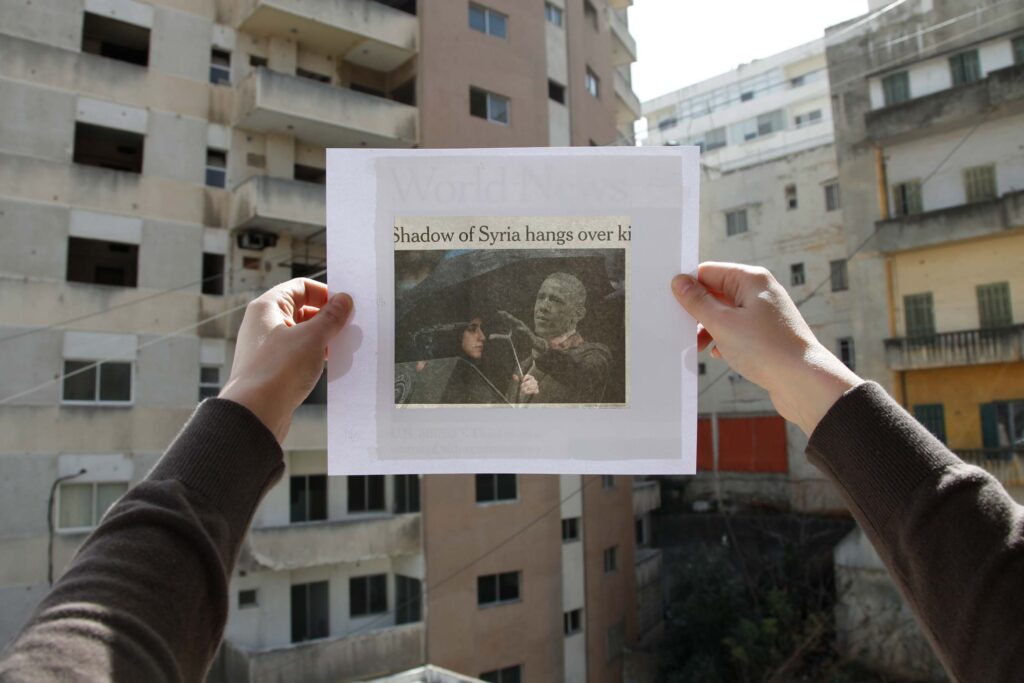
Khaled: The media was never innocent because it does not simply report war; it formats it. It decides who is visible, from what distance, through which voice, and in what emotional register. But what troubles me is not only distortion, but calibration: the way war is edited into scales of urgency, familiarity, and distance. A bombed city can become a headline for one week and then a visual habit the next. In that trading shift, the public does not become more knowledgeable; it often becomes more desensitised, and repetition becomes part of the problem: once violence becomes a continuous stream of headlines and footage, catastrophe turns into an atmosphere for those watching from elsewhere. So the issue is not only whether an image is true, but how that truth is arranged, who becomes grievable, who becomes background, and who is reduced to suffering without history, or history without suffering.
Anna: Your work seeks alternative engagements with media imagery. What role can artists play in interrupting or reframing dominant news narratives through their practice?
Khaled: Artists cannot outpace the news cycle, and I do not think we should try. We need more time, emotional distance, and sometimes even geographical distance, so we can interrupt its structural habits: slow recognition down, alter framing, shift attention from spectacle to structure, and expose the machinery around the image rather than only the image itself. In my own work, that has sometimes meant removing the body, sometimes focusing on legal procedure, metadata, institutional language, or public staging, because the visible image of conflict is often only the smallest fragment of a much larger arrangement of power. Art becomes useful when it makes what has become too easy to see difficult again in the right way.
Anna: How does land function as a site of memory and loss, and in what ways can art reveal the histories and conflicts embedded within it?
Khaled: In places shaped by conflict, land is never neutral. It can become a massacre site, a graveyard, a border, confiscated property, a route of flight, or a source of inherited trauma. That is why I resist speaking of land only in sentimental terms, as origin or homeland. Because land also carries the afterlife of power: what law has sanctioned, what violence has erased, what memory refuses to relinquish, even if it doesn’t exist anymore.
Through art, I have long been interested in collective memory and the infrastructures through which societies remember themselves, because land is a material form of memory and often the most stubborn witness a society has. Art can return to its complexity, making visible the layers of violence, longing, law, and memory sedimented within it. It can hold contradictions where politics often force closure: it can show land as both refuge and wound, as something inhabited and stolen, remembered and denied.
In places shaped by conflict, land is never neutral. It can become a massacre site, a graveyard, a border, confiscated property, a route of flight, or a source of inherited trauma. That is why I resist speaking of land only in sentimental terms, as origin or homeland. Because land also carries the afterlife of power: what law has sanctioned, what violence has erased, what memory refuses to relinquish, even if it doesn’t exist anymore.
Khaled Barakeh
Syrian contemporary artist
Words by Maddalena Fragnito
Interview and Introduction by Anna Borrie
Anna Borrie is Associate Editor at Planted Journal, where she explores the intersections between ecology, art, and storytelling. Her work is rooted in a creating meaningful connections between people and their environments. She runs a community garden in Madrid, where she cultivates both plants and relationships with fellow gardeners. Her interests lie in creating collaborative environmental art and promoting zero-waste practices, seeking ways to harmonise creativity with environmental responsibility.