

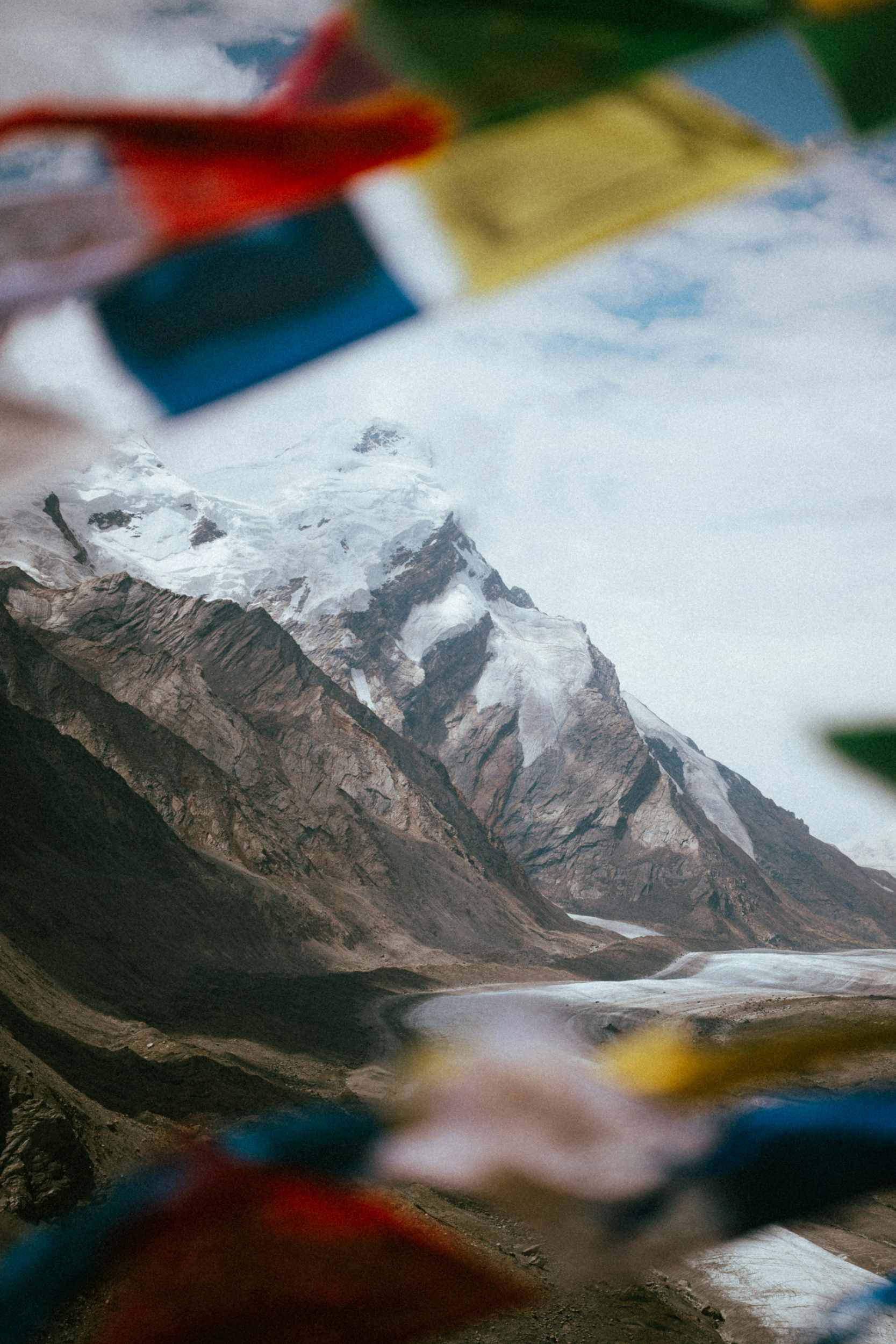
In the Himalayas, thousands of glaciers began with a snowflake falling from the sky, shaped by temperature and humidity and absorbing dust and pollen. The possible forms of a snowflake are greater than the number of atoms in the universe. It is minuscule, yet within it are the memories of Earth, her wind and her warmth. At the end of its flight, it greets the ice, where billions of snowflakes have converged into one growing body which will soon move under its own weight, rising with each snowfall, and glaciers will be born.
In the Hindu Kush Himalaya (HKH), there are more than 54,000 glaciers, supporting two billion people downstream, nearly 1/4th of humanity. These glaciers have not only sculpted the valley and the mountains but also the people who have inhabited these landscapes. Unlike Antarctica, here the relationship with ice is more visible. Across these regions, people make pilgrimages to sacred sites carved by the flow of ice and its friction. From Mount Kailash in the Tibetan Transhimalaya, sacred in Hinduism, Buddhism, Jainism, and Bön, to Nanda Devi, which is personified as a goddess, and the Bhagirathi, which emerges from the Gangotri Glacier and later becomes the Ganga River, where Hindus cremate their loved ones, to name only a few. Since 2000, Himalayan glaciers have been losing ice at double the rate. They reveal a total loss of up to 27 metres of ice thickness since 1975. While in the West this is another sign of climate change, an issue to be solved scientifically, in the East, these glaciers, valleys, mountains and rivers are the celestial realm, home to their gods. If these landscapes keep changing, it will scar the human spirit; melting ice will not only erode the mountains but also culture, stories and memories.
The glacial collapse followed by the flash flood in Nepal on the morning of 26 August 2026 is only one among many disasters that have happened in the Himalayas. It was preceded by the 4 October 2023 Glacial Lake Outburst Flood from South Lhonak Lake in Sikkim, India, and by the February 2021 rock-and-ice avalanche and debris flow in Chamoli, India; the list goes on. While Nepal only creates 0.01% of global CO₂ emissions, India’s historical responsibility falls when emissions produced under colonial rule are reassigned to the colonial powers. The fractured infrastructure of the Global South reflects how centuries of colonisation and extraction have left these nations comparatively underprepared. The resources and wealth of their land, taken through spices, herbs, cotton, and stolen people, now flourish in economies that are most responsible for the crisis.
“What we’re doing to glacier-worshipping people by putting carbon in the atmosphere is not really different in kind to what’s happened millennia past with colonisation and the destruction of Indigenous peoples’ native ways of life, using other means than carbon,” says Dale Jamieson, Professor of Environmental Studies and Philosophy at New York University. While loss and damage funds account for financial support for climate-related harms, the intangible losses are far greater. “It’s a very Western concept to equate biodiversity and nature with economics. When nature has intrinsic value, we cannot economise.” Janita Gurung, ecologist. How can one ever compensate for a life lost? For the stories, the songs, and the deities that are vanishing with these glaciers? For memories of thousands of years to be washed away?
As someone whose family lives in Gorakhpur, and across the Gangetic plains close to rivers that flow down from the Himalayas, when I read the UN report that the world is set to cross 1.5°C of global warming. I hear: we refuse to accept responsibility for our emissions, for the Earth, for the people who inhabit it; we refuse to change our ways, even if it erodes the very land on which we stand. So I write as a South Asian woman, as a body that grew on grains from the rivers of the Himalayas; I see your denial, your refusal, and I too refuse to give up on places and people that I hold close to my heart.
Words by Priyanka Singh Parihar
Founder and EIC
Priyanka Singh Parihar is a BIPOC writer, curator, and art director who explores the connection between humans and nature, seeking new ways of existing. Hailing from a rural farming community in India and now residing in Milan, she observes the world through two distinct cultural perspectives: East and West, rural and urban.
Her work with Planted Journal began during a period of severe depression and eco-anxiety. Through creative practice, she found a path to healing. With a history education in Delhi, which provided her with critical and academic tools, and a master’s in fashion styling in Milan, where design, fashion, and aesthetics have shaped her, she is now dedicated to applying her experience to the field of climate justice.