

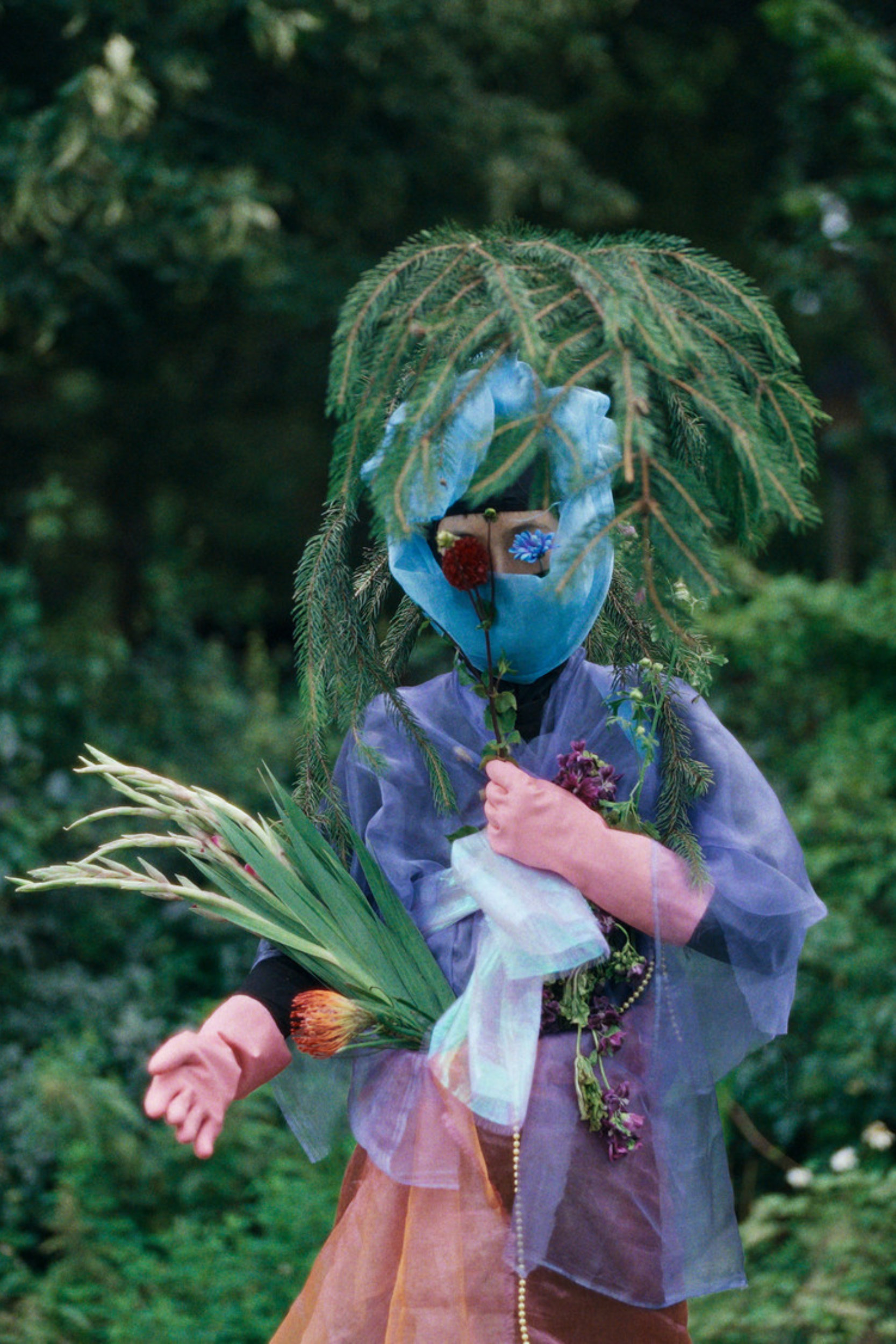
Mistura (Mixture) is a performance workshop that explores possible choreographic relationships and artistic rituals between people and plants. It aims to imagine together what a future based on ecofeminist values such as fertility, regeneration, care and protection would be like. In the workshop, a game of immersion in plant presence and time is proposed, as well as the choice of fabrics, objects and accessories that can create a mix between the many “skins” that we inhabit. The performance workshop also proposes an approach to the city from the perspective of the plants that surround us, inviting them to a common dance. The conclusion takes place with a performative crossing and the capture of images of the small, ephemeral interactions that take place between the participants and their mixtures.
At the height of the pandemic, I had the privilege of being able to work from home. I was, therefore, isolated from my family of humans and more-than-humans. I decided it would be an interesting period to increase the number of beings in the house, and so I adopted a dog.
This experience made me have to go out every day for a walk around my house. I went with my daughter, and on these routes we began to collect plants. I live near a small square that has a community garden and a compost bin. We started to find several fallen plants, some we collected, growing in the middle of the asphalt.
In addition to this collection carried out outside, I started a collection for the inside of the house—the cupboards had long been closed; the clothes smelled of storage. I put all the costumes and party clothes out in the sun. The colours of what was previously used by us adorned the garden. One day we arrived loaded with plants from our walk and were struck by the appearance of all this colourful tissue with the foliage. We then started mixing everything we had on hand.
Throughout the spring of 2020, my daughter and I made Mistura #0. The photos you see in this publication are from Mistura #10; they were made by Edgard Berendense during the performance that took place in Berlin, in summer 2025, as part of the program of The Vegetable Parlament, directed by José Delano.
Looking back on this experience now, I realise that it was an exercise in resistance and creation with what we had at hand: pieces of clothing, some fabrics, scarves, costumes and an immensity of plants. A practice of care between us, of emphasising beauty, of cultivating joy and abundance, even in a difficult and sad moment.

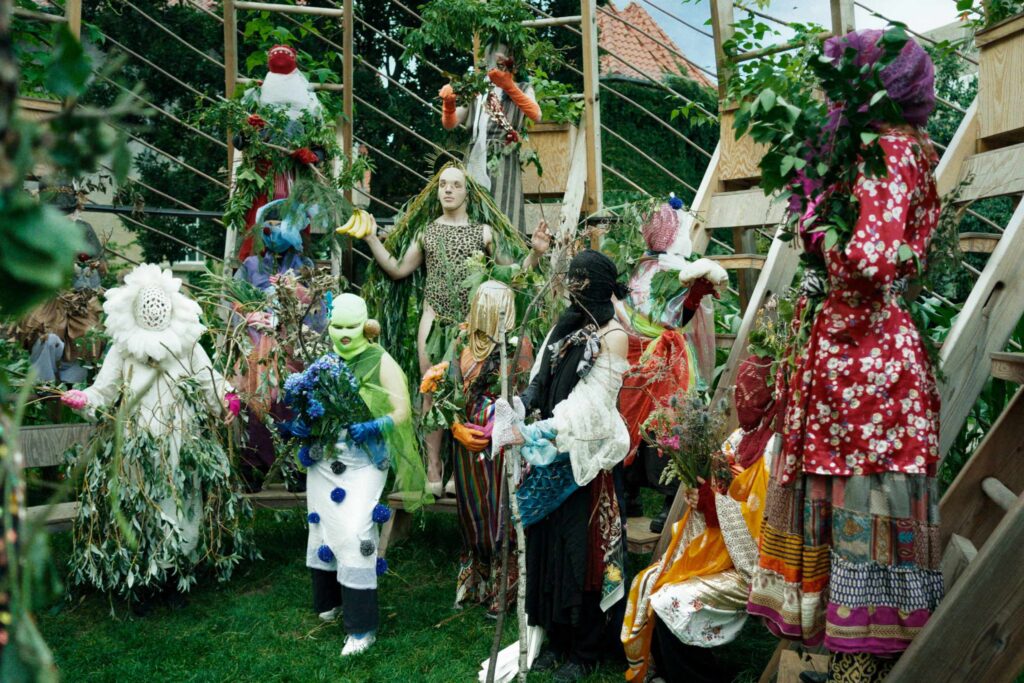
In the work developed later with women from vulnerable territories, something similar to this feeling of resisting by inventing small beauties was present. As described above, Mistura emerged from an intimate game with my daughter during the pandemic, mixing plants collected on our walks with costumes and fabrics we already had at home. As the pandemic came to an end, this game began to take on a collective dimension through my work with a group of women in Santos, São Paulo, Brazil, where I work. What had started as a domestic experiment gradually became a shared process of artistic exploration. The project has since unfolded in Araraquara and São Paulo, Brazil; Cádiz and Pamplona, Spain; Santiago, Chile; Coimbra, Portugal; Paris and Aurillac, France; and Berlin, Germany. In each territory, encounters with different people, plants, materials and landscapes added new performative layers, transforming the game while retaining its openness to play, intimacy and discovery.
I bring the cultivation of eroticism as proposed by Audre Lorde in 1978. Mistura encouraged us to seek the power of the feminine, the vital force that we have and can cultivate among ourselves. The erotic as an operation of sharing an activity with another person (or plants?). A kind of nutrient for looking at life, at what surrounds us, but mainly at what lives inside our body-home. Eroticism as an exercise in deepening relationships of affection, listening, satisfaction. Not necessarily linked to sex or sexuality. A relationship with the beauty and power of life.
The very word erotic comes from the Greek word eros, the personification of love in all its aspects—born of Chaos, and personifying creative power and harmony. When I speak of the erotic, then, I speak of it as an assertion of the lifeforce of women; of that creative energy empowered, the knowledge and use of which we are now reclaiming in our language, our history, our dancing, our loving, our work, our lives.
Audre Lorde
“The Uses of the Erotic: The Erotic as Power”
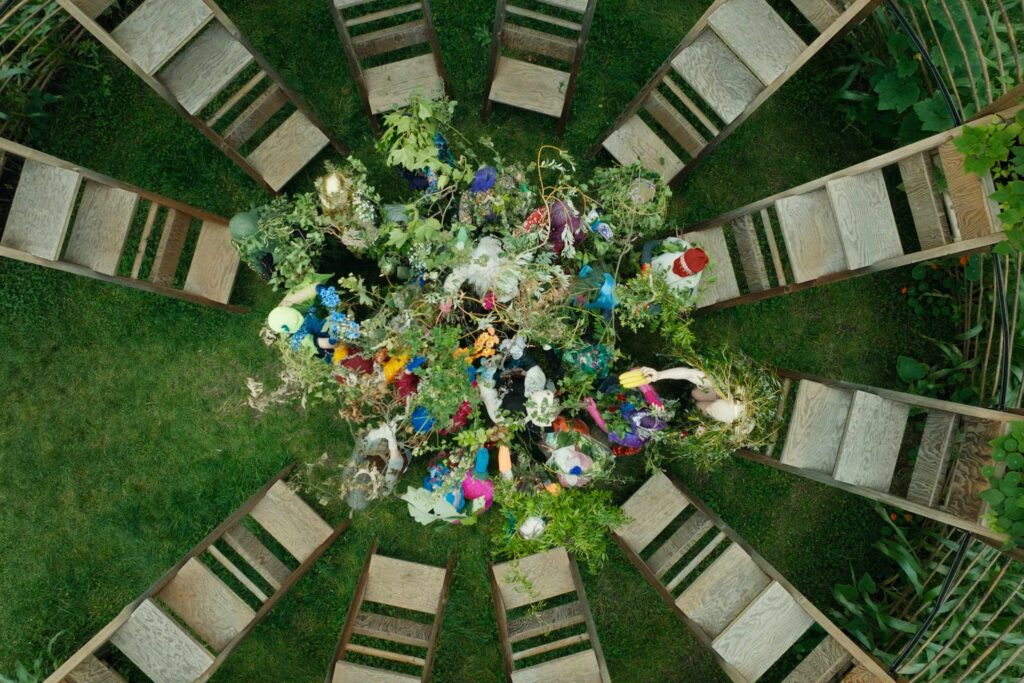
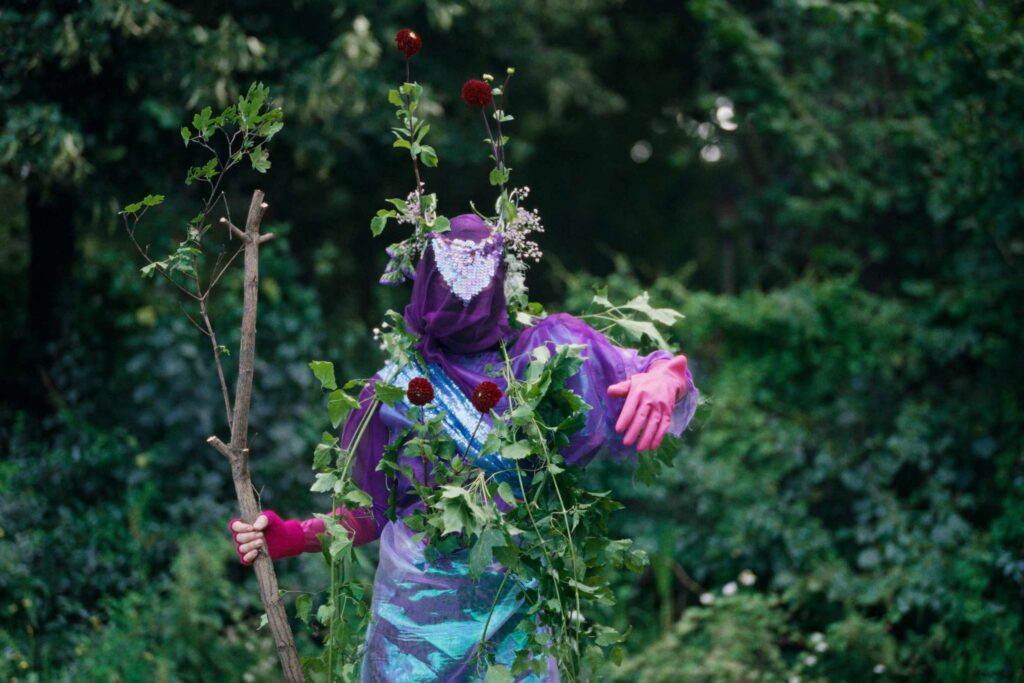
The climate crisis is largely a crisis of care: a sense that goes beyond our individual and human bodies and affects other beings and the planetary body itself. By expressing, imagining with the body, moving internal and external worlds, dancing with the plants, the earth, the waters, the mountains and, most importantly, dancing with others, we are proposing ways of caring. The way we dance is also putting the body in relationship with space, with time, with each other. Dancing can therefore be a form of care. A slice of experience that “writes in time” a certain form of relationship.
The term “care” refers to many issues, means many things and articulates varied fields of study, which do not always dialogue with each other. Philosopher and educator María Puig de la Bellacasa, in Matters of Care: Speculative Ethics in More than Human Worlds, helps us think that there is not just one production circuit to dialogue with when we talk about care. Similarly, as described in The Logic of Care by ethnographer Annemarie Mol, care must always be analysed in its relationships, agencies and proposals. This multiplicity of care makes us less ask the “what” of care (what it is, what it stops being) and think about how it is done, who performs it, why they do it and, more than that, who “cares”.
In other words, by opening this connection between dance and care, we open up many possible perspectives and paths. We begin to consider that abundance is something we already hold, that it can emerge through attention to what is already available: clothes stored in cupboards, plants gathered on a walk and the relationships that sustain us. Within an economy that encourages us to seek pleasure and renewal through continual consumption, what we possess can quickly come to feel insufficient. Mistura explores how care can transform this relationship. Bringing existing materials into new compositions allows us to rediscover their textures, dance with histories and imagine new possibilities. Abundance takes shape through the ways we rearrange what is at hand.
It is necessary to expand an understanding of care as a practice of responsibility, acceptance and attitude towards social and individual processes, including other-than-human perspectives as well. In this sense, dance / ecosomatic practices can contribute to establishing the necessary attention to bring us closer to a connection with the Earth.
By expressing, imagining with the body, moving internal and external worlds, dancing with the plants, the earth, the waters, the mountains and, most importantly, dancing with others, we are proposing ways of caring. The way we dance is also putting the body in relationship with space, with time, with each other.
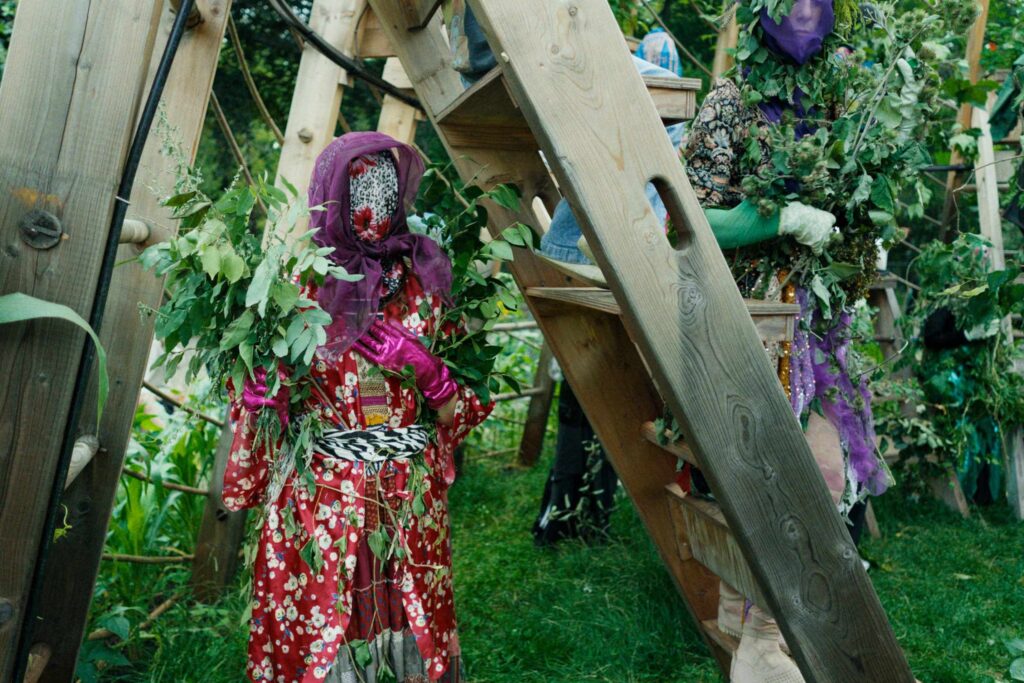

Words, creation, and research by Marina Guzzo
Artist and researcher Marina Guzzo concentrates her creations at the interface of the body and the landscape, mixing dance, performance and circus when tensioning the limits of subjectivity in cities and in nature. Since 2011, the climate crisis and the role of the artist in the production of imagery for crossing a ruined world on the Anthropocene have been at the centre of her research. She works in partnership with health, culture and social assistance equipment, thinking of art as a political action that weaves a complex network of people, institutions, objects and nature. The artist has a post-doctorate from the Department of Performing Arts at ECA-USP and a master’s and doctorate in social psychology from PUC-SP. She is an associate professor at Unifesp at the Baixada Santista Campus and a researcher at the Corpo e Arte Laboratory in the Society and Health Institute. She is a current fellow at Affective Societies in Freie Universität Berlin.
Photos by Edgard Berendsen
Edgard Berendsen is a Santiago-born visual artist based in Berlin since 2010. Working across photography, moving image and 3D, he has developed an interdisciplinary practice that brings photographic observation into dialogue with cinematic composition and digitally constructed environments. Active since 2005, his work spans multimedia art, cinematography, animation and visual effects, including collaborations on independent short films. Exhibited in Santiago and Berlin, Berendsen approaches still, moving and computer-generated images as interconnected forms of image-making, with particular attention to composition, space and atmosphere.
Costume assistance: Lacy Barry
Participants/Performers: Giovanna Rodrigues, sWithA, Jae, Ana Santos, Diane Lavoie, hüga-hüga, Kristina Vasilevskaja, Anja Malec, Romana Ruban, Jorinde Sayar, Nicol Rivera, Xalteva González, Katerina Murysina, Hye Young Sin, Lia Robert Horne, Meitong Chen, Amadalia Liberté, Florencia Lasch Macaya, Cora, Kei Watanabe, Nellie Alexandre, Sophie Spiral
Research platform // Lab Corpo y Arte UNIFESP
As part of a research project in Affective Societies- Freie Universität Berlin sponsored by National Council for Scientific and Technological Development of Brazil (CNPq)
Mistura #10 took place as part of the series THE GROWING SESSIONS, in the frame of the project The Vegetable Parliament by José Délano, funded by Hauptstadtkulturfonds.