

La Pietra: On Body and Landscape
What shapes our desires when attention trains itself on endless signals?
What happens to myth when collective memory is replaced by the spectacle of commodities?
Knowledge and tools expand faster than sensory integration, but what do they offer when perception lacks grounding?
During the second half of the twentieth century, Western thought began to register a growing disjunction between technological acceleration and embodied experience. An emerging sensibility took shape around the idea that as machines accelerated, lived experience was also being transformed, progressively translated into data, extended beyond locality, and distributed across expanding and overlapping temporal and spatial scales.
In a widely circulated interview from 1993, Terence McKenna spoke with the cadence of a warning omen as he described a world entering an era of intensified weirdness. Technology, in his view, amplifies external signals beyond the nervous system’s capacity for digestion. The internet collapses distance and scale, delivering war, catastrophe, and cruelty as repetition. Genocide circulates as daily content, and violence loses friction. McKenna framed this as a crisis of embodiment: meaning detaches from ground, myth floats free of ritual, and imagination accelerates without anchor.
In The Birth of Tragedy (1872), Friedrich Nietzsche argued that the progressive detachment of the Western mind from the natural world began with the suppression of the Dionysian impulse. The ecstatic, chaotic, and corporeal dimensions of experience, those that once allowed humans to commune with nature and confront mortality, were gradually subordinated to Apollonian order, rationality, and form. Over centuries, Christian moral frameworks amplified this detachment, embedding guilt, shame, coloniality and ascetic discipline as dominant cultural values, thus displacing immediate, embodied engagement with life and landscape.
The result is a persistent tension between the acceleration of knowledge, technology, and information and the diminishing capacity of the body to apprehend its own rhythms, limits, and resonance with the world. Psychologists observe fragmentation within the self as continuity of experience weakens. Artists, musicians and choreographers search for forms capable of restoring contact between perception and material life. Questions have thus emerged around how meaning is produced, how desire is shaped, and how we might retrain our attention.
What shapes our desires when attention trains itself on endless signals?
What happens to myth when collective memory is replaced by the spectacle of commodities?
Knowledge and tools expand faster than sensory integration, but what do they offer when perception lacks grounding?
As a technology and cyber-enthusiast myself, growing up playing video games with my brother, staying up late into the night scrolling memes and chatting online, I approach these questions not from a standpoint of preaching, but as invitations: open questions to be explored together, through attention and attunement to the land.
How does perception shift when form appears as a living process?
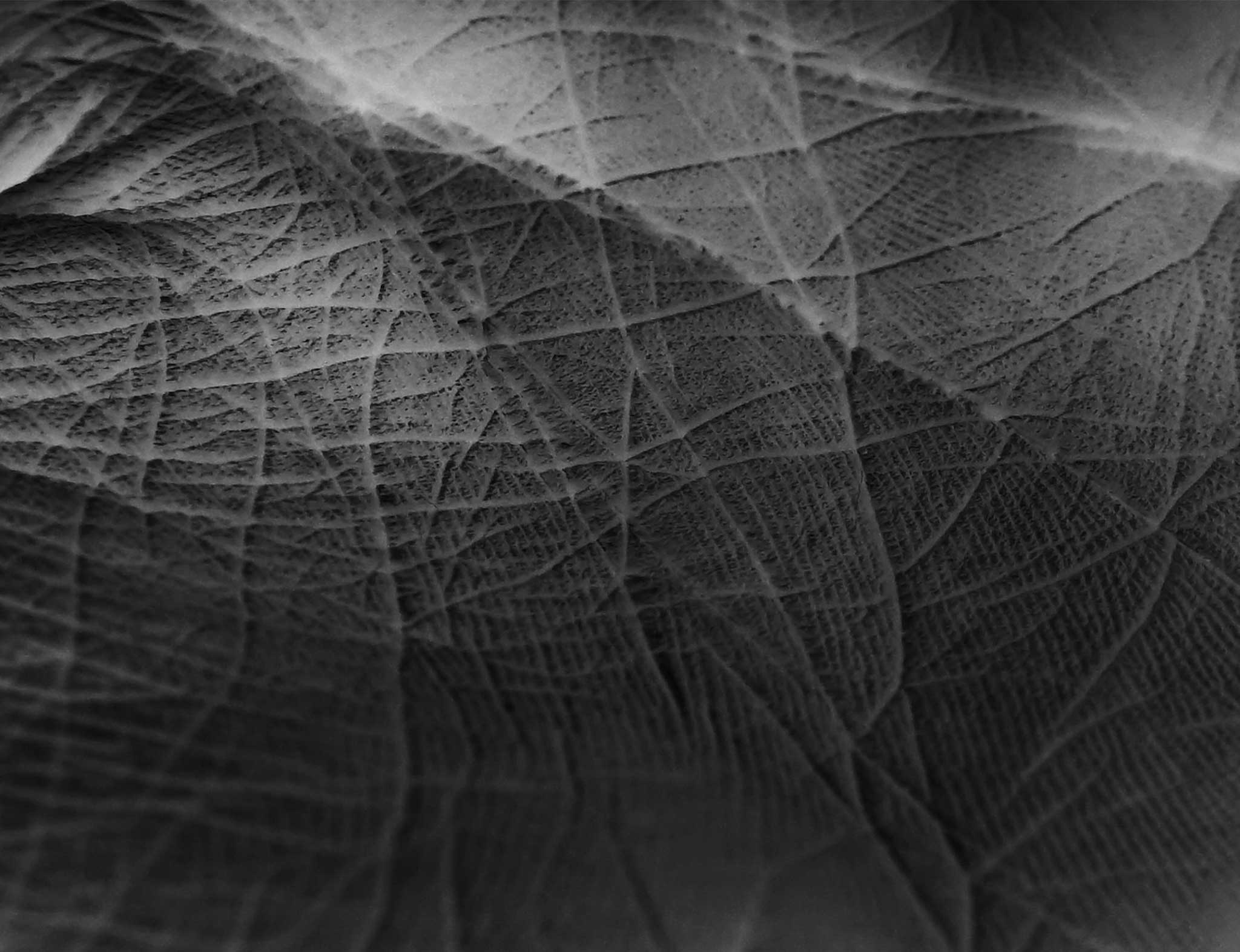
These questions resonate across disciplines that long preceded digital saturation. In Sensitive Chaos, first published in 1965, the German scientist and philosopher Ernst Schwenk studied water and air as formative forces. Through close observation of vortices, spiral currents, and turbulence, Schwenk demonstrated how movement itself generates structure, order emerging through sensitivity to context, pressure, and flow. His work challenged mechanical views of nature and influenced biodynamics, ecological philosophy, and somatic research. Intelligence, in this framework, resides within motion. Pattern grows through responsiveness. How does perception shift when form appears as a living process?
La Pietra, a retreat shaped by the collective exploration of land-based artistic practices, emerged within the landscape of Valle d’Itria in Puglia, Italy, which unfolds as a limestone plateau shaped through erosion, wind, and centuries of cultivation. Dry stone walls curve according to gravity and rainfall. Sinkholes and caves puncture the surface, opening into shadow and echo. Human gestures here developed through close negotiation with geology and climate; memory persists through stone and path, and knowledge transmission stays embedded in form. La Pietra emerged as a slow inquiry into listening as an embodied practice, perception a relational skill shaped through duration.
Can active participation in the Earth’s rhythms create new forms of mytho-ecological thinking? Can ritual emerge through repetition and care, and the body become an extension of landscape?
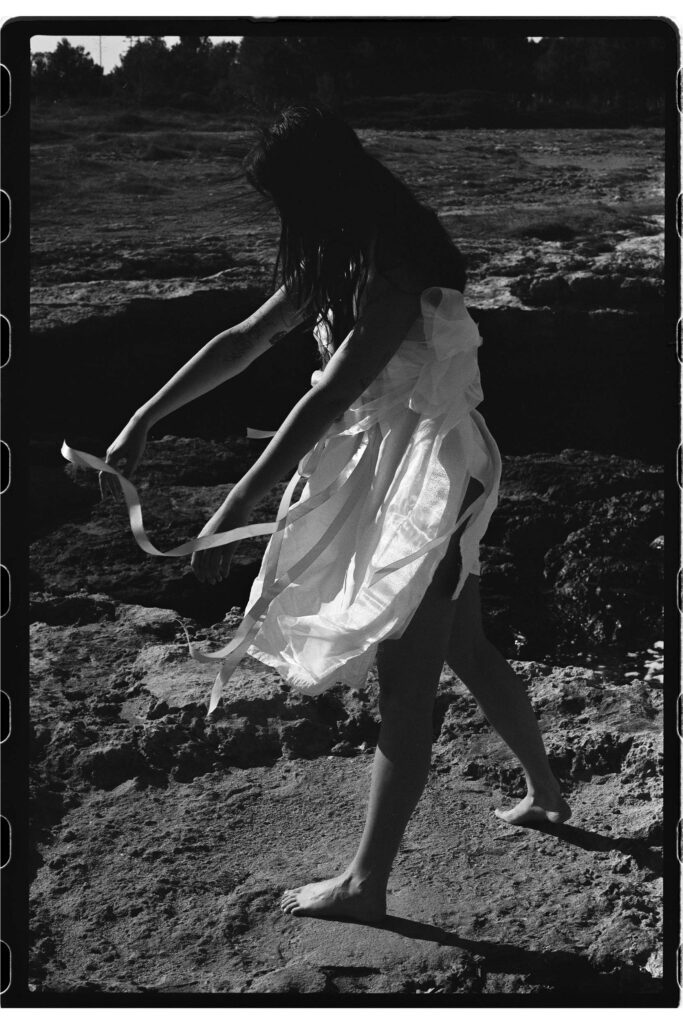
Daily practices within La Pietra drew from early twentieth-century dance lineages that treated the body as a psychic and elemental site. Mary Wigman’s work during the 1920s within the movement of German expressionism and esotericism articulated movement as an expression of inner necessity, the body a liminal space where the individual encounters collective energies, ancestral echoes, and elemental tensions. Loïe Fuller, working decades earlier, transformed the human figure into wave, flame, and spiral through continuous motion, fabric, and light. Her work dissolved anatomical clarity in favor of vibration and flow. Together, these lineages informed our project’s practice as bodies aligned with slope, airflow, and resistance. Walking, standing, leaning, and falling gained expressive charge.
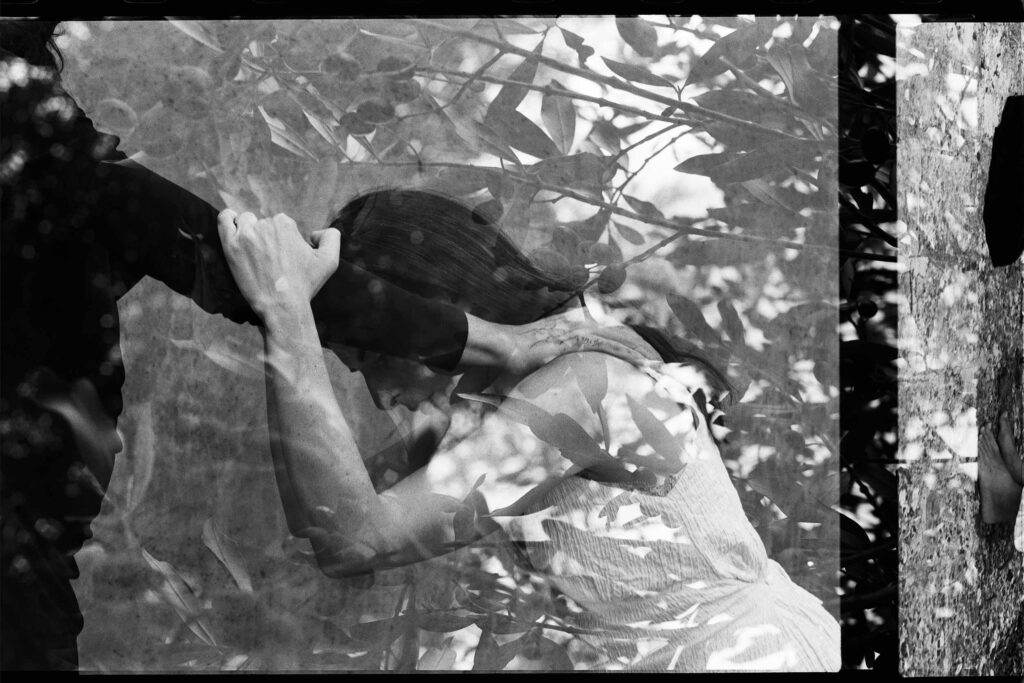
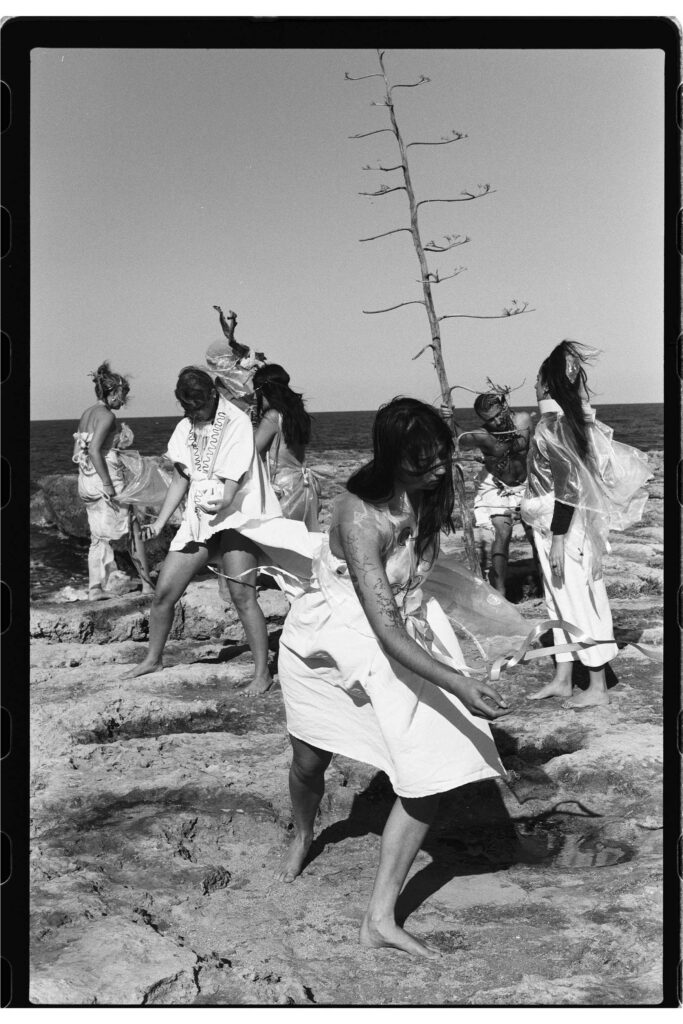
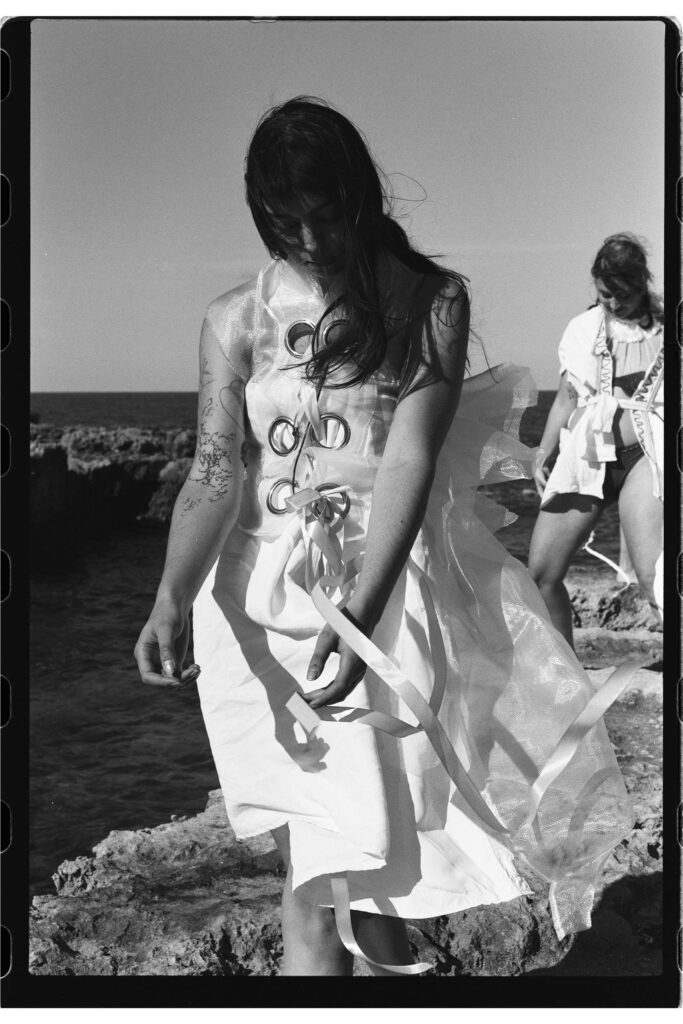
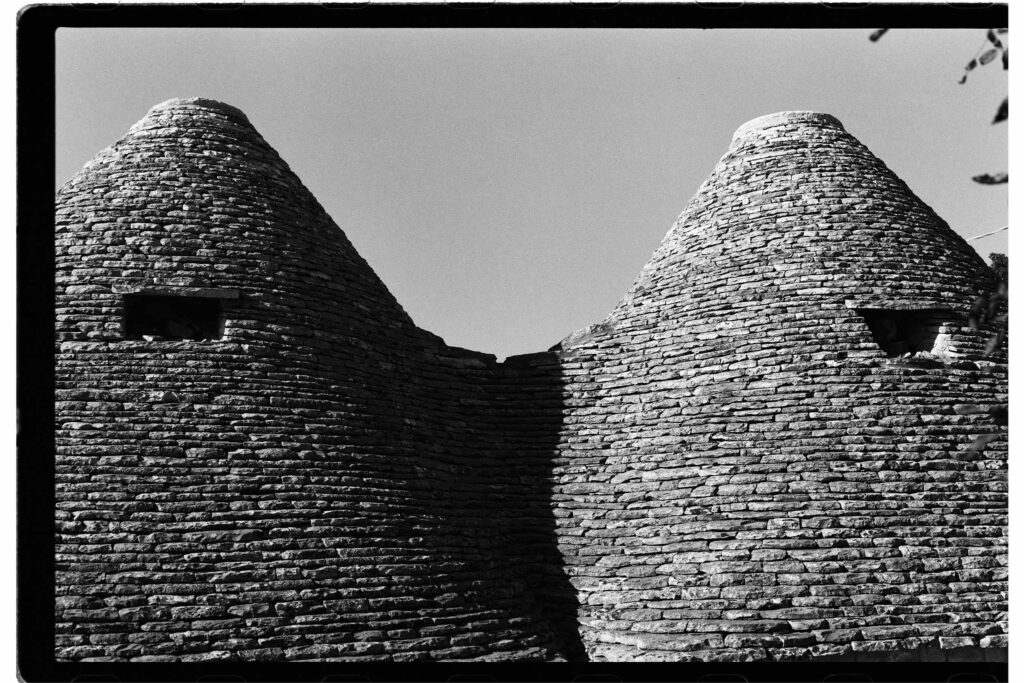
What moves through the body when technique loosens its authority? What memories surface when a gesture begins from presence?
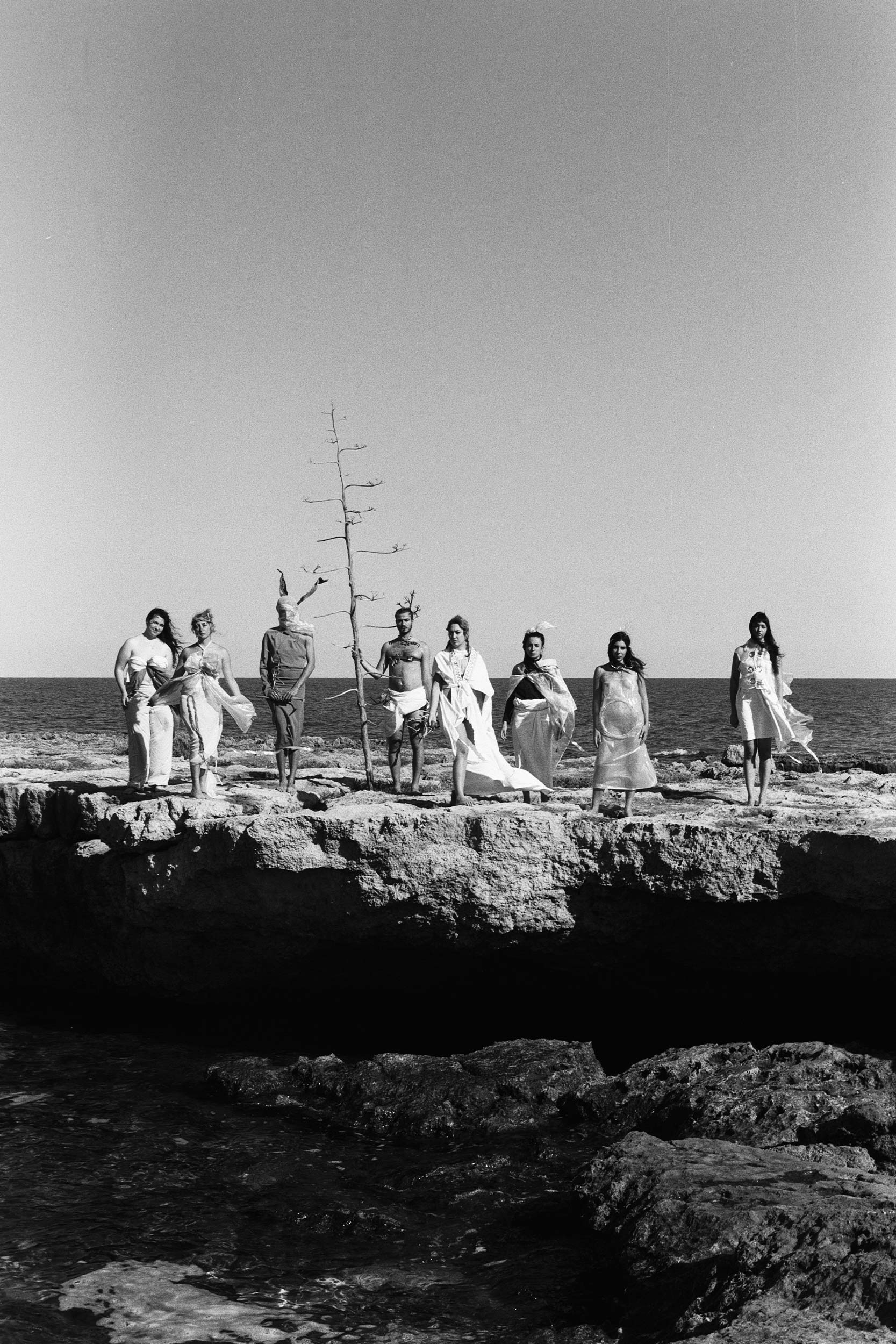
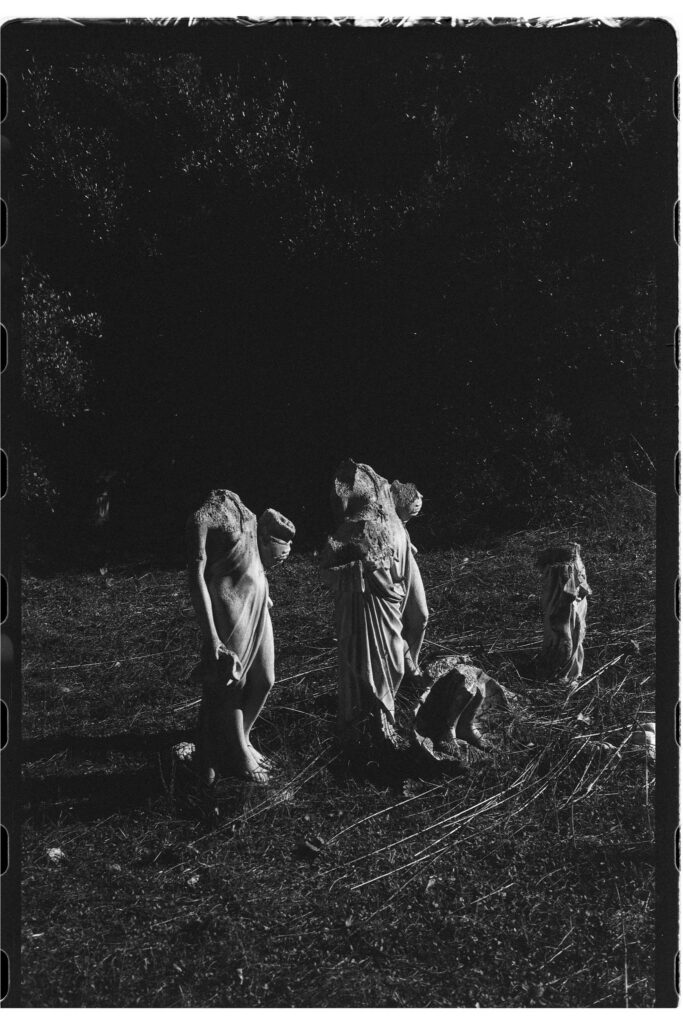
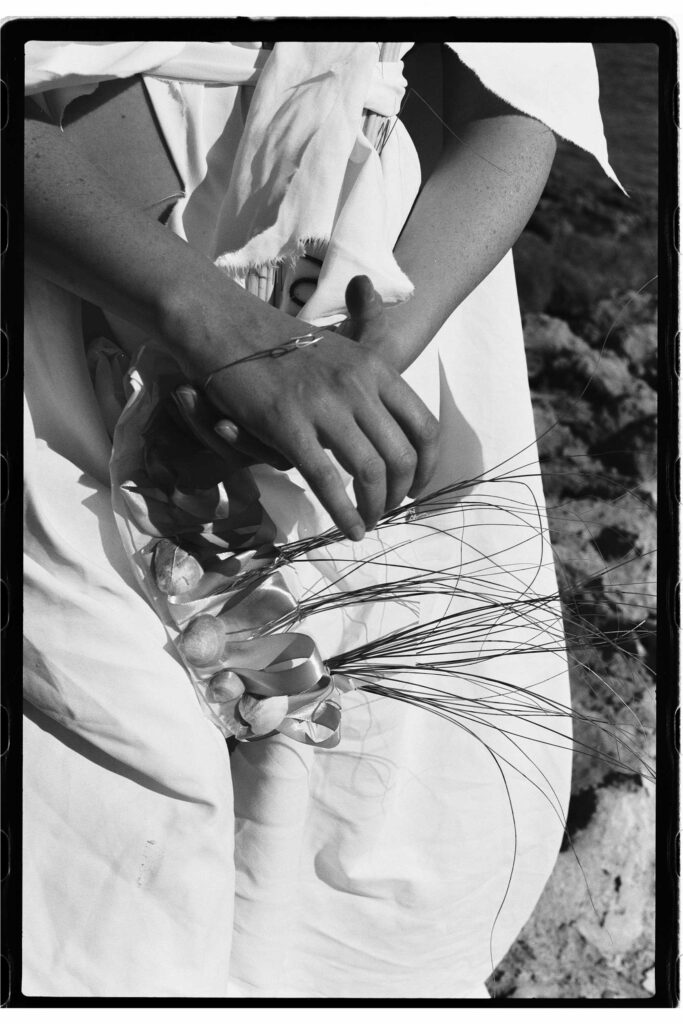
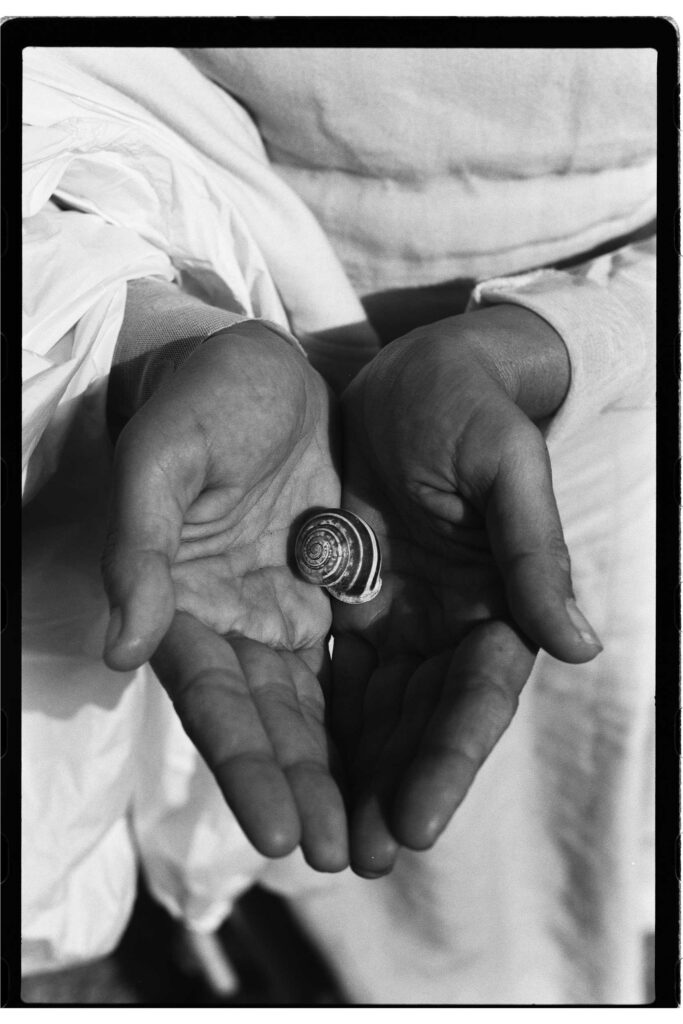
Michaela Meadow’s photographs trace these states of permeability. Bodies align with stone formations as limbs echo erosion lines. Temporary constellations of shells, ammonites, and fragments appear, then dissolve back into ground.
During the week, we invited Celia Philips, founder of Sacrificium, and researcher Grazia Di Giorgio to give lectures that deepened our participants’ engagement with material, psychological, and artistic inquiry. Material inquiry was enriched through the work of Celia Philips. Her practice operates at the intersection of textile and mythology, Sacrificium functioning as a research laboratory where garments emerge from studies of archaic adornment, organic form, and baroque excess. Adornment unfolds as choreography while stones, fibers, and found objects carry symbolic and physical charge through wear. Costume extends perception outward, binding skin to landscape and reflecting on how material educates movement and expression.
Archaeological insight entered our explorations through Grazia Di Giorgio, an Apulian scholar and senior analyst at the Colorado Institute of Jungian Studies, whose research bridges analytical psychology, myth, and material culture. Her reflections on the Canosa vases from Puglia’s third century BC approached these objects as containers of psychic transformation. Saturated with ornament and color, the vessels embody death, continuity, and passage, tracing cycles of life and ritual across centuries.
Building on this, Ernesto de Martino’s La terra del rimorso (1961) illuminates the broader context of ritual as lived practice in Puglia. His work resonates with the ways land, movement, and gesture encode historical consciousness: how human bodies carry the past, respond to it, and sustain heritage across generations.
What forms allow crisis to move through bodies without erasing desire or imagination? How might engagement with landscape and material practice transform our experience of continuity and rupture?
Within La Pietra, journeys toward the sea extended these inquiries as breath aligned with the tides and feet came into contact with water, drifting consciousness toward new possibilities. How does the body remember when sensation itself becomes a medium of understanding? As we discovered, an erotic intensity emerges in the openness of the body to sensation, and pleasure becomes a form of knowledge, sharpening awareness and amplifying perception. Through encountering resonance in stone, water, wind, and the small creatures that inhabit them, the body learns its own capacities. This force exceeds the individual: it circulates, binds, and instructs, registering through touch, movement, and the delicate choreography of feeling that carries across flesh, soil, and sea. Together, our bodies are gathered into this shared pulse that precedes speech and outlasts any single life.
How does the body remember when sensation itself becomes a medium of understanding?
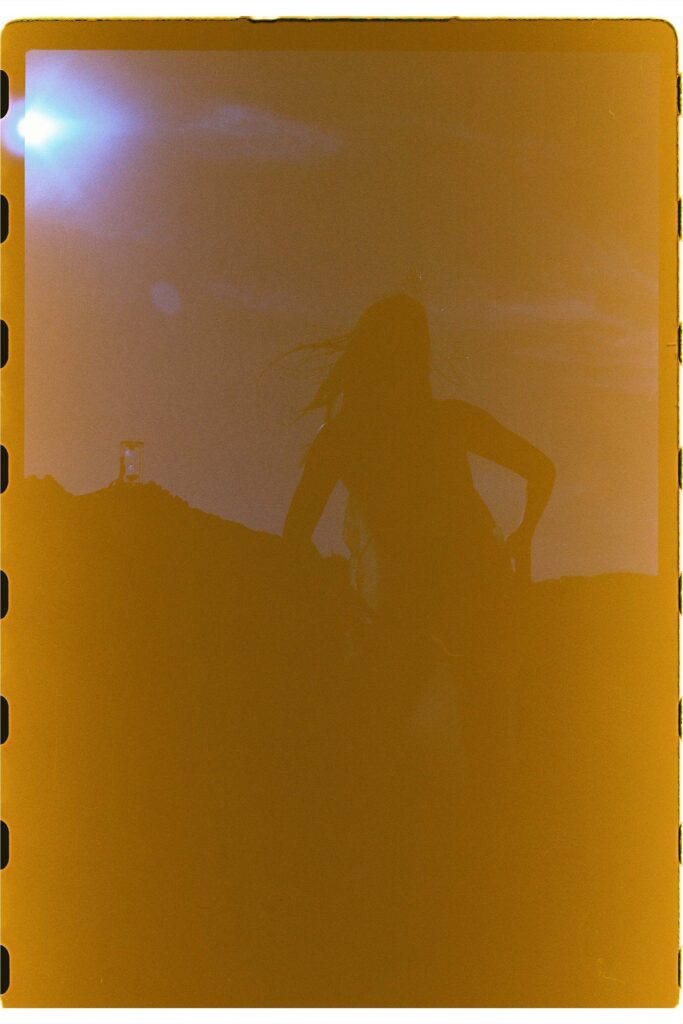
Dimora Casanoja formed the living center of this retreat. Meals, cultivation, rest, and circularity emerged through daily acts.
La Pietra, a project by Archaeochoreology and Collina Noja, remains suspended in the imagination until the next manifestation.
Photography by Michaela Meadow
Words by Francesca Heart
Francesca Heart is a Milan-based musician and dancer who uses myth, transformation, and nature in creating soundscapes focused on the physical experience of movement. She works with found and collected sounds, both natural and machine-made, that blur and blend what is real and what is an augmentation of it. Playfulness underpins her creative process, resonating through her work and transporting listeners into dreamscapes that are energising, revitalising, and meditative.