Through Her Eyes: A Bridge Between Womanhood and Nature
There is something raw, ancient and sacred when a woman channels the connection between femininity and nature. A quiet remembering, carried within. Ecofeminist scholar Vandana Shiva writes that modern society has been shaped by systems that separate humans from the Earth, valuing domination and extraction over reciprocity and care. This worldview, often linked to patriarchal structures, frames nature as a resource rather than a living system we belong to. Artist and theorist Carolyn Merchant similarly describes how Western history transformed Earth from a nurturing mother into something to be controlled, a shift that paralleled the marginalisation of women’s knowledge and embodied ways of knowing. As a result, humanity has increasingly come to see itself as separate from land, from animals, and from one another, divided by culture, gender, and identity. Yet thinkers such as Donna Haraway remind us that we are not outside of nature but entangled within it. By reframing our relationship with the Earth through care, interconnection, and responsibility, we can begin to move away from narratives of crisis and guilt toward ones of rebirth, healing, and shared survival.
Within this madness, women are reminded every day of where we come from, through the creation we hold inside, the metamorphosis of our bodies, and the cycles we carry in our blood. In a world that refuses to honour our natural rhythms, we’ve adapted, becoming resilient survivors. Objectified and silenced, we have long been cast aside by systems that seek to control and diminish us. But we began to speak, to reclaim, to seek wisdom, to remember. Artists, visionaries and women from around the world have returned their bodies to nature, and in doing so, they’ve given us new ways of seeing and knowing. Through art, and particularly photography, women communicate emotions, experiences, and truths that are often silenced in everyday life.
Artists like Ana Mendieta return their bodies to the Earth, creating work that speaks to both the violence and beauty of existence. Janaina Tschäpe explores how nature shapes human memory and perception; she attempts to connect patterns and variations in light, reflecting our memory of moments lived in nature, into her art. Nora Lowinsky invites us to confront ancestral memory through her intimate photos, emphasising that the body holds the stories of survival, with the land as witness. Jeanne K. Simmons challenges us to listen to the forgotten parts of ourselves and nature, saying, “My work asks us to reconnect with what has been lost.”
The voices of these female artists echo deeply in our hearts, as our roots and bodies whisper to be reclaimed by nature. Through their art, they use visual storytelling as acts of reclamation, inviting us to question: Who are we, really? What makes us feel alive, and what yearns to come out? These sacred reconnections replace the body where it belongs, pushing us towards a reimagining of the reality that has long forgotten our roots. They explore a slow, feminine vision of living in harmony with the Earth, honouring it through an archive of visionary voices. These visual narratives make us feel and move with the Earth – her soil and breath – reminding us that the boundaries between our bodies and Earth are not separate but interwoven. Through their eyes, we see ourselves as a community of women, a force of transformation capable of changing the world around us. Breathing in new air, reclaiming our strength, healing our wounds, and rewilding the Earth, this new energy will bring light to the struggles of climate change, gender inequality, and social injustice.
A thin line stands between us,
betrayed by men’s fast-paced world,
us,
creators of life,
who quietly exist
in search of streams of life,
when our inner worlds collide.
The ones who sync with the moon
as tides level up,
as waters reach the surfaces.
The ones who have survived,
as we get shattered,
turned apart,
doubted,
silenced.
Us who feel everything,
whose scars mimic the ones engraved in stones,
whose rhythms flow with the sky above.
Standing still,
capturing all,
creators of life.
Curve lines,
shaping the whole.
Birthed from the soil.
We stand,
even when torn apart,
we stand with you,
as we have an understanding,
we know,
we feel,
lift, in mid-air.
I hear you,
I am here.
Virginia Melodia
One true visionary who embodies this work is Ana Mendieta, a Cuban artist born in 1948. Mendieta, a sculptor, photographer, filmmaker, and installation artist, worked with organic materials – earth, water, and fire – to create powerful, nature-infused art. Her story began when she was exiled from Cuba as a teenager; she experienced displacement, loss, and the search for belonging, which deeply informed her artistic practice. One of her most inspirational works has been the Silueta Series, also described as “earth-body works,” which comprises over 200 pieces. This series began in 1973 with Imágen de Yágul, where Mendieta lays her nude body enmeshed in a rocky tomb. She lies there still like a corpse at the bottom of the grave; we only see her arms and legs while the rest is covered by a loose arrangement of feathery flowers, as if they were growing from her body. It invokes temporality, the growth of weeds in a tomb, “nature’s reclaiming of the site.” The piece explores the cycles of life and nature’s ability to renew itself, honouring Mexican funerary rituals.
My art is the way I re-establish the bonds that unite me to the Universe. It is a return to the maternal source.
Ana Mendieta
It began with the artist’s nude body enmeshed in natural landscapes and shifted to bodily outlines, imprints, or mounds shaped as silhouettes. By embedding her form into the earth, Mendieta rejected the separation between woman and nature; her art is a radical act of reclamation, where the body becomes one with the landscape. Her use of organic materials like earth and blood symbolises the feminine principle of life, growth, and transformation. Her exile, her search for roots, and her profound sense of connection to the natural world evoke the emotional and spiritual depth of her practice, reminding us that her art is not only visual but deeply human, a reflection of longing, resilience, and the desire to belong. As Mendieta said, “My art is the way I re-establish the bonds that unite me to the Universe. It is a return to the maternal source.”
Mendieta returned to the earth as an act of remembrance, a reclamation of herself, and this lineage of women who merge with the landscape continues beyond her.
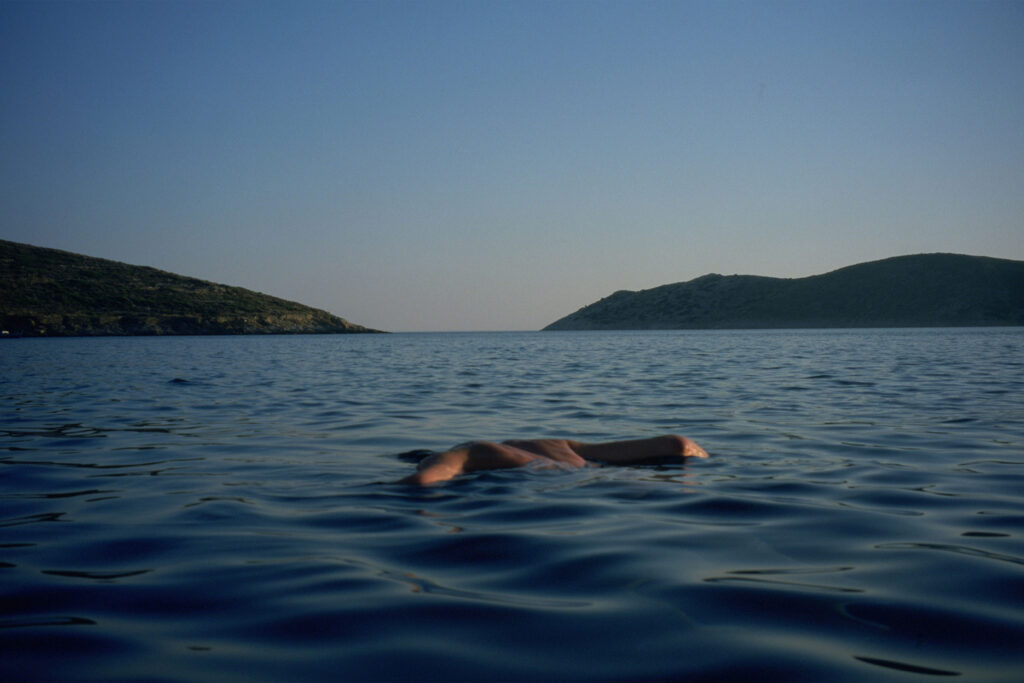
I was really a landscape.
Janaina Tschäpe
Decades later, Janaina Tschäpe, a German-Brazilian artist, extends this revolution of women returning the body to the earth, but she approaches it through a lens of metamorphosis and surrender. Her long-term photographic work, 100 Little Deaths (1996–2002), becomes a poetic ritual of dissolution, dissolving the boundary between the female form and nature. Her body is laid face down in landscapes across the world, almost swallowed by them. Tschäpe has said, “I was really a landscape,” and within these images, her words feel literal. She gives herself to each environment, abandoning the illusion of separation and allowing the land, the sea, and the world to shape her.
Each photograph becomes a moment of quiet death, not a tragic end, but a shedding. She describes the series as “living a little history that was very short in every place,” leaving behind small remnants of the self, as if each site holds a fragment of her spirit. In this gesture, Tschäpe mirrors the internal cycles of womanhood: the releasing, the renewing, the constant becoming. Her “little deaths” often occur near water, echoing her own name, Janaina, drawn from an Afro-Brazilian sea goddess. Her form becomes a line between worlds: woman and water, vulnerability and strength, death and renewal. Water here is not just an element; it is lineage, ancestry, and myth. A return home: women, like Earth, carry cycles within them, deaths, rebirths, and metamorphosis.
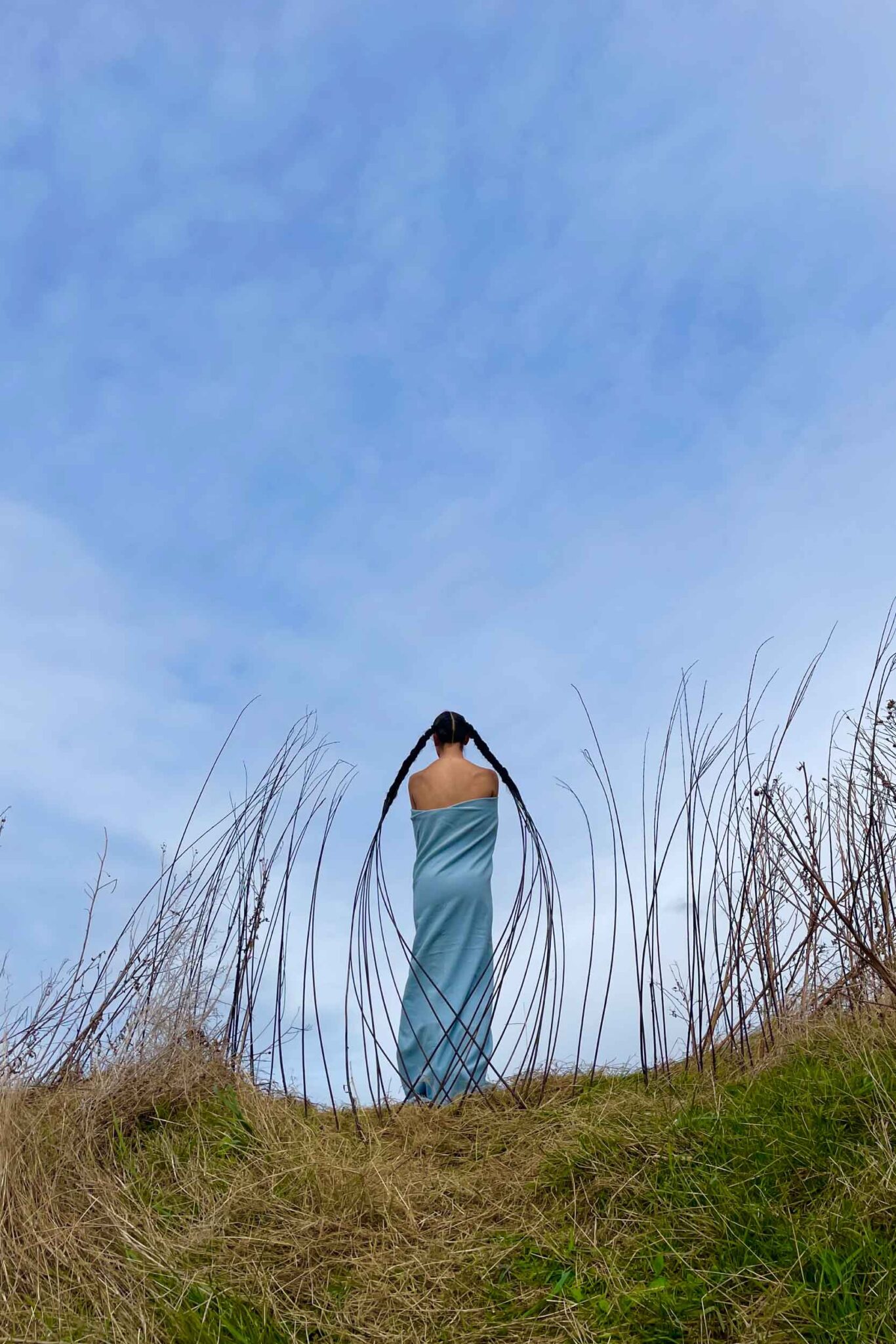
Similarly, Jeanne K. Simmons, a contemporary artist, sculptor, and photographer, whose work begins from a lifelong connection to the natural world. She spent her childhood foraging for acorns, seashells, stones, and sea glass, making necklaces out of daisies, and admiring the blossoms on apple trees outside her window, in her home in coastal New Hampshire. These experiences, filled with curiosity and wonder, gave her a deep reverence for nature that continues to guide her work.
We are all, whether we admit it to ourselves or not, in a committed relationship with the natural world. We are part of its fabric. There can be no ‘us’ without ‘it’. My work is an expression of this interconnectedness.
Jeanne K. Simmons
Simmons creates sculptures and photographs using materials she discovers while walking the landscapes near her home – branches, twigs, leaves, and grasses – transforming them into art that celebrates the sacred bond between women and Earth. Her work reflects the impermanence of life, the cycles of growth and decay, and the human responsibility to care for the natural world. She has said, “I view the women depicted in my work as goddesses. I hope the world views them this way as well,” highlighting how her practice counters the violence of patriarchy while elevating both women and nature.
Her artistic process is grounded in exploration, vulnerability, and attentiveness: daily walks, encounters with storm-washed kelp, or discoveries of hidden beaches spark ideas for photographic projects and sculptures. Through these acts, Simmons channels personal reflection and environmental concern into art, inviting viewers to reconnect with their own relationship to the Earth. In her work, human life and the natural world are inseparable: the body rests, the land responds, and together they embody cycles of transformation, renewal, and reverence. Simmons’ art is both a personal antidote and a call to collective action, reminding us that healing ourselves and the planet are inseparable acts.
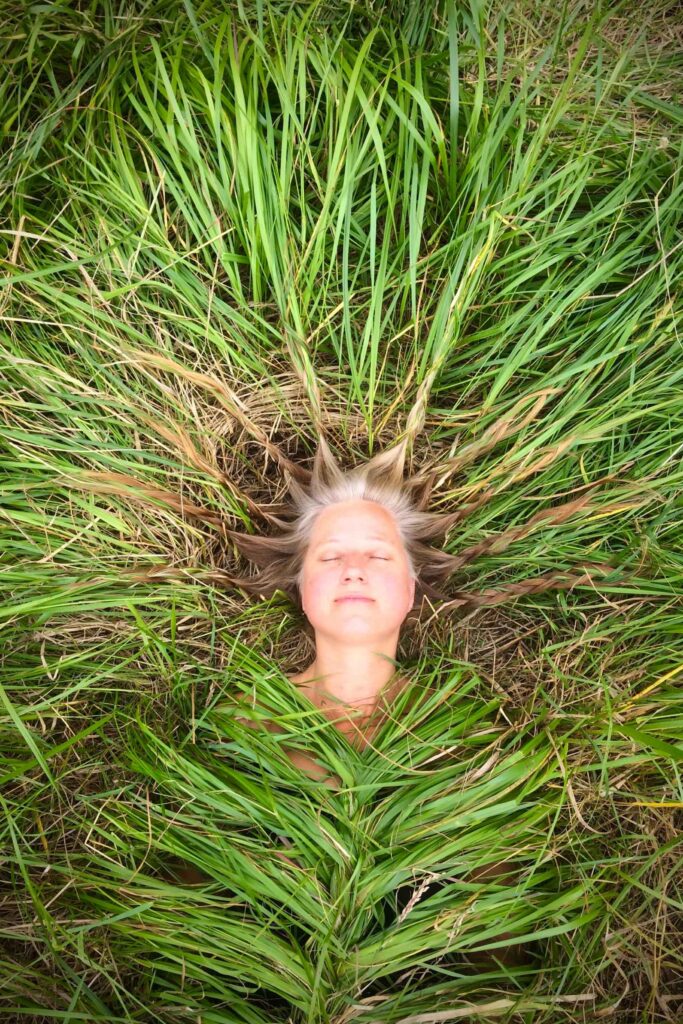

Finally, there is Nora Lowinsky, an artist whose photographs reflect on memory, ancestry, and connection to the land. Drawing from her own experiences growing up in a Jewish family with roots in Eastern Europe, her art reflects an ongoing search for identity, lineage, and the ways in which history and environment shape the body. Lowinsky’s work is infused in human experience, especially the narratives embedded in the body, land, and family. Her photographs are intimate and personal, they explore the body as a vessel of memory, both collective and individual. Through her lens, the body is a site of continuity, a source for stories that cross generations, linking the past with the present.
As Lowinsky returns to her own heritage, she speaks of a spiritual and cultural reclamation, especially for women who have been silenced and erased from history. Her work asks us to consider what gets passed down not just in words, but through touch, through earth, through the body. She captures women in nature as a dream, an old memory, blowing in the wind, lost in the mist, sitting in the forest.
I am free to live joyfully
I am my ancestors’ deepest wish
I welcome new beginnings, cycles of life and spirit
I bow out from relationships, dynamics and situations not honoring me
I come from a tribe, but I walk my path alone
I take what I need from my ancestry, leaving what is not for me
I know my own medicine better than anyone
I honor those who came before me by being true to myself
I see my innocence, which helps me to see yours
I can still step away
I am healing and having fun
I value my sacred space
I live in abundance
Nora Lowinsky
This idea of healing is central to her practice. By returning to the body and its connection to the Earth, Lowinsky invites us to question how we can reclaim the stories of our ancestors and honour the deep ties we have with the land. Her work reflects her personal journey toward reclaiming her own history, and in doing so, reminding us that we are our own medicine, the keepers of memory, caretakers of the land, and the body is our most sacred vessel.
These artists weave the stories of humanity and nature, rewriting the misguided belief that we are separate. Their work offers not only a vision of reconnection but also a call to action: to honour the cycles within us, within our communities, and within the Earth. As Vandana Shiva and Carolyn Merchant suggest, humanity’s survival depends on recognising our interconnection with the natural world, and through the eyes of Mendieta, Tschäpe, Simmons, and Lowinsky, this understanding becomes real. By witnessing their work, we are invited to reclaim our own histories, feel the rhythms of life and landscape, and reimagine a world where care, reciprocity, and feminine wisdom guide the way forward. These artists’ visions teach us that healing ourselves, reconnecting with nature, and embracing our embodied knowledge are inseparable acts. Through this rebirth, we begin to repair both our inner and outer worlds, not only as individuals but as a collective, recognising the vital role women have always played in nurturing and sustaining the Earth.
Words by Virginia Melodia
Virginia Melodia is a creative storyteller. She tells stories through writing, poetry, photography and video. Her mission is to connect people with nature and our shared humanity. She wants to inspire others to consciously live and remain in the presence. She shares narratives that evoke a deep sense of connection and reverence for our planet and ourselves.
As a creative, Melodia loves shaping experiences that feel alive and draw people in. Growing up between languages and living in different countries opened her eyes to many ways of seeing, and taught her to value the beauty in every culture and viewpoint.
She’s passionate in blending visuals and language into stories that speak to the soul. She looks for inspiration in the world as it unfolds around her—the honesty of nature, the intensity of human feeling, and the many layers of everyday life. She believes storytelling can help us understand one another, look inward with courage, and ignite positive change in the world.