

What if the discolouration of nature is a reflection of the discolouration of human culture? What if the natural world is mimicking the greying of cities as rivers are being poisoned and skies are covered in smog? Perhaps this is the sign that the story of humans and nature is coloured with the same hues, mirroring each other. Then aesthetics is not just sensorial but spiritual, an instrument that can penetrate the world in multitudes.
The sun is an ember, turning red, its hue spreading like a slow wildfire on the spectrum of the sky. The concrete of the city is mostly grey, but the clouds don’t conform to this homogeneity. A shade of indescribable orange reflects on the glass of the skyscraper. It continues its poetry; from orange, it’s turning pink, then a few streaks of purple, swallowing the city sky in colours.
The world in colours is unique to each eye. As unique as the patterns of the fingerprints, tree rings, and falling snowflakes. The white light conceals within it every shade that the eyes interpret here on Earth. The etymological root of “colour” is from Old Latin “colos”, originally “a covering” (akin to “celare”, “to hide, conceal”). Two eyes never see the world in the same hues; even between the left and right eyes, the photoreceptors read the light in variation. Perhaps this is the true concealment, nature’s enigmatic creativity, speaking a secret language to each eye that witnesses it.
However, humans have created their own language of colours, giving meaning, social hierarchy, and order to the tangible wavelength of light. Historically, the colours in our world were limited by our local geographies. The colours our ancestors saw in their lifetime were a matter of where they came from. Within Europe, certain colours were only accessible to and allowed to be worn by nobles and kings and were extracted from trade and colonies overseas. Until the mid-nineteenth century, when synthetic colours became commercialised and available to the masses, the cultural perception of colours transformed.
Colourism and racism subordinated the colonies overseas, diminishing their vibrancy as distasteful and loud. While also stripping their own masses of dignity for expressing their inclination towards wearing colours. In these changing social dynamics orchestrated by captivating colours, mute and quiet colours reigned as ‘superior’. Even till today, cities carved out of natural spaces are often muted in tones and homogenised. History, society, and norms have coloured the way we understand colours. Quiet colours, uniformity, and minimalism are not just aesthetics but a powerful tool to mute the diversity of cultures.
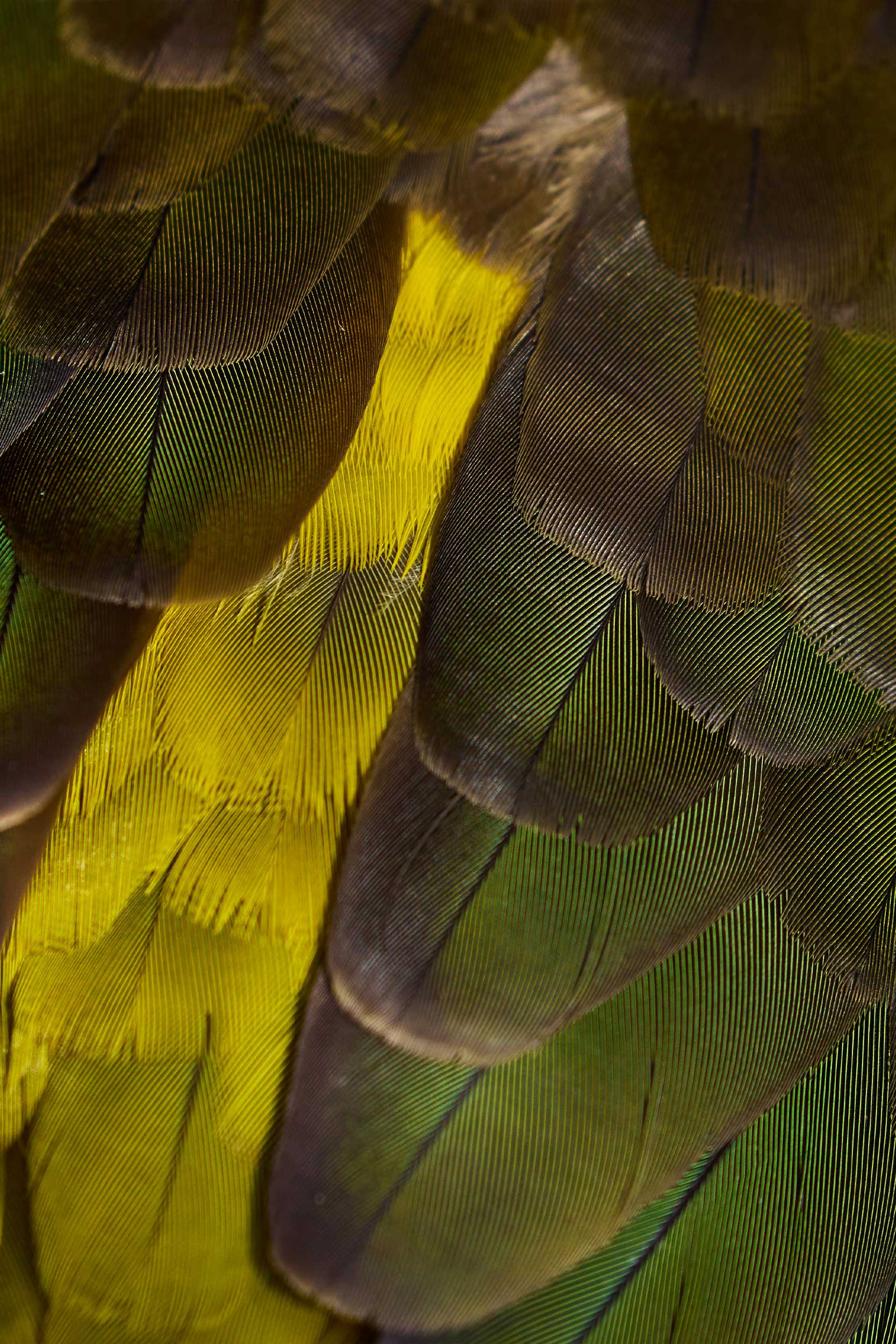
Elsewhere in the natural world, organisms are following the cues of a muted world. Vibrant butterflies are losing colours as rainforests are turned into monoculture plantations to fit their environment – duller, brown, or grey-winged species are becoming dominant. Plumage of songbirds is changing colour to avoid heat stress, disturbing their mating patterns. Corals are bleaching, interrupting the lifelong partnerships between organisms.
What if the discolouration of nature is a reflection of the discolouration of human culture? What if the natural world is mimicking the greying of cities as rivers are being poisoned and skies are covered in smog? Perhaps this is the sign that the story of humans and nature is coloured with the same hues, mirroring each other. Then aesthetics is not just sensorial but spiritual, an instrument that can penetrate the world in multitudes.
The etymology of ‘aesthetics’ traces back to ‘aisthesis’ (to sense and perceive); its root is in the word ‘aisthomai’ (to breathe in). We don’t merely see colours; we breathe them. In the words of artist and author Heidi Gustafson, “Colour is social, behavioural, messy, tangible stuff,” and “pigments are our co-evolutionary partners and affect our everyday lives.” As beings of the biosphere, we interpret colours as a biological function: tracing the ripening of the apple from green to red, harvesting as leaves turn brown, and seeking shelter when white snow blankets the landscape.
To embrace colours is natural; while the forceful social norms press the identity to conform to muted shades of superiority, the human experience in itself is not monotonous or monochromatic. We need colours as a language, as a tool, and as an expression of solidarity speaking for the natural world. We need cities and cultures that are vibrant and welcoming to the diversity of colours in the human and more-than-human world, and in doing so, we might just become the force that will return the hues in the wings of butterflies, the plumage of birds, and the depth of the sea, where algae return to coral, bearing the gifts of colours.


