

Around 2500 years ago, from the lovemaking and separation of two birds, one of the greatest ancient epics was born. This epic will become an instruction of moral virtues, a map into the rich inner spiritual realms, and a sacred text; it will be recited for millennia to come. Till today, the Ramayana remains at the centre of Hindu religious life, yet it’s often missed; it is an ecological story, an instruction for living in harmony with nature.
As Sage Valmiki contemplates the riverbanks of Tamas, he watches two cranes mating. Then suddenly, a hunter strikes the male; he bleeds, giving in to death, and the female squeals in agony. Valmiki is moved by this incident; he curses the hunter with a metrical verse and receives a revelation to write the Ramayana in the same metre. This story of birds is perhaps the root of ‘Viraha’, the central motif of the sacred ache of separation from a loved one and the Divine, that repeats in the Ramayana. Every time an animal is killed, separation follows, and so does the longing.
Despite its profound significance, Ramayana is still a recent addition to the world of stories, for there are myths whose origins might go back in time to over 15,000 years. These myths outlived the language in which they were first narrated; such is their hold on the psyche.
The cosmic hunt might have originated when humans were first developing primitive stone tools, and as they dispersed across Africa, Asia, and the Americas, they carried this story with them. Among the Haudenosaunee nations, the following version is told: Four brothers chase a bear into the silent forest, where rabbits and deer have disappeared, and the wind has changed. One of the hunters is growing tired, but they finally catch the bear and cook the meat. Once they eat, they look down and see thousands of small sparkling lights. The bear was magical; he had run into the sky, and the hunters had followed him there. Then, from the bones of the feast, the bear comes back to life, and the hunters begin the chase anew. Each autumn, as the hunters follow the bear across the sky and feast on it, blood falls down and colours the landscape in fiery orange. The great bear is the square shape some call the bowl of the Big Dipper. The hunters and their small dog are close behind the dipper’s handle. It’s a story of changing seasons.
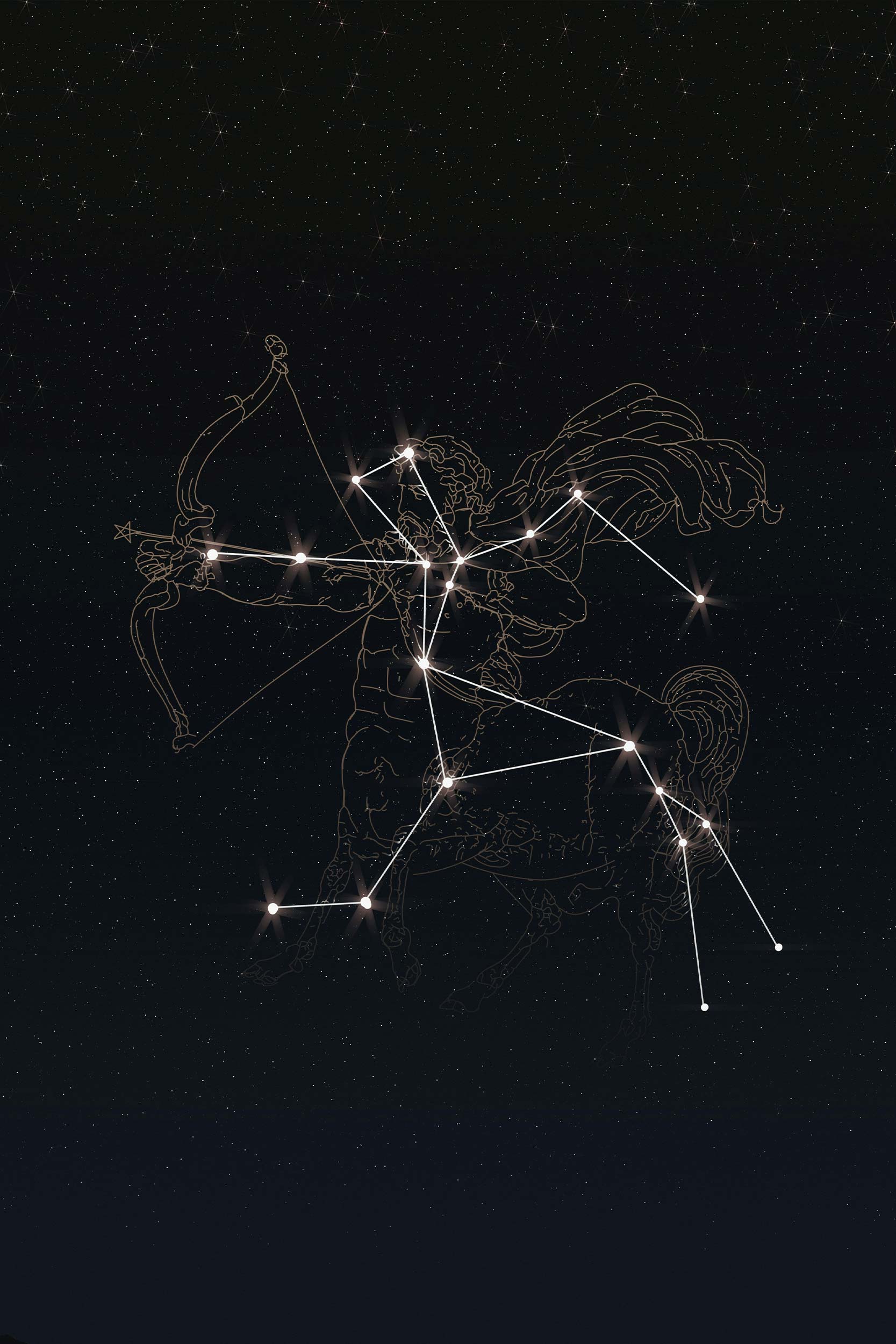
In Greek mythology, this myth is told as a tale of deception and divine intervention. Artemis, the goddess of the hunt and chastity, binds Callisto and other handmaidens with a vow of chastity. Zeus, in disguise, violates Callisto; she breaks the vow and gives birth to her son Arcas. In jealousy, Hera, Zeus’ wife, transforms Callisto into a bear, and she escapes into the forest. Time passes by, Arcas grows up, and becomes a hunter. One day in the forest, he comes across a bear. Not recognising Callisto, he aims the spear. Seeing this, Zeus intervenes. To save them from Hera, he turns both of them into constellations, Ursa Major and Minor, so they can finally be together. In one version, Arcas kills Callisto; in another, he is associated with Bear Watcher and not Ursa Minor. What if the story of Callisto and Arcas is also a story of humans forgetting their mother nature? What if we also need a supernatural intervention? Perhaps this is why our ancestors looked at the stars; the immortal lights could offer guidance and meaning. In each telling of the cosmic myth in different regions, the animal and the constellation might change, but the story carries the same motif of an animal transforming into a constellation.
In the 1800s, German scholar Friedrich Max Müller proposed that myths interpreted the workings of “the sun, the sky, and the dawn”. Through metaphors, humans calibrated nature; words gave meaning to the workings of the world. Yet through time, the true meaning of metaphors erodes. He calls this “disease of language”, where every time a metaphor loses its context and meaning, it’s no longer “rationally intelligible”, and the secrets of the natural world appear plainly as “irrational” activities of heroes, fairies and gods within the myth. Could it be possible that, as we lost the meaning of myths, our connection with nature weakened? Is the meaning of myths and nature no longer understandable to the conscious mind, so we rely on science and not on stories? What if we have the meaning and makings of our spiritual world kept under a veil, waiting to be seen and awakened?
Elsewhere, a tree of myth is growing, and Historian and mythologist Julien d’Huy is tracing the branches of ancestral stories and their lineage through phylogenetic analysis, a method used by biologists to study the evolution of species. He traces variations, core themes, and influences in myths through “mythemes” functioning as the basic narrative “DNA” of stories and maps prehistoric myths in the ancient tree of stories. And he suggests that, as early humans migrated, they carried their myths with them across the living landscape. Like biological species, stories also changed, inheriting fauna and flora from the local natural world into their storyline. As humans migrated further and further, their stories diverged, creating new branches. Through his research, d’Huy aims to “glimpse” the mental universe of our prehistoric ancestors.
But how to glimpse beyond the human mind? Perhaps we need myths to live on the land, to understand our own psychic realm as part of the Earth and its magic, and to connect with the world that whispers to us through stories of changing seasons and cycles. We need myths to echo through the future and the past, where the human and more-than-human remain in relationality. For we are living the myth, and it will surely outlive us, yet will we remember our own story, not solely as humans but as nature, telling the tales of itself?
Words by Priyanka Singh Parihar