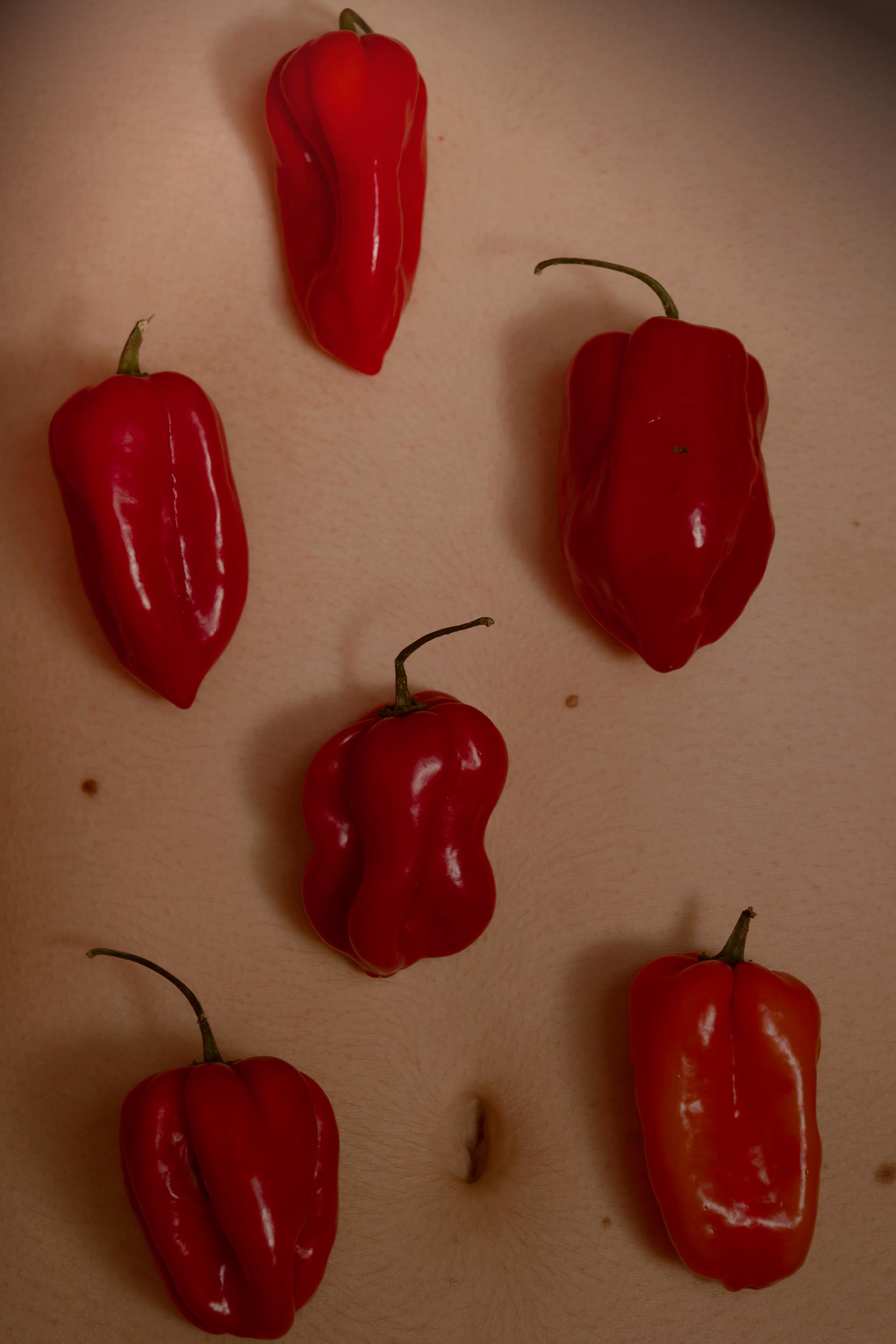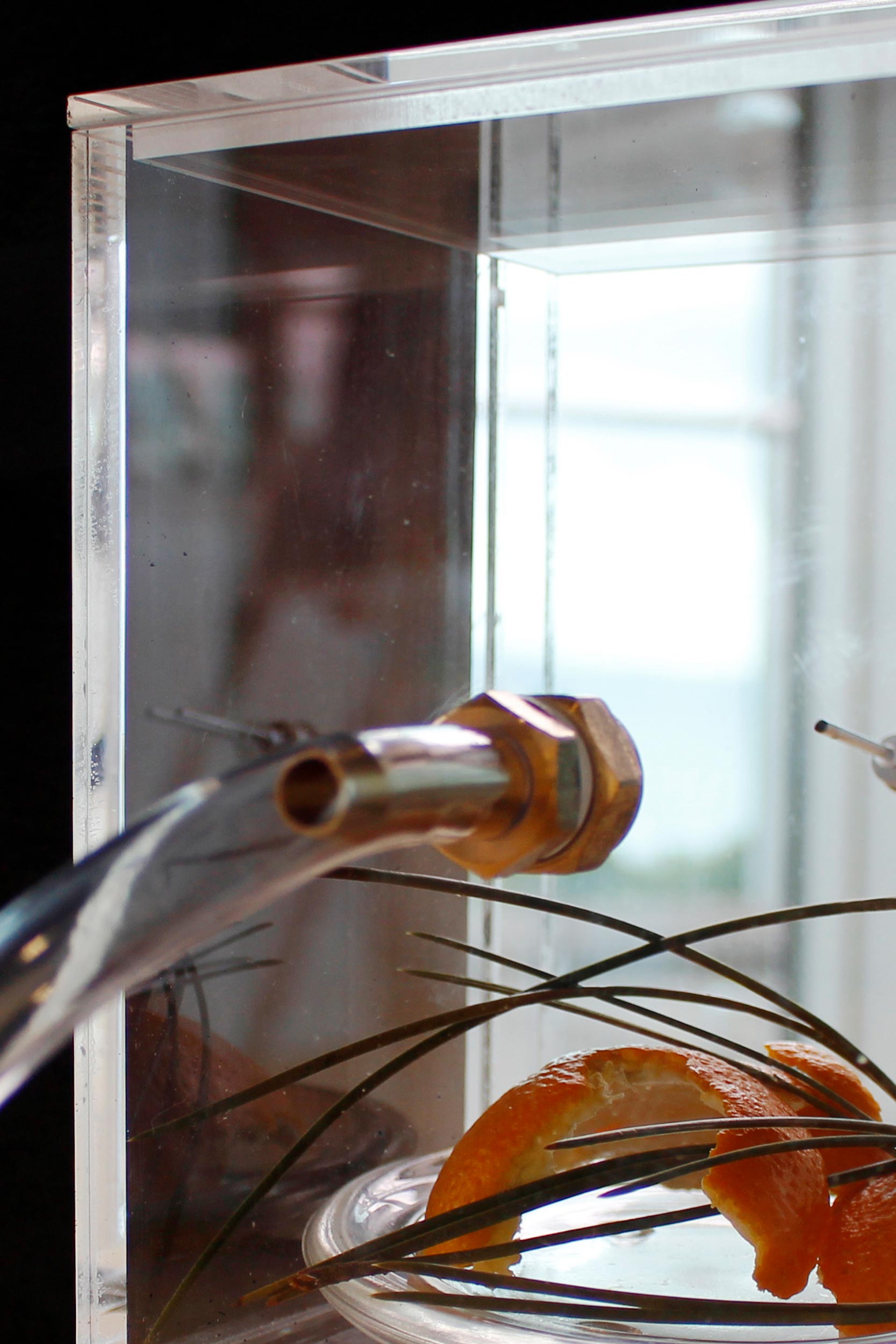

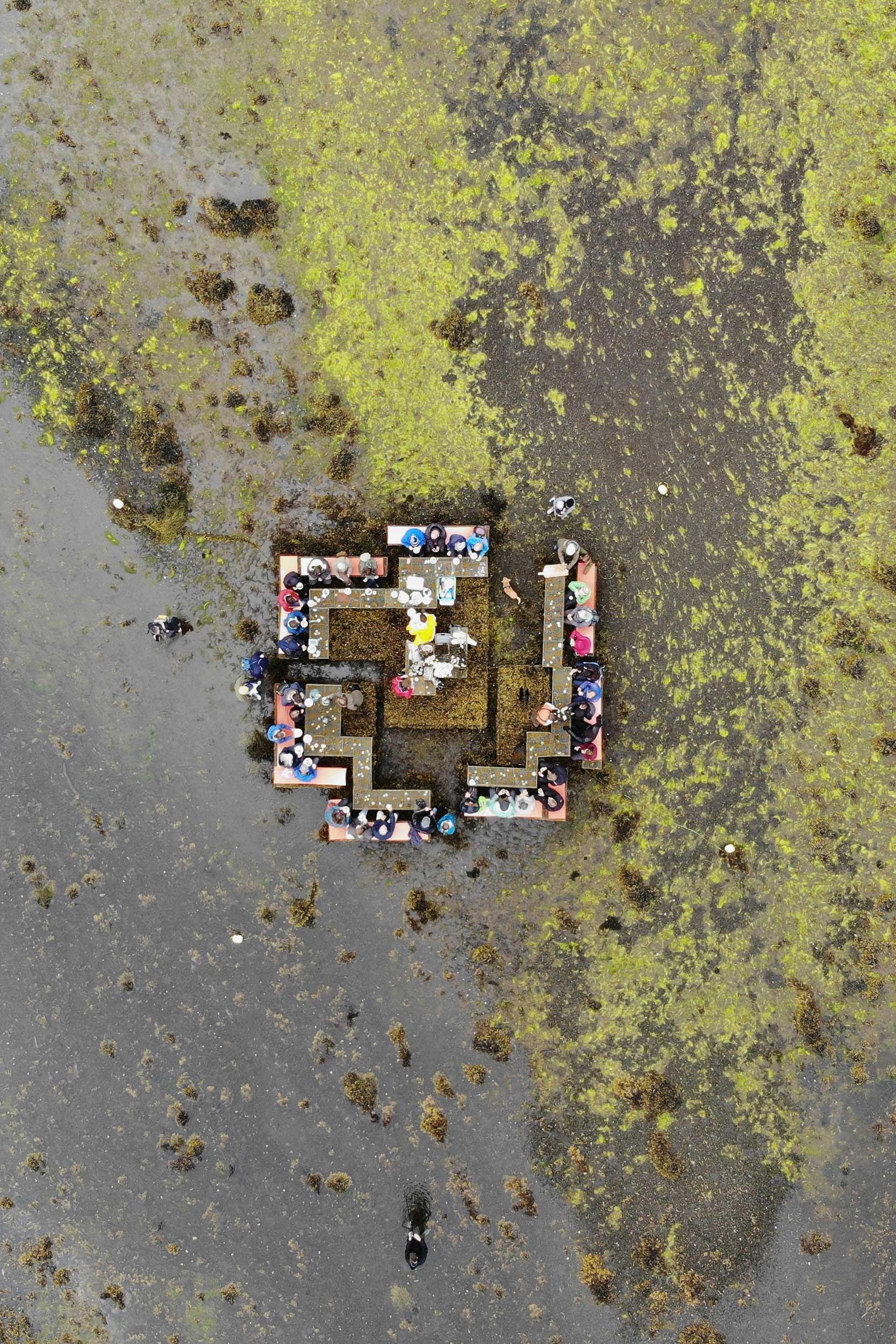
We started the practice back in 2013, looking at the different frictions between food systems and the construction of landscapes, the built environment. We’ve been using different ingredients or foodstuffs to trace these different dependencies or relations to land, to corporate structures, extractivism, etc.
Daniel Fernández Pascual
Cooking Sections
The forces that shape our food often move in silence. Land changes hands. Seeds become property. Cooking Sections, led by Daniel Fernández Pascual and Alon Schwabe, asks, How might we achieve resonance when we ask about kinship instead of yield? How can listening be an active space for solidarity and organising?
Since 2013, this artist‑led duo has worked where food meets the built landscape. Their practice carries the weight of land erased, of legislation that obfuscates, and of zones drawn to keep some out and others in.
Cooking Sections empowers these alternative narratives in which a seed becomes a relative and bitterness becomes a form of restoration. Where others seek efficiency, Daniel and Alon seek to understand gastronomy as a relation, not as luxury. In each place, they ask how a museum might become a living vessel rather than a frozen archive. The cycle is not broken but expanded.
Through assemblies, audio installations, and open portals, Cooking Sections invites us to taste the systems behind our food. As the climate shifts and laws tighten, how do we understand our capacities for consent?
Planted Journal’s conversation with Daniel Fernández Pascual and Alon Schwabe is a meditation on what we grow, what we bury, and what we choose to pass on.
Madeleine Freundlich: Tell me a bit about the impetus for Cooking Sections. How would you describe your early relationships with food and landscape having influenced the creation of this project?
Daniel Fernández Pascual: We started the practice back in 2013, looking at the different frictions between food systems and the construction of landscapes, the built environment. We’ve been using different ingredients or foodstuffs to trace these different dependencies or relations to land, to corporate structures, extractivism, etc. The work takes place sometimes within museum environments, but also uses cultural platforms to organise different actions outside those environments.
Madeleine: Were there any personal or professional past lives that came into the formation of this project or even your collaboration together?
Alon Schwabe: I think [yes] in many ways. We have a background in both architecture and performance and visual arts. I think this has been Cooking Sections – it formed around this idea of how food allows us to understand these worlds in transformation. In many ways, our practice doesn’t stem from the fact that we have an interest in food per se, but rather that food infrastructure is a vehicle, or can become a vehicle, to understand all of these changes.
Madeleine: I was interested to see the diversity of locations that you have chosen, whether it is a museum or local community action. Tell me why site‑responsive interventions work for you? How does going into a community that is not necessarily your own align with your method of collaboration and understanding?
Daniel: The projects we do within Cooking Sections or Climate – they start by invitation from a cultural institution that wants to produce new work together. From there, depending on the topic or the project or the response, it is a process that often starts with an exhibition. But exhibitions have limited duration. Then we try to figure out ways in which those conversations and collaborations can continue over time, in terms of human resources, financial resources, but also political contexts sometimes. That in a way evolves, sometimes organically, with our team but also the teams of other partner institutions and organisations.
Alon: Yeah. I think there is a big part of this work and of the commitment to such processes that stems from the fact that today – or throughout the past decade with our practice – we try to understand how we practice or how we bring these ecological processes into cultural spaces and cultural institutions. That required a set of strategies and ways to operate that do not limit themselves to the duration of an exhibition or an event. So that is very much how all of this evolved – how the practice has grown and evolved over the past years.
Madeleine: Tell me a little bit more about that process. What does that look like?
Alon: With many of our projects, it begins with an invitation from a cultural institution. Then we initiate a research process that includes speaking to many different practitioners – which can range from environmental activists, farmers, bakers, policymakers, lawyers – all dedicated to questions around land and land use in a particular area. From there, by understanding the different challenges various communities and groups are facing, we formulate a response. That response many times then uses the cultural institution that invited us as a platform for action.
I think this has been Cooking Sections – it formed around this idea of how food allows us to understand these worlds in transformation.
Alon Schwabe
Cooking Sections
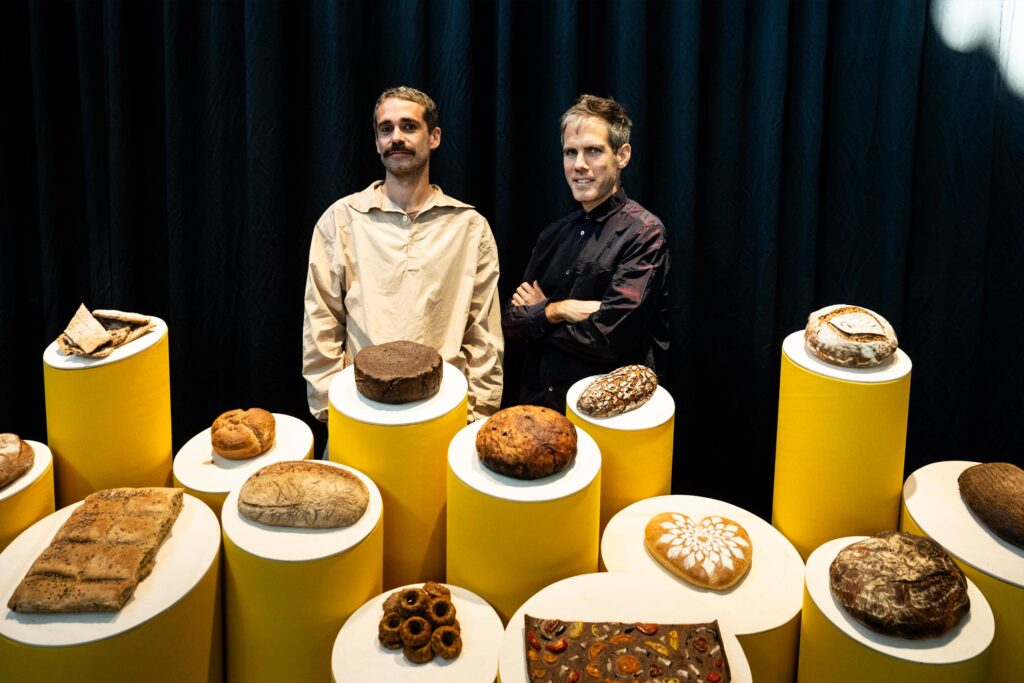
For many cultures around the world, seeds are almost like human relatives. There’s a whole other system of kin around seeds. In the case of the project in Italy, it was a tool to think of seeds as cultural objects – even if they’re not just objects – but that allowed us to use this grey zone to propagate them.
Daniel Fernández Pascual
Cooking Sections
Madeleine: How do collaborative relationships arise, especially because you have worked so internationally and across land but especially across language barriers or practices as cultural heritage?
Daniel: In the case of the project we’ve been running in Italy, for instance, with peasant seeds – there’s a whole team led by Danny Burrows, Enrico Milazzo, and Gabriela Patera. Each one brings different skills and backgrounds. Enrico and Gabriela live there on site. They have regular conversations with the farmers. Enrico himself is also an anthropologist, so he brings those skills in terms of holding conversations over time. Gabriela has a background in law, so for the whole question around the rights of seeds – the declaration we are working on to launch in the spring, Declaration on the Rights of Peasant Seeds – that has also been very helpful. So depending on the project and the collaborators we bring together, it makes it flow in an easy way.
Madeleine: I was excited to see your project in Sicily and Puglia, because it is the same thing with an added dose of intense industrialisation in the region. Talk to me a little bit more about that project, and especially the idea of seeds as not only a potent form of information, but as a potent form of communication.
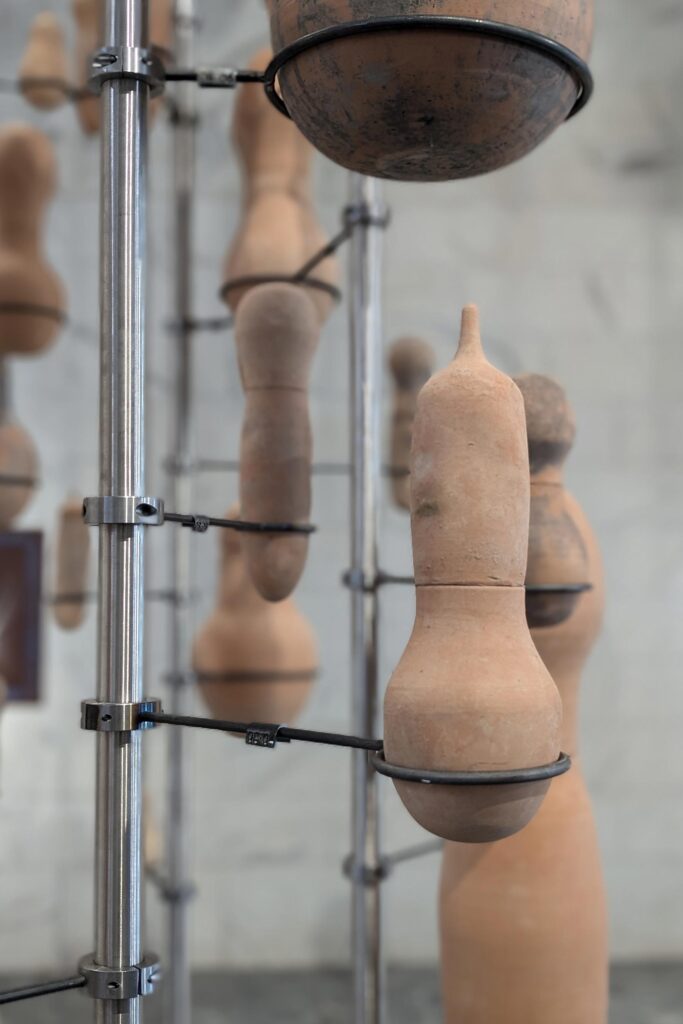
Daniel: The project in Italy started some years ago, in 2018 actually, in Palermo, Sicily, by invitation from Manifesta as a cultural event happening in the city. We collaborated with different agronomists from the University of Palermo to construct installations across the city to figure out ways of watering without water. This was inspired by the Giardini Panteschi, which is a typology from the island of Pantelleria off the coast of Sicily, between Sicily and Tunisia. Learning from those systems to replicate some of those conditions that create microclimates around trees to survive extreme weather or drought contexts within moisture‑retention environments. From there, the project grew into a collaboration with now more than 40 farms, social cooperatives and agroecological farms in Sicily and Puglia. We’ve been working with this network to first identify 125 varieties of drought‑resistant vegetables – peasant varieties – and record unregistered peasant varieties of pumpkins, aubergines, cucumbers, tomatoes, and lentils. First, we identified them, and then we created a network of what we called ‘drought nurseries’ to find those seeds for the farms. We also created an agreement between the Museo delle Civiltà – the Museum of Civilisations in Rome – and this network of farms to propagate the seeds for cultural purposes that would otherwise not be possible. Through that agreement, we use the tools that the museum has to create provenance for artefacts but use that provenance for these unregistered peasant seeds. Thanks to that, the seeds can come into the museum, acquire an origin, and then go back to farms again to be propagated. To materialise that, we also made an installation that was acquired by the museum: a repository of the seeds, almost like a living collection, consisting of clay vessels where the seeds are temporarily stored. It’s not a seed bank that freezes them in time. It’s a vessel where seeds come in, get an origin, and go out.
Madeleine: Can you tell me about the impact for your stakeholders that arrive from such disparate disciplines? Provenance for seeds is a really helpful framework for thinking about cultural heritage in a way that scientific or agronomic methods and languages might not completely understand.
Alon: Yes. One of the ways the project in Italy started was through this Climate Water Assembly, where we brought farmers, practitioners, artists, museum curators, directors, policymakers together to the Museo delle Civiltà in Rome and also to Campidoglio, the city Senate. We really asked the farmers: what could cultural institutions do to support your work, your advocacy, the challenges you’re facing? It was very much from that convening, from opening up the space for farmers, that this dialogue began. This process of translation – this idea of provenance – really came from the dialogue with the farmers who are experiencing the challenges around seed registration, seed propagation, circulation of seeds that have been grown by generations of farmers but are becoming outlawed. The practice of cultivating them and commercialising them becomes outlawed. Then a parallel emerges between these two practices. On the one hand, we have farmers dedicated to the propagation of drought‑resistant heritage seeds. On the other hand, we have a practice within museums and the cultural sector dedicated to safeguarding and preserving cultural artefacts for future generations. These things have many connections between them. That’s where we try to put the practices together, create a bridge between these two worlds that on the surface perhaps seem very disconnected. Bringing the seeds into the museum and thinking about seeds as cultural objects becomes a really interesting space for us.
Daniel: For many cultures around the world, seeds are almost like human relatives. There’s a whole other system of kin around seeds. In the case of the project in Italy, it was a tool to think of seeds as cultural objects – even if they’re not just objects – but that allowed us to use this grey zone to propagate them.
Madeleine: Sicily is very unique in its history, but it also shares histories of immigration, migration, empire, and industrial shifts that so many other places in the world – particularly distinct agricultural zones – share. What did you find were areas of resonance and dissonance within these projects or the experiences of the farmers you were working with?
Daniel: Something that has been quite interesting across the south of Italy – we are no experts by any means – is the role of land confiscated from the Mafia, which happens in Puglia, Sicily, Campania, and many other regions. That has triggered a lot of other forms of social organisation. In the 1950s, 60s, and especially the 70s, you had movements of land occupation of huge areas of agricultural land that were abandoned. But this new wave of land confiscated from the Mafia has also allowed some of these collectives and cooperatives to come together and rethink questions of land, also from an educational point of view. Not only producing food, but many see themselves as custodians of agrobiodiversity and the relations between seeds and people. That has been a really exciting learning curve for us – to see a network of all these initiatives that sometimes didn’t even know of each other but, through the project, have connected beyond Sicily or beyond Puglia to other places, even Lampedusa. Perhaps it’s particular to the south. The dependence on water and water scarcity – but at the same time, the fact that some of the terrain was not necessarily prone to industrialisation or machinery because it was rocky or hilly or too dry – allowed people to preserve varieties that were not fit for industrial purposes and yet were highly nutritious or very resistant to drought. They were growing in very difficult terrain or were very thorny or very bitter. We like to see those qualities – the bitterness and the thorniness – as something that allowed these varieties to exist in the margins of industrialisation.
Bringing the seeds into the museum and thinking about seeds as cultural objects becomes a really interesting space for us.
Alon Schwabe
Cooking Sections
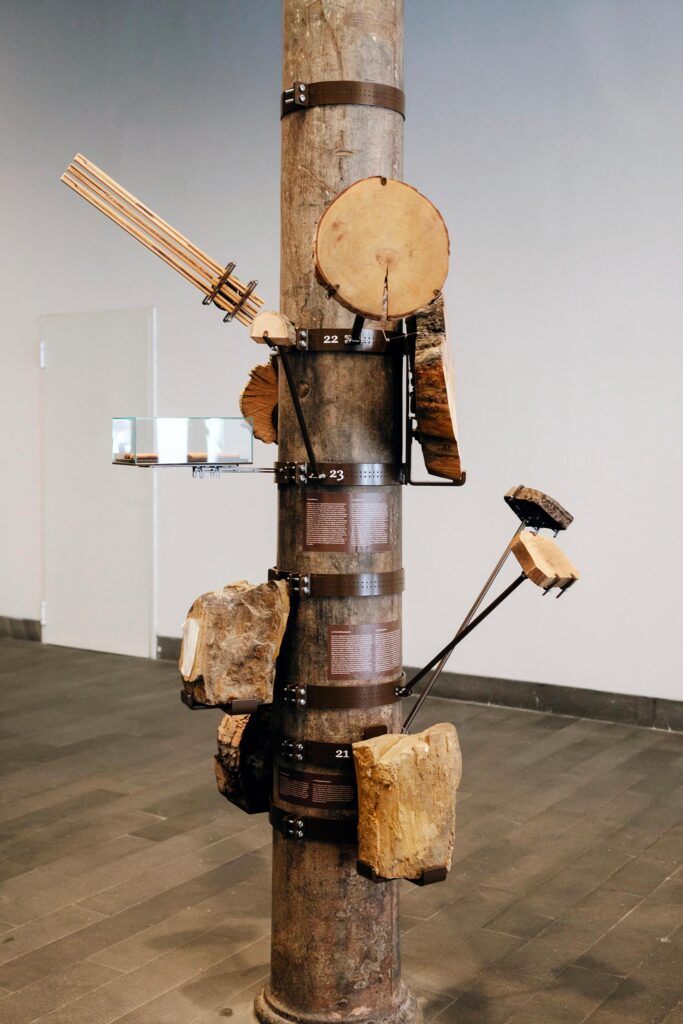
I think the metabolic approach – the inherent metabolic process in food – creates a certain reality. It allows us to understand life as a process where every living being on the planet is involved in processes of ingestion and digestion. In that way, these metabolic processes transgress and intersect every structure that has been imposed on us, or that we find ourselves living through – any kind of political situation or order, political system, class‑based system, or even divisions between what we see as human and non‑human, natural and artificial.
Alon Schwabe
Cooking Sections
Madeleine: How do you view your role as artists with these projects with a huge, necessary amount of collaborators? How do you see art in community as another means of communication, outside of simply communicating politically or communicating through science and data? Where do you feel yourself filling in?
Daniel: Because of our role, we could also access collaborations with a museum like the Museo delle Civiltà. That’s why we enjoyed hosting the Climate Water Assembly at the museum. That also allowed us to access the Senate in the city of Rome, Campidoglio, to host part of the assembly there – in the city Senate – to have some of these farmers and cooperatives speaking. It was quite unique for them and for everyone. At the same time, we used the opportunity to set up this research initiative at the Royal College of Art in London, Climate & RCA, which gives a different sphere to think of it as a research project within an academic environment. So it operates within action on the ground, the academic component, and the artwork that allows for some of these relations to exist.
Madeleine: Do you feel like food allows you to push those social boundaries of culture, class, and material economy? How do you place people such as farmers in occasions and spaces that they wouldn’t usually have access to?
Alon I think the metabolic approach – the inherent metabolic process in food – creates a certain reality. It allows us to understand life as a process where every living being on the planet is involved in processes of ingestion and digestion. In that way, these metabolic processes transgress and intersect every structure that has been imposed on us, or that we find ourselves living through – any kind of political situation or order, political system, class‑based system, or even divisions between what we see as human and non‑human, natural and artificial. When you receive it through a metabolic perspective or process, you find yourself entwined and transgressing all of these boundaries constantly. That doesn’t mean these boundaries don’t exist – they still absolutely exist. But for our practice, food has become such an important tool because it allows us to cut through some of these boundaries, or break through them, or create new connections and bridges for things that seemingly are not connected, or where there is a perception of tremendous distance between them.
Madeleine: What is something currently unseen, or not spoken about enough in our global food system that you attempt to make visible through your work?
Daniel: Perhaps another recent project to mention is what we just opened in Denmark last week, which has to do with the impact of the pig mega‑farm industry in Denmark but also in Europe. Italy is huge, Spain is huge, many other countries are, the U.S. Sometimes it is also to make visible the planning processes that allow people to express their opinion. In that particular case, it has to do with the right to access information. Many residents in Denmark – and I suppose it happens in other countries in the EU – want to oppose the opening of these megafarms in front of their homes. But many times, the municipalities or councils make those decisions very obscure so that people don’t complain or object, even if according to the Aarhus Convention, every European resident has the right to express an objection for these farms not to open or expand. So what we did was work with data scientists to make those planning processes more transparent, basically to map whenever they are open for people to express their opinion and aggregate that on a website and a portal for people to access and be informed. Then they can decide what they want to say about it – to make that access to information more legible and easy.
Madeleine: And how did you translate that into an exhibit? An installation?
Daniel: It had two components. One was the experience of entering an audio installation where there were different sculptural objects – a window, a door, a bed, a table, a chair – speaking about how they are made out of renderings of the big industry. They explain how they came to be as objects that are inventions facilitated from technologies of big waste, pork waste. Then a digital portal that different groups and residents can access to be up to date with these periods where they can object to planning applications. So you had these two components: the more physical and sensorial, and then the digital platform.
Madeleine: Right. What was the reception to that?
Alon: It was quite interesting. Last week there was a general election in Denmark. In a country where pigs outnumber people by five to one at any given moment, there are a lot of things. The environmental consequences of industrial pork farming have and continue to have a tremendous impact on the watersheds, on runoff, etc. The conversation around pork has really surfaced in the last few months. Many parties took a very concrete stance either against or for pig farming. Pig farming became a central point of the agenda in this election. The exhibition opened five days before the election. It was quite timely in many ways, even though this topic has been important and many groups and activists have been working on these questions for a very long time. It was very interesting to see how it surfaced around this particular political moment and how the exhibition fed into this debate that has been uncovered with various journalistic stories and exposés, and quite big social debate across various platforms.
Madeleine: Throughout your thirteen years of Cooking Section, you have engaged in projects rooted in quite urgent ideas and arguments and at times quite dismal, as you said. How do you balance the heaviness of these arguments and the urgency in the context that it’s existing with constructing hopeful, fertile, and actionable futures?
Alon: Sometimes we try to bring notes of humour, and that helps a lot. The project in Denmark, which is called “The House that Pigs Built”. It builds on the children’s rhyme, “The House That Jack Built”, where these different animals and entities eat one another, to use as a community tale … I think that that endless chain and using formats that are perhaps less expected to talk about very complicated stuff sometimes helps to bring a different lens into how people navigate a house where every object has a connection to the big industry and they speak in their own voice in a very cheerful manner.
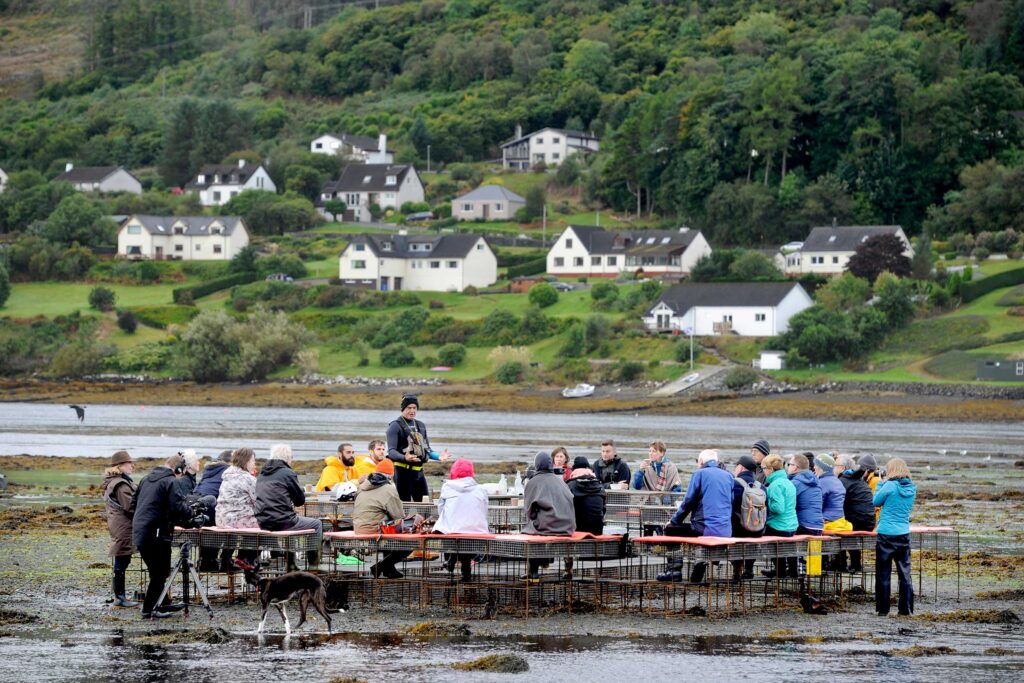
Cover photo by Nick Middleton
Interview by Madeleine Freundlich
Madeleine Freundlich is a researcher, writer, and farmer who seeks to weave the threads that connect land stewardship to cultural futurity. Growing up in the American northeast, Madeleine’s outlook is informed by walks through the undergrowth, blueberry patches, and a deep sense of agricultural community. Having worked as a vegetable farmer, weaver, and cheesemaker, her sense of self is grounded in an understanding that labour has the potential to be a daily artistic expression. In turn, her background in fibre arts forms her perspective on sustainable systems that value cyclical thinking, craftwork, and meaning-making through the landscape.
As a writer, Madeleine is interested in exploring artisanality as an expression of both scientific inquiry and artistic practice. Issues concerning sustainable meat production, fermentation, and workers’ rights are central to the agricultural landscape these days and are hoped to be explored in future essays. Currently a Fulbright Scholar residing in northwest Italy, she is excited to contribute an agroecological lens to Planted.