


Three bombs went off in Nam Bo the night before we arrived. By morning, the village chief had decided it was safe for us, foreigners, to go. Yet, ‘safe’ in this corner of Thailand just means that the violence has moved somewhere else for the moment.
What awaited us in Nam Bo was not a story of ruin, but a family at work by the sea, fermenting budu, a Southern Thai fish sauce, in giant clay vessels under the strong sun. They washed the silver anchovies with seawater drawn from the same shore where the fish had been caught. Crucially, one does not remove the scales nor the innards before fermentation with Pattani’s sweet salt. It is a refusal to alter the ocean’s bounty, leaving the fish entirely whole to honour everything the water provides.
Nine months later, the budu would be ready. When we tasted it, the ocean did not arrive as a metaphor. It arrived as a total, overwhelming abundance: bright, blunt, fiercely alive in the mouth. This is exactly why the flavour of the sea is so concentrated. The entirety of the catch is left to transform in the jar, an offering so uncompromising that a stubborn fish scale remained wedged between my teeth long after the tasting, a lingering remnant of the tide’s heavy yield. The family does not sell it beyond the village. Not because they cannot, but because they know what happens when something so richly rooted in a place is uprooted and displaced. It loses the sheer abundance of its context—the exact sun, the native sea, the specific hands—that made it itself.
That thought lingered with me as we moved through Thailand’s Deep South for a research trip, where the three border provinces of Pattani, Yala and Narathiwat carry the long shadow of insurgency, militarisation and colonial division. The region is often described through what happens to it: bombings, gunfire, checkpoints, surveillance, loss. Less often is it described through what persists in spite of all these.
To understand this persistence, one must look at the roots of the conflict. The current situation is deeply connected to a century-long struggle over identity, as the local population seeks to maintain its unique Pattani-Malay culture amidst broader national development after the modern border between Thailand and Malaysia was permanently fixed with the signing of the Anglo-Siamese Treaty of 1909. These national integration efforts extended to language, religion and education, as administrative policies prioritised a unified and centralised narrative over local historical perspectives. When official channels of expression are restricted, everyday domestic rituals carry a deeper significance. Ingredients become archives, and food emerges as a vital tool of cultural resistance. It is a way to assert identity quietly. In the face of this, the land keeps offering food, and the food keeps carrying memory. It grows in forests, in salt fields, in markets, in jars sealed against time. It survives in the hands of people who strive to live as usual.
When official channels of expression are restricted, everyday domestic rituals carry a deeper significance. Ingredients become archives, and food emerges as a vital tool of cultural resistance. It is a way to assert identity quietly. In the face of this, the land keeps offering food, and the food keeps carrying memory. It grows in forests, in salt fields, in markets, in jars sealed against time. It survives in the hands of people who strive to live as usual.
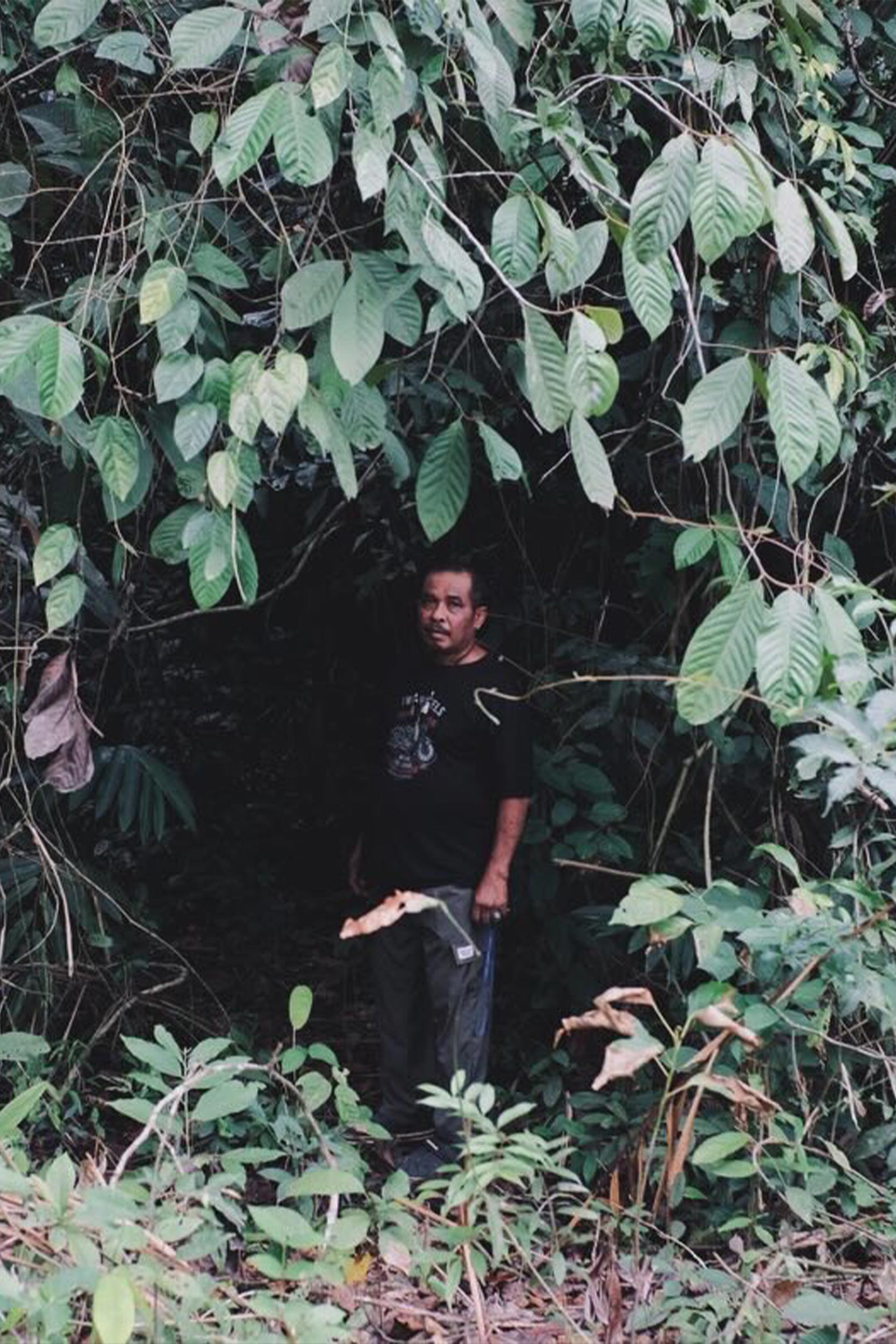
On the first day, we met a herbalist named Chao-On, who had left his former life to live self-sufficiently in the Pattani forest. He handed us bananas fermented in stingless bee honey and pressed kratom leaves into our palms. The leaves felt ordinary at first touch, but their history is anything but. Kratom was criminalised in Thailand in 1943, folded into the machinery of state control that sought to regulate bodies as tightly as borders. Today it is legal again, but its legal return does not erase the long shadow of prohibition. In the villages and forests of the Deep South, kratom has persisted as a local herbal medicine, a painkiller, a stimulant, a plant for working bodies and worn ones alike. It was kept alive by knowledge that never depended on official recognition. That is part of abundance too: not excess, but the endurance of a remedy, the way a community continues to recognise what heals it even when the law has tried to make that knowledge disappear.
In the local provincial market, we discovered Garcinia Cowa. This sour forest leaf stood in for lime in a place where the ordinary routes of supply had been interrupted by war, geography and history. The substitution was practical, but it was also a kind of quiet intelligence. A leaf can become a citrus note. The forest can become a kitchen. And when the market or the road fails, the wild still manages to feed the body.
The leaf matters because colonial power has always deployed hunger as a political tool. In Malaya, the British food denial campaign during the Emergency was designed to sever guerrillas from the land that sustained them. Under campaigns like Operation GINGER, the military tightly controlled rations, sealed rice mills and centralised cooking to starve out resistance. Crops were destroyed, soil was poisoned, movement was restricted, and the countryside was made to serve as a weapon against the people who lived there. The logic was old and merciless: if you can cut off food, you can cut off freedom. Today, this logic echoes in the Deep South. Anthropologist Anusorn Unno observes how the modern Thai security apparatus relies heavily on surveillance and localised checkpoints to monitor resources and control the movement of ‘insiders’. The land is not only where life happens. It is also where power is contested.
if you can cut off food, you can cut off freedom.
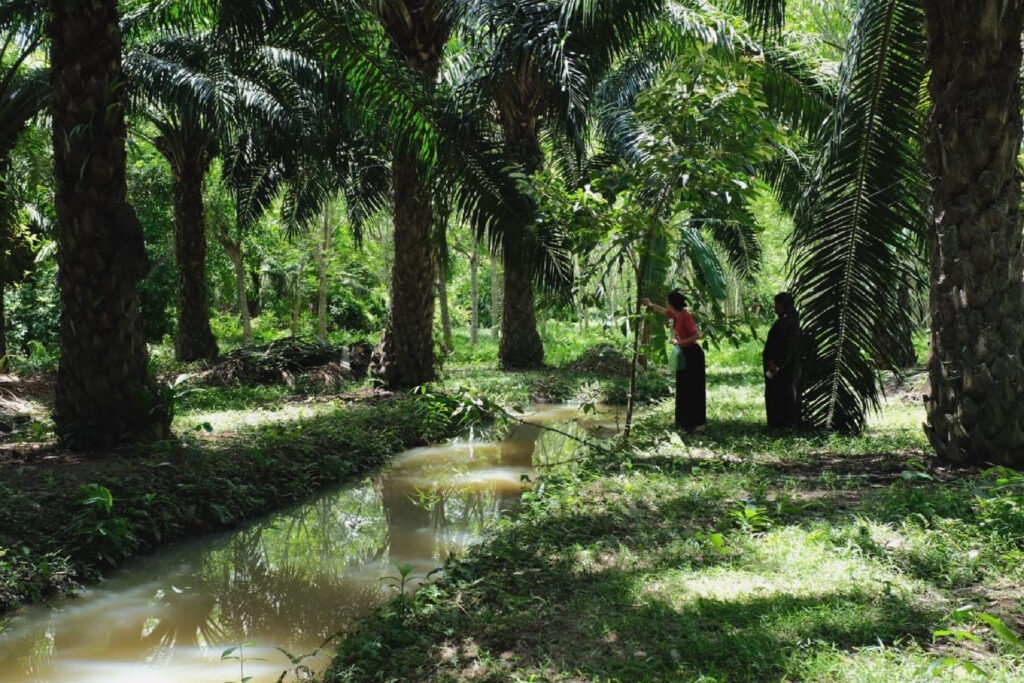
Yet the land did not stay muted. Beneath the machinery of state control in the Thai-Malay borderlands, Indigenous and local knowledge continued to thrive. The Orang Asli knew the forest in ways the state could not legislate away. They became vital guides, leading their comrades to ducks, edible flowers, wild herbs and the sour leaves that kept their daily broth from collapsing into plain water. This exchange gave rise to what outsiders came to call “Sup Communist” (Communist Soup). However, the dish is far more than a historical anecdote; it is a living record of adaptation under pressure, built from what remained when everything else had been taken. Its defining sourness is the taste of survival, and its complex depth is a product of collective knowledge—a rich culinary convergence blending Chinese and Indian recipes with the vital foraging wisdom of the Orang Asli.
Interestingly, the soup’s identity shifts depending on who is speaking of it, known as “Sup Communist” to outsiders and “daliwang soup” (the powerful soup) to the locals of Than To, while remaining entirely nameless to the comrades who actually relied on it.
For the Comrades, the importance of a meal lay entirely in its abundance, nutrition and energy, rather than its presentation or title. The soup was born strictly to serve a physical purpose. In the bitter cold of the mountain forest, after hours of grueling labour, nothing rivaled a bowl of this hot, spicy and high-energy broth. It was a perfect synergy of diverse cultural recipes and Indigenous survival tactics, proving that even in the harshest conditions, a simple, nameless soup could be a profound tool for endurance.
There is a temptation, when writing about food under conflict, to turn everything into allegory. But the violence here is not symbolic. It is literal. Bombs are detonated. Families are displaced. Martial law and emergency measures shape ordinary life. People cross borders for work and come back carrying wages, recipes and fatigue. The politics of the region are written not only in official documents and security reports, but in the smell of fermented fish, in the bitter edge of a leaf, in the patience required to let budu mature over months rather than days.
This is why abundance in the Deep South does not look like plenty. A jar of budu can hold a sea’s worth of labour and time. A bowl of jungle soup can preserve a history of evasion and solidarity. A leaf can stand in for a lime because the forest has been learned, not merely entered. Abundance, in this setting, is not excess but continuity: the ability of a community to keep making something meaningful under conditions designed to break meaning apart.
Abundance, in this setting, is not excess but continuity: the ability of a community to keep making something meaningful under conditions designed to break meaning apart.
The family in Nam Bo seemed to understand this without needing to name it. Their budu was not a product in the market sense, not a thing to be scaled up and detached from the village where it was born. It was a practice of patience. Fish, salt, seawater, clay and time were allowed to do their work together. The result was not simply flavour. It was a form of belonging. To remove it from the village would not just change the taste; it would alter the social and ecological grammar that gave budu its life.
That grammar is also what links the Deep South to the broader Malay world, where food often travels with labour, migration and displacement. Malay Muslim communities in southern Thailand and northern Malaysia have long been connected through family ties, religious life and work. Movement across the border can mean economic survival, but it can also mean being asked to translate oneself into paperwork, documentation and useful labor. Food resists that reduction. It crosses with people, but it keeps a memory of where it came from. A dish is never only a dish. It is a portable record of loss, adaptation and continuity.
Movement across the border can mean economic survival, but it can also mean being asked to translate oneself into paperwork, documentation and useful labor. Food resists that reduction. It crosses with people, but it keeps a memory of where it came from. A dish is never only a dish. It is a portable record of loss, adaptation and continuity.
The communist soup still cooked in villages of Yala and Narathiwat carries that record. Its name belongs to a past in which resistance and subsistence were entwined, when guerrillas in the jungle depended on what the forest could offer. But the soup did not just stay in the past. It continues to be cooked because its logic remains necessary. When the land is pressured, when roads are blocked, when official narratives fail to account for what people actually live through, the soup returns as a practical answer to an old question: how do you eat when power is trying to make the world uninhabitable?
To answer that question is to understand that food is never politically innocent. Salt can preserve ingredients, but it can also mark routes of trade and extraction. Fermentation can be slow care, but it can also register what a community does when scarcity demands invention. Sourness can be a flavour, but it can also be an archive of adaptation. In the Deep South, food is one of the few languages that can carry ecological knowledge, historical memory and political refusal all at once.
What stays with me most is the difference between portability and belonging. Some things can be carried without damage. Others are whole only where they are made. The budu in Nam Bo belongs to the sea and to the village at once. The cowa leaf belongs to the forest and to the soup. The communist soup belongs to the borderlands, to the people who learned to cook under pressure, and to a history that insists on surviving in taste. These are not just dishes. They are forms of knowing.
There is a kind of violence in the modern instinct to make everything movable, scalable, and exportable. It is the same instinct that turns labour into a commodity and land into property, the same instinct that imagines culture as something to be extracted and displayed elsewhere. The foods of southern Thailand resist that logic. They are valuable because they cannot be separated from their origin without being changed.
In that sense, the leaf that replaced the lime is more than a substitution. It is a philosophy of survival. When the lime is absent, the leaf is not a lesser thing. It is what the forest offers when the usual world has fallen apart. It is evidence that abundance can still exist under pressure, though it may appear as patience, ingenuity and ecological intimacy rather than surplus. It is evidence, too, that people under siege do not only endure; they continue to make taste, and with taste, they can still recognise their own world.
The Deep South is often introduced through its violence. But what I carry away from it is this: a village that keeps its budu, a forest that keeps its sour leaves, and a soup that remembers insurgency without becoming a relic. These are not gestures of nostalgia. They are the ongoing work of making life in places that have been repeatedly interrupted. If there is a politics in the bowl, it is this: to feed oneself without surrendering the terms of belonging.
Words and Photography by Iris Sham Sin Hang
Iris Sham Sin Hang (Hong Kong) explores the intersections of social justice, motherhood and diaspora, tracing how individuals navigate the quiet violence of colonial displacement and systemic control within contemporary realities. With a dual background in politics and law from the University of Hong Kong, alongside an Alternative MA in Food-Based Art Research from The Gramounce, her interdisciplinary practice brings together image-making and culinary processes as forms of cultural and social inquiry. Drawing on the intersections of photography and food, her work reclaims personal and collective narratives, examining human agency in the face of ongoing societal shifts.