The honey reveals itself as a kaleidoscope into what nature is trying to teach us about prosperity. It folds into a prism of lessons; each fragment multiplies with meanings of the biological world around us. The droplet is a way of seeing.
How is it possible that a tiny creature can live more abundantly than I? A flash of golden light streams in from my kitchen window and catches in a thick treacle of honey suspended in the spring air above my cup of warm tea. The visible moisture of the tea’s steam collides with the mellifluous golden syrup as it descends into the mug.
For a brief moment, I take in its scent. The nose opens with a prominent warm confectionery aroma driven by notes of toasted marshmallow and burnt sugar, balanced by a subtle undercurrent of damp earth, with a floral finish. I know this because I am a honey sommelier in training. I am also a beekeeper, and this droplet was harvested from my very own hive.
I drizzle about one teaspoon of the decadent honey into my cup before it slurps itself back into the jar from which I pour it. That’s the lifetime’s work of 12 honeybees. Each worker bee (female) will spend her entire life making about 1/12th of a teaspoon of honey. To us, that is minuscule; to her, that is abundant.
I observe this and ponder the sentiment. The honey reveals itself as a kaleidoscope into what nature is trying to teach us about prosperity. It folds into a prism of lessons; each fragment multiplies with meanings of the biological world around us. The droplet is a way of seeing.
I thought abundance meant having more. I think most of us do. The hive is teaching me that abundance may have less to do with possession and more to do with participation. To belong to something that sustains you, and to sustain it in return.
The world teaches us to take, but nature teaches us to participate in an exchange and recognise the interconnectedness at work.
Click, I turn the metaphorical kaleidoscope to divulge its first lesson. A look into the production of what sustains the hive: each other.
I see a honeybee scurrying around a beautifully architectured hexagonal brood pattern. I see another, and another, and another. I see thousands of worker bees, all female, busy tending to their daily duties. There’s no ownership, no applause, no conflict amongst them.
I see a group of honeybees feeding the young, another group tending to the queen, and another group returning to the hive with pockets full of nectar.
No bee makes honey alone. Their labour overlaps, inherits, and blurs together until the golden nourishment becomes impossible to trace back to a single individual. They take only what is necessary to give them the energy to do their jobs, which in turn creates their supply of liquid gold. The foragers I observe entering the hive have reached their final responsibility to their sisters. They have gone from nurse bees to queen attendants to guards, and now they spend their days collecting nectar and pollen outside the hive until one day they will pass on to another realm. But what are they leaving behind?
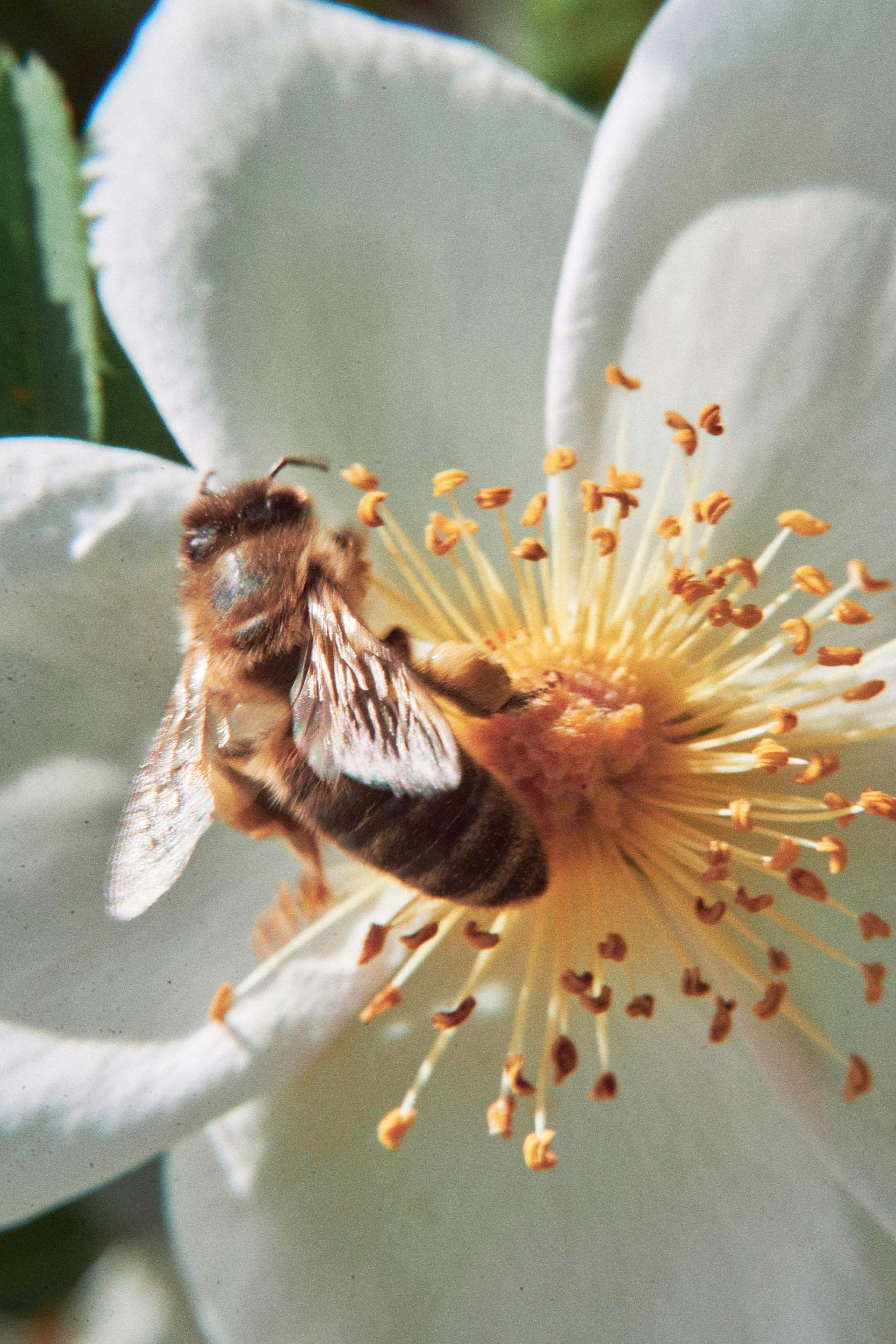
Click. Another turn of my kaleidoscope exhibits the world from which the honeybee takes her nectar and pollen. In the wake of her flight path, which spans for miles outside of her hive, she creates a plethora of new growth. As she bounds from flower to flower, she gathers from one place and gives to another. Nectar becomes pollination; pollination becomes fruit; fruit becomes seed; abundance continues by passing through her rather than belonging to her.
As she collects nectar, pollen, and propolis on her daily flights, she weaves new life into the environment surrounding her home. The gifts she gathers will be brought back to the hive and blended to create a journal of all the flowers she and her sisters visited.
Sunlight is stored in honey. It is a geographic thumbprint of the ecosystem she borrows from. Each flower exists as an archive and is turned into flavour. Nestled somewhere deep in its flavour profile, it answers questions about where it came from. What changed this year? What does drought taste like? What does spring taste like?
While the flavours of honey metamorphose in sync with the seasons, the honeybees do as well. Spring and summer are for gathering; fall and winter are for hunkering down on current supply. With a life span of about six weeks, winter bees and summer bees perform vastly different roles within their community. Concurrently, each holds equal value in providing for their sisters, and in return, they both live in abundance, consuming their golden splendour just the same.
I peer closely into the golden droplet sinking into my tea. I hear the muffled high-pitched clinking sound of my spoon bouncing from wall to wall within the liquid of my mug as I stir. The honey in my mug invites me to acknowledge what it holds. Rain, bloom, wind, soil, sunlight, time, growth, sacrifice, abundance. All coexist in physical form. Geography has been given a body, and yes, both sacrifice and abundance coexist within this sweet treat.
Click three. One final turn displays a small philosophical lift.
The beekeeper does not produce honey.
The eater does not merely consume it.
If the bees each sacrifice their life’s work to create abundance for their colony, what is my role in this exchange as the beekeeper? When I indulge in my honeyed tea, where is my reciprocity in the exchange? Then I remember the frames of honey I left behind for the bees, the water I ensure is accessible to them, the plants I planted for them to forage on, the patience I have when they slow their production down, or when one mistakenly stings me while protecting her sisters. I sigh with relief as I slink into the folds of my kitchen chair. I have meaningfully entered into this exchange. But I must go a step beyond providing for the bees; it is my responsibility to share my unique perspective of their incredible systems, so that other humans, too, not just beekeepers, can learn.
Beekeeping has shown me that reciprocity is less about repayment and more about participation. Leaving enough behind. Planting what will bloom later. Accepting slower seasons. Understanding that stewardship is not control but remaining in relationship to what is serving you.
As I nourish my body with this liquid, I will be given the energy to provide back to the hive and share its stories. As my daughter nourishes her body with its sweetness, she will have renewed energy to share her very own kindness and gifts with the world beyond the hive.
I return to the droplet of honey, catching the morning light; nothing has changed except my way of seeing it.
It is still only honey, yet suspended inside is a complex journey of earthly elements and a brief stewardship of my own hands. I think now that abundance is not endless accumulation, but remaining in relationship with what sustains us long enough to help sustain it in return. Reciprocity begins in remembering to actively participate in what is being provided for us.
I lift the cup to my mouth and drink.
I invite you to turn the kaleidoscope one final time. This lens shows a world that has learned from the bees: one where taking and giving belong to the same gesture and where abundance is measured not by what we keep, but by what continues after us. What do you see?
Words by Emma Kate Hess
Emma Kate Hess is a beekeeper and storyteller based in Hawaiʻi. Drawn to the hidden relationships between our local environments, food systems, and our plates, she writes about the ways ordinary ingredients carry extraordinary stories. She is currently training as a honey sommelier and is developing a cookbook that explores food through the lens of a beekeeper, tracing ingredients from soil to plate. Much of her work centres on observing what honey can teach us about the world around us.